
Last Updated on February 28, 2026 by Brian Beck
(A kid-friendly science story)
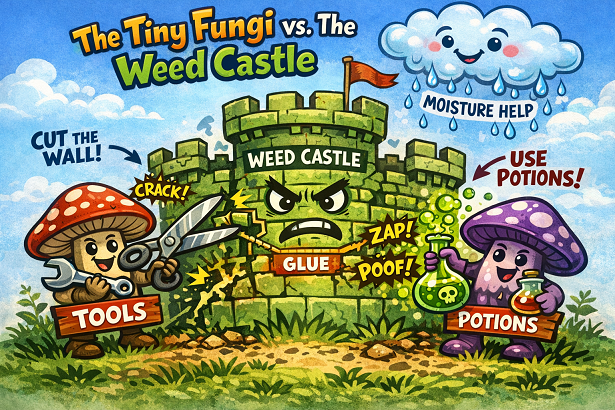
Imagine a weed is a castle.
It has:
-
Brick walls (the tough plant wall)
-
Glue between the bricks (the “sticky stuff” that holds plant cells together)
Now imagine a fungus is a tiny castle-breaker that wants to move in and take over the weed.
Fungi can hurt weeds in two main ways:
1) The “Scissors & Tools” Trick (Enzymes) ✂️🧰
Some fungi make special tools called enzymes.
Enzymes are like:
-
scissors
-
wire cutters
-
tiny chewing machines
One of the biggest tools is a kind that chops the glue between plant cells.
So instead of smashing the bricks, the fungus cuts the glue, and the castle starts to fall apart.
That’s why infected weeds can look mushy, like they’re turning into plant soup.
2) The “Potion & Poison” Trick (Toxins) 🧪💥
Some fungi don’t need to break the wall much at first.
They can make chemicals (called secondary metabolites) that act like:
-
stink bombs
-
sleep spells
-
poison potions
These chemicals can make leaves:
-
turn yellow
-
get spots
-
dry up
-
die
Sometimes the fungus uses both tools and potions. Double attack!
The Secret: It Depends on the Fungus 🧠
Different fungi have different “superpowers.”
-
Some are tool users (enzymes do a lot of the damage).
-
Some are potion users (toxins do most of the damage).
-
Many are mixed fighters (both together).
Scientists don’t just guess which one is doing it. They test it.
How Do Scientists Figure It Out? 🔬
They do clever experiments like:
A) “Fungus Juice Test”
They let the fungus grow in a liquid, then remove the fungus.
If the leftover juice alone still hurts the weed, that hints:
✅ chemicals/potions were doing a lot.
B) “Take Away a Tool” Test
They use a fungus that is missing an important “tool” enzyme.
If the fungus becomes weak and can’t hurt the weed as well, that hints:
✅ enzymes/tools were important.
A Funny Example (Real Science, Kid Version) 🌿
One fungus (with a long name) seems to hurt a weed better when the “glue-cutting tools” go up.
But scientists also say:
“Hold on… the plant might be making some of that glue-cutting action too!”
So the honest answer is:
We think the tools matter, but we’re still proving exactly who made the tools and how much the potions helped.
That’s how real science works: strong guesses + careful proof.
The “Weather Gate” (Why Dew Matters) 💧🌙
Here’s something surprising:
Some fungi only work well when there’s enough moisture—like dew.
Think of dew like a slippery slide that helps the fungus:
-
stick to the leaf
-
wake up
-
start growing
-
get inside
Without moisture, the fungus might not get started.
So people sometimes mix fungi with special sprays (like oils) to help them work better.
Three Big Takeaways (Super Simple) ⭐
-
Fungi can hurt weeds by cutting their walls (tools/enzymes).
-
Fungi can hurt weeds by making nasty chemicals (potions/toxins).
-
Many fungi use both, and weather (like dew) can decide if they win or lose.