
Last Updated on April 29, 2026 by Brian Beck
There is a hard truth about lawn recovery that most homeowners do not want to hear:
A struggling lawn does not recover because we are frustrated. It recovers when the actual causes of failure are corrected.
That may sound blunt, but it is also liberating. Because once we stop guessing, comparing, panicking, and chasing symptoms, we can finally begin solving the real problem.
Recently, we had a situation that illustrates this perfectly.
A homeowner originally came to us after becoming frustrated with a large national lawn care company. The opening concern was essentially this: “They are killing my lawn. Can you help?”
That is not an uncommon story. Many homeowners eventually reach the point where the traditional synthetic fertilizer model stops making sense. The lawn may green up for a while, but underneath the surface the soil is still compacted, biologically weak, mineral-imbalanced, low in carbon, poorly structured, and dependent on repeated inputs just to appear functional.
In other words, the lawn may look managed, but it is not healthy.
So we started the process correctly. We recommended a soil test. We performed a biological correction late in the season. We began laying the foundation for recovery.
But here is where expectations and reality often collide.
Being on a Program Is Not the Same as Completing the Correction
Many homeowners count time emotionally.
They think, “I have been paying for lawn care for a year, therefore my lawn should be fixed.”
But the soil does not measure time that way.
A lawn does not actively rebuild in the middle of winter. Roots are not expanding aggressively. Soil biology is not operating at full capacity. Nutrients are not cycling at peak speed. The plant is not in full repair mode.
So if a correction begins at the tail end of the season, that work may help set the stage, but it does not magically erase years of dysfunction before spring arrives.
And if spring is cold, delayed, wet, or inconsistent, the biological clock starts even slower.
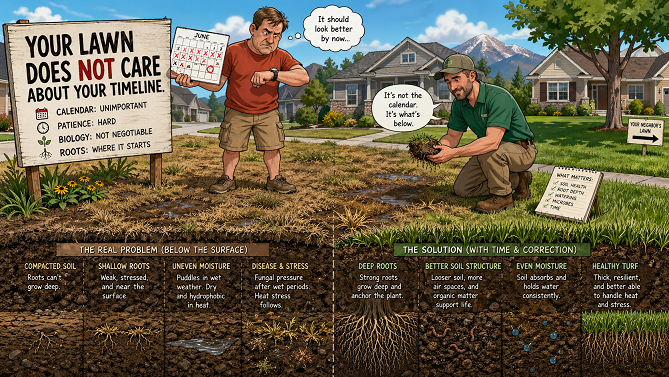
This is why we do not measure recovery by an artificial timetable. We measure recovery by function.
Is water moving into the soil?
Are roots getting deeper?
Is biology becoming more active?
Is the plant able to access nutrients?
Is the soil holding moisture longer?
Is disease pressure decreasing?
Is the lawn becoming more resilient?
Those are the measurements that matter.
Not emotion. Not impatience. Not the neighbor’s lawn. Not how long it feels like it has been.
The Neighbor’s Lawn Is Not a Soil Test
One of the most common mistakes homeowners make is looking across the street and using the neighbor’s lawn as proof that something is wrong with theirs.
That is not diagnosis. That is lawn envy with a tape measure.
The neighbor may have different soil. Different shade. Different irrigation coverage. Different mowing height. Different root depth. Different disease pressure. Different compaction. Different history. Different watering habits. Different levels of synthetic stimulation.
A lawn can look green and still be weak.
A lawn can look better temporarily and still be completely dependent.
A lawn can be artificially pushed with quick-release inputs and still have no long-term resilience.
This is why appearance alone is a dangerous measurement. It tells you what the lawn looks like today. It does not tell you how well the system is functioning underneath.
And the underneath is where the truth lives.
Disease Is Usually a Symptom, Not the Root Problem
In this particular situation, the lawn experienced a significant disease outbreak during the season.
The issue was consistent with Ascochyta, a common turf disease that often appears after cool, wet weather followed by heat and stress. The disease can seem sudden and dramatic. One week the lawn looks like it is moving in the right direction, and then the heat turns up, the root zone is not properly hydrated, and the weak areas collapse.
That is the part many homeowners miss.
The disease is not always the original problem. It is often the visible expression of deeper weakness.
Cool, wet conditions can create the opportunity. Heat adds stress. Shallow roots make the plant vulnerable. Poor watering depth leaves the lower root zone dry. Nutrient flow gets restricted. The plant weakens. Then the disease takes advantage.
That is not a random disaster. That is a system exposing its weak points.
And when that happens, the answer is not to panic, blame the last person who touched the lawn, or throw more synthetic fertilizer at it.
The answer is to ask better questions.
Is the lawn being watered deeply enough?
Is moisture reaching 6 to 8 inches into the soil?
Are the roots deep enough to survive heat stress?
Is the soil compacted?
Is the biology active enough to support recovery?
Is the lawn being managed for long-term health or short-term appearance?
These questions matter because a lawn cannot outperform the condition of the system supporting it.
Watering More Is Not the Same as Watering Correctly
This is another uncomfortable truth.
A homeowner may be very willing to water and still be watering incorrectly.
That does not mean they are lazy. It does not mean they do not care. It means effort and effectiveness are not the same thing.
In Colorado Springs and along the Front Range, watering shallow and frequent is one of the easiest ways to create a fragile lawn. It trains roots to stay near the surface. It increases evaporation. It can contribute to stress. It can keep the surface wet while the deeper root zone remains dry.
Then summer arrives, temperatures rise, disease pressure increases, and the lawn has no depth, no reserve, and no resilience.
The lawn does not need emotional watering.
It needs effective watering.
The goal is not simply to run irrigation. The goal is to get water into the soil where the roots need it, and then build a soil system that can hold that water longer.
That is the difference between managing symptoms and improving function.
The Synthetic System Has Trained People to Expect the Wrong Thing
For decades, homeowners have been conditioned to expect lawn care to work like a light switch.
Apply something. Get green.
Apply something else. Kill weeds.
Apply another thing. Stop disease.
This has created a very dangerous expectation: that every lawn problem should have an immediate cosmetic answer.
But the biological method does not work that way.
The biological method is not about forcing the lawn to look better for a few weeks. It is about correcting the soil so the lawn can begin functioning properly again.
That takes patience.
Not blind patience. Not “trust me forever” patience.
Measured patience.
The kind of patience that says:
“We are going to identify what is broken, correct the soil, support the biology, improve water movement, build root depth, and judge progress by the actual condition of the lawn—not by panic, comparison, or artificial deadlines.”
That is how real recovery works.
We Can Fix a Broken Lawn. We Cannot Fix an Unwilling Process.
This is where homeowners need to be honest with themselves.
Do they want the actual problem solved?
Or do they simply want their discomfort removed as quickly as possible?
Those are not the same thing.
If someone wants to solve the actual problem, we can help.
If someone wants soil testing, measurable correction, better watering, deeper roots, stronger biology, improved structure, less dependency, and long-term resilience, then we are probably a very good fit.
But if someone wants a lawn that has been damaged by years of synthetic dependency, poor soil function, weak roots, disease pressure, and watering problems to suddenly obey an emotional deadline, that is not a biological program.
That is wishful thinking with an invoice attached.
The lawn does not care how frustrated we are.
The soil does not care how much money we have spent.
The plant does not care what the neighbor’s lawn looks like.
The biology does not care whether we think it should be faster.
It responds to conditions.
Fix the conditions, and the lawn can recover.
Ignore the conditions, and the same problems keep returning.
The Right Customer Gets the Best Result
This is why we care so much about education.
The best customers are not the ones who simply want a green lawn. Everyone wants that.
The best customers are the ones who want to understand why the lawn is struggling in the first place.
They are willing to test instead of guess.
They are willing to correct instead of chase symptoms.
They are willing to water effectively instead of emotionally.
They are willing to judge progress by function instead of neighborhood comparison.
They are willing to stay with the process long enough for the soil to respond.
That does not mean they have to be experts. That is our job.
But they do have to be willing participants.
Because a biological lawn program is not a magic trick. It is a partnership between the homeowner, the service provider, the plant, the soil, and the microbes that make the entire system work.
When that partnership is intact, remarkable things can happen.
Water use can drop. Root depth can improve. Disease pressure can decrease. Weeds can become less dominant. Fertilizer dependency can decline. The lawn can become more stable, more resilient, and less expensive to own.
But when the process is abandoned too soon, the potential is never fully realized.
The Real Question
So the real question is not:
“How fast can you make my lawn green?”
The better question is:
“What is preventing my lawn from functioning properly?”
That is the question that leads somewhere.
Because once we know what is broken, we can begin correcting it.
If the soil is compacted, we address structure.
If the biology is weak, we support microbial life.
If the root zone is shallow, we change the watering strategy.
If minerals are out of balance, we correct the imbalance.
If the soil cannot hold water, we improve carbon and humus.
If disease shows up, we do not just blame the disease. We look at why the plant was vulnerable.
That is how serious lawn recovery works.
A Better Lawn Requires a Better Mindset
A biological lawn is not built through panic.
It is built through correction.
It is not built by comparing your lawn to the neighbor’s.
It is built by understanding your own soil.
It is not built by demanding that nature follow an artificial calendar.
It is built by cooperating with the biological process that actually governs plant health.
So yes, we can help broken lawns recover.
But the homeowner has to be willing to fix what is actually broken.
Not what they wish were broken.
Not what is most convenient to blame.
Not what makes them feel better in the moment.
The real issue.
The measurable issue.
The soil issue.
The water issue.
The root issue.
The biological issue.
That is where the answer is.
Final Thought
Your lawn does not care about your timeline.
It cares about whether the soil can breathe.
It cares about whether water reaches the root zone.
It cares about whether biology is active.
It cares about whether minerals are available.
It cares about whether the roots are deep enough to handle stress.
It cares about whether the system underneath the grass is actually working.
That may not be the quick answer people want, but it is the answer that produces lasting results.
And if you are tired of guessing, comparing, panicking, and paying for temporary appearances, we can help.
But we are going to start with the truth.
Because the truth is where real lawn recovery begins.
Engage with us: