
Last Updated on April 27, 2026 by Brian Beck
Why healthy soil lowers the cost of owning a lawn — and bad soil quietly charges interest
Most homeowners think their lawn is expensive because lawns are just expensive.
That is the story people have been told.
Lawns take too much water.
Lawns need constant fertilizer.
Lawns require weed control every year.
Lawns are high-maintenance.
Lawns are needy, dramatic, fragile little green divas that exist only to drain your bank account and ruin your weekend.
And to be fair, some lawns absolutely behave that way.
But here is the part most people miss:
The lawn is not always the expensive part. The soil underneath it is.
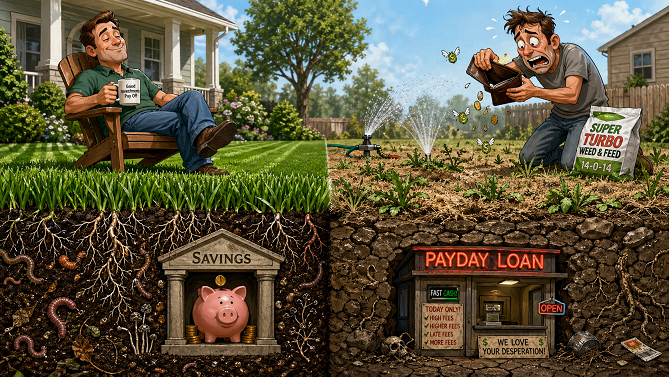
Your soil is either helping you store value or forcing you to borrow against the future.
In other words, your soil is either a savings account or a payday loan.
And if your lawn constantly needs water, fertilizer, weed control, aeration, disease treatments, repair, and emotional support, there is a good chance your soil is charging you outrageous interest.
Healthy soil stores value
A good savings account holds resources.
You put money in, it stays there, and over time it gives you stability, security, and options.
Healthy soil works the same way.
It stores water.
It stores nutrients.
It stores carbon.
It supports biology.
It buffers stress.
It protects the plant.
It creates resilience.
When soil is balanced and functioning, it becomes a reserve system for the lawn. It is not just dirt sitting under the grass looking humble and unappreciated. It is the bank.
A lawn growing in healthy soil does not have to panic every time the weather changes. It has reserves. It has structure. It has biology. It has roots that can access what they need.
That kind of lawn is not constantly begging for rescue.
It may still need management, but it does not need constant life support.
And that is the point.
A healthy lawn should become more efficient over time. Not more needy. Not more expensive. Not more chemically dependent. Not more dramatic every July.
If your lawn gets more expensive every year but never becomes more stable, you are not building health.
You are servicing debt.
Bad soil charges interest
Now let’s talk about the payday loan side of the equation.
Bad soil does not just fail to help. It actively makes everything harder.
If the soil is compacted, water cannot move in properly.
If the soil has low humus, it cannot hold moisture efficiently.
If the calcium and magnesium relationship is off, structure suffers.
If pH is too high, nutrients may be present but unavailable.
If biology is weak, nutrients and organic matter do not cycle well.
If roots are shallow, the lawn becomes fragile.
If the turf is thin, weeds move in like they own the place.
And every one of those problems creates a bill.
More water.
More fertilizer.
More weed control.
More disease pressure.
More aeration.
More repair.
More stress.
Bad soil is expensive because it turns basic lawn care into a constant emergency response system.
The homeowner thinks, “My lawn needs more.”
But often the truth is, “My soil is wasting what I already give it.”
That is the cruel part.
You may be watering enough, but the soil cannot receive or hold it.
You may be fertilizing, but the nutrients are not flowing properly.
You may be killing weeds, but the lawn is still too weak to occupy the space.
You may be aerating, but the underlying structure keeps collapsing back into dysfunction.
That is what bad soil does.
It makes you pay over and over again for the same unresolved problem.
The water bill is usually the first warning sign
Water is where poor soil gets exposed.
A healthy soil system should accept water, hold water, and make water available to the roots.
That sounds simple because it is supposed to be simple.
But many lawns fail at this basic function.
Water runs off.
Water puddles.
Water evaporates.
Water stays too shallow.
Water never reaches a meaningful root zone.
The lawn dries out quickly and starts waving the little brown flag of surrender.
So what does the homeowner do?
They water more often.
And just like that, bad soil has turned into a utility bill problem.
This is where people start believing lawns are naturally wasteful. But many lawns are not inherently wasteful. They are growing on soil that cannot manage water properly.
That is a very different problem.
If your soil cannot infiltrate water, your irrigation system becomes inefficient.
If your soil cannot hold water, your watering schedule becomes expensive.
If your roots are shallow, your lawn becomes fragile.
If your lawn is fragile, you start watering out of fear instead of strategy.
That is not water management.
That is lawn anxiety with a sprinkler attached.
The solution is not always to abandon turf, rip everything out, and replace it with rock or artificial turf.
The better question is: Why is the soil wasting the water in the first place?
Humus is the lawn’s emergency fund
If soil is a savings account, humus is a major part of the emergency fund.
Humus is stable organic matter that helps soil hold water, buffer nutrients, support biology, and create a more forgiving environment for roots.
Low-humus soil is like living paycheck to paycheck.
There is no cushion.
No reserve.
No buffer.
No margin for stress.
So when heat arrives, the lawn struggles.
When watering is inconsistent, the lawn struggles.
When nutrients are applied, the soil does not manage them well.
When the weather gets weird, the lawn reacts quickly.
High-functioning soil has more room for error.
That matters in Colorado, where the weather can behave like it lost a bet.
Hot, dry, windy, cold, sunny, hail, drought, and then somehow all of it in the same week.
A lawn without soil reserves has to depend heavily on the homeowner to keep rescuing it.
A lawn with better humus, better structure, and better biology has more internal capacity.
It can handle stress with less drama.
And less drama usually means less cost.
Biology is the workforce
Money sitting in a bank does not do much unless it is being managed.
The same is true with soil resources.
Biology is the workforce that helps move, digest, transform, and cycle materials through the lawn system.
Microbes help break down organic matter.
Fungi help connect soil and roots.
Soil organisms help build structure.
Biology helps cycle nutrients into plant-available forms.
Roots feed microbes through sugars created by photosynthesis.
This is not mystical. It is just how living soil works.
A biological lawn is not built on the idea of constantly forcing the plant with synthetic stimulation. It is built on the idea of restoring the relationship between the plant and the soil.
The grass captures sunlight.
The plant makes sugars.
The roots feed biology.
The biology helps cycle nutrients.
The soil improves.
The plant becomes stronger.
That is a wealth-building model.
The synthetic-dependent model is different.
The plant is pushed.
The soil is ignored.
The biology is weak.
The lawn responds temporarily.
The effect fades.
The homeowner buys more.
That is not wealth-building.
That is borrowing at 400% interest from a shady lawn-care lender named Chad.
Nutrients are useless if the plant cannot access them
One of the biggest misunderstandings in lawn care is the idea that if a lawn looks weak, it must simply need more fertilizer.
Sometimes it does.
But often the issue is not just what is present in the soil. It is whether the plant can access it.
A soil test may show nutrients exist, but high pH, poor biology, mineral imbalance, low humus, poor structure, and nutrient antagonisms can interfere with availability.
That means the homeowner may keep adding more inputs while the real problem remains unresolved.
This is like having money in the bank but no debit card, no checks, no online access, and the bank is closed every time you show up.
Technically, the money is there.
Practically, you cannot use it.
That is how many lawns operate.
Nutrients are present, but not flowing.
Water is applied, but not stored.
Organic matter exists, but is not cycling.
Roots are alive, but not thriving.
The grass is green sometimes, but not resilient.
This is why diagnosis matters.
If you do not know what the soil is doing, you are guessing. And guessing is usually more expensive than testing.
Weeds are overdraft fees
Weeds are not just random punishments from the lawn gods.
They are often signs that the system has open space, stress, imbalance, compaction, poor density, or weak competition.
A thick, healthy lawn is one of the best weed control strategies because it occupies the space.
A thin, stressed lawn leaves openings.
And nature does not leave openings empty.
So when weeds show up, yes, they may need to be managed. But they also need to be interpreted.
The weed is not always the main problem. The weed may be evidence that the lawn is not functioning well enough to defend its territory.
If the only answer is to spray weeds every year while doing nothing to improve density, soil health, water movement, root function, and biology, then weeds become a recurring expense.
They become overdraft fees.
Every season, the same penalty shows up because the account is still out of balance.
Compaction is financial suffocation
Compacted soil is another hidden cost.
When soil is tight, air movement is poor. Water movement is poor. Root growth is restricted. Biology struggles. Nutrient flow slows down.
The lawn might still grow, but it is doing it under pressure.
A compacted lawn is like a business trying to operate with the doors half closed, the lights flickering, and employees trapped in the break room.
Things can still happen, but not efficiently.
Many homeowners respond with mechanical aeration, and sometimes aeration has its place. But if the soil chemistry, calcium-magnesium relationship, humus level, and biology are not addressed, the soil often tightens back up.
That is why repeating the same intervention every year without changing the underlying condition can become another cost loop.
The goal should not be endless mechanical interruption.
The goal should be soil that naturally develops better structure.
That is a savings account mindset.
The lawn should become less dependent over time
Here is a simple test:
Is your lawn becoming easier or harder to own?
Not perfect. Not maintenance-free. Not magical.
Just easier.
Does it use water better?
Does it recover better?
Are weeds decreasing?
Is the turf getting denser?
Is the lawn less reactive to heat?
Does it hold color more naturally?
Does it need fewer emergency interventions?
Is the soil improving?
If the answer is yes, you are building equity.
If the answer is no, you may be trapped in a cycle of lawn debt.
A good lawn program should not just create a temporary response. It should move the system toward better function.
That is the difference between spending and investing.
Spending disappears.
Investing builds capacity.
When you invest in soil health, you are building the lawn’s ability to perform with less waste.
Cosmetic green is not the same as equity
This is where the lawn industry has confused people.
A green lawn can be a sign of health.
It can also be a sign of stimulation.
Those are not the same thing.
If the lawn greens up after fertilizer but still has shallow roots, poor water retention, recurring weeds, weak biology, and constant stress, then the color may be masking dysfunction.
That is like putting fresh paint on a house with a cracked foundation.
It may look better, but the structural problem is still there.
Real lawn equity is underground.
Root depth.
Humus.
Biology.
Water infiltration.
Mineral balance.
Soil structure.
Nutrient cycling.
Plant resilience.
Those are the things that make a lawn more valuable, more stable, and less expensive to own.
Color matters, of course.
Nobody wants a lawn that looks like it lost the will to live.
But color should be the result of function, not the substitute for it.
The Balance Horizon
The goal is to move the lawn toward what we call the Balance Horizon.
That is the point where the lawn starts functioning more like a self-supporting system and less like a needy dependent.
Water moves in better.
The soil holds moisture better.
Roots explore deeper.
Microbes become more active.
Nutrients cycle more efficiently.
The turf thickens.
Stress tolerance improves.
The lawn becomes less expensive to manage.
This does not happen because of one magic product or one dramatic treatment.
It happens by removing obstacles.
Correct the soil.
Support biology.
Improve structure.
Build humus.
Water correctly.
Mow correctly.
Stop treating every symptom like it is the root cause.
Once the soil starts acting like a savings account, the whole lawn changes.
Not overnight.
But steadily.
And steady is exactly what most lawns need.
The real cost of ignoring soil
Ignoring soil does not save money.
It delays the bill.
You may avoid the soil test.
You may skip correction.
You may keep buying quick fixes.
You may keep chasing color.
You may keep watering more.
You may keep spraying weeds.
You may keep pretending the lawn is just “high maintenance.”
But the soil is still keeping score.
And eventually, the cost shows up.
It shows up in the water bill.
It shows up in the repair bill.
It shows up in thinning turf.
It shows up in weeds.
It shows up in summer stress.
It shows up in frustration.
Bad soil always collects.
Healthy soil pays dividends.
That is the choice.
Stop renting green. Start building wealth underground.
Most homeowners do not need a more complicated lawn program.
They need a smarter one.
They need to stop renting temporary green from products that fade and start building underground wealth that compounds.
Because when soil improves, everything else has a better chance of improving.
Water becomes more efficient.
Fertilizer becomes less wasteful.
Roots become stronger.
Biology becomes more active.
Weeds lose opportunity.
Stress becomes more manageable.
The lawn becomes less dependent.
That is how you lower the real cost of owning a lawn.
Not by abandoning the lawn.
Not by panicking every spring.
Not by throwing more inputs at a broken system.
By turning the soil from a payday loan into a savings account.
Call to Action
If your lawn constantly needs more water, more fertilizer, more weed control, more repair, and more attention, the problem may not be the grass.
It may be the account underneath it.
At Blade to Blade, we help homeowners move beyond temporary lawn response and into real soil function. Our biological lawn care approach is designed to improve the conditions that make lawns stronger, more efficient, and less expensive to own over time.
A healthy lawn is not built from the top down.
It is built from the soil up.