
Last Updated on April 27, 2026 by Brian Beck
Why a “pretty good” lawn may be quietly draining your wallet
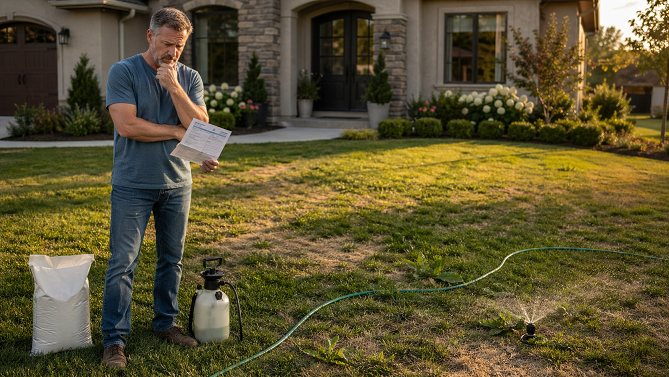
There is a lawn that is easy to recognize once you know what to look for.
It is not completely dead.
It is not a total disaster.
It is not the neighborhood embarrassment.
In fact, from the street, it may even look decent.
That is what makes it so dangerous.
Because the most expensive lawn is often not the lawn that has completely failed. The most expensive lawn is the one that almost works.
It greens up, but only after you push it.
It looks good, but only when you water constantly.
It survives summer, but just barely.
It has weeds, but not enough to make you panic.
It has disease pressure, but only when the weather gets weird.
It responds to fertilizer, but never seems to get stronger.
It looks good enough to keep you paying, but not healthy enough to give you peace.
That kind of lawn is not thriving.
It is negotiating.
And unfortunately, you are usually the one paying the ransom.
The “almost good” lawn is the perfect trap
A truly bad lawn forces a decision.
You either fix it, renovate it, or stop pretending.
But an almost-good lawn keeps you stuck in the middle. It gives you just enough hope to keep throwing money at symptoms.
A little more fertilizer.
A little more water.
Another aeration.
Another weed treatment.
Another bag of something.
Another weekend spent staring at brown patches like they owe you an explanation.
This is the lawn care version of a check engine light that turns off right before you take the car to the mechanic.
You know something is wrong, but because the lawn still looks acceptable some of the time, you keep managing the symptoms instead of correcting the system.
That is where the cost starts to pile up.
Not all at once. Quietly.
In the water bill.
In the fertilizer bill.
In the weed control.
In the disease treatments.
In the repair work.
In the emotional cost of wondering why the lawn looks good one week and starts acting dramatic the next.
A lawn that almost works is expensive because it constantly needs help.
Green does not mean healthy
This is where homeowners get misled.
We have been trained to believe that green equals healthy.
That is not always true.
A lawn can be green and weak.
A lawn can be green and shallow-rooted.
A lawn can be green and dependent.
A lawn can be green because synthetic fertilizer forced a response, not because the soil is functioning.
Color is easy to manipulate.
Function is harder to fake.
A healthy lawn is not just the one that looks good after being stimulated. A healthy lawn is the one that can handle stress. It can use water efficiently. It can resist weeds. It can recover. It can cycle nutrients. It can grow roots. It can stay stable when Colorado decides to act like Colorado, which is usually sometime between breakfast and lunch.
The problem is that most lawn programs sell visual response.
Green-up. Fast growth. Quick color. Temporary improvement.
And to be fair, those things are emotionally satisfying.
But they do not automatically mean the lawn is improving.
Sometimes they mean the lawn has become very good at responding to a crutch.
The hidden cost is dependency
The traditional lawn model is built around dependency.
The lawn needs fertilizer to green up.
It needs more water to survive.
It needs weed control because the turf is not dense enough.
It needs disease control because the plant is stressed.
It needs aeration because the soil structure is poor.
It needs constant attention because the underground system is not doing its job.
That is not maintenance.
That is life support with edging.
And once a lawn is stuck in that pattern, the homeowner often believes that high input is normal.
“It just takes a lot of water to have a lawn here.”
“You have to fertilize constantly.”
“You have to spray weeds every year.”
“You have to aerate every season.”
“You have to fight the lawn into shape.”
No, you do not.
You have to fight a dysfunctional lawn into shape.
A functioning lawn is different.
A functioning lawn is not free. It still needs management, hydration, mowing, observation, and correction. But over time, it should become more efficient, not more needy.
If your lawn becomes more expensive every year and still does not become more stable, that is not progress.
That is a subscription to frustration.
Poor soil makes everything more expensive
Most lawn problems are not really lawn problems.
They are soil problems wearing a grass costume.
If water cannot infiltrate, you need more water.
If the soil cannot hold moisture, you need more water.
If roots are shallow, the lawn burns faster.
If biology is weak, nutrients do not cycle well.
If humus is low, the soil has poor buffering capacity.
If calcium and magnesium are out of balance, structure suffers.
If pH is high, nutrients may be present but unavailable.
If the plant cannot access what it needs, you keep buying more of what may already be there.
That last point is important.
Sometimes your lawn is not starving because nutrients are absent.
It is starving because access is blocked.
This is why dumping more product on a dysfunctional soil system can become so wasteful. You are not fixing the road. You are just sending more trucks into the traffic jam.
The result is predictable: more inputs, less efficiency, more frustration.
Water is where the pain gets obvious
Nothing exposes a weak lawn faster than water stress.
A healthy soil system should receive water, hold water, and make that water available to the roots.
A dysfunctional soil system does the opposite.
Water runs off.
Water evaporates.
Water sits too shallow.
Roots stay near the surface.
The lawn wilts quickly.
The homeowner panics and waters more often.
Now the lawn is not just a turf problem. It is a utility bill problem.
This is where people start looking at rock, artificial turf, or giving up entirely. Not because they hate grass, but because the grass has become too expensive to trust.
But the answer is not always to abandon the lawn.
The answer is often to fix the reason the lawn is wasting water in the first place.
Healthy soil changes the economics of turf.
When soil structure improves, water moves in better.
When humus improves, water-holding capacity improves.
When roots deepen, the plant becomes less fragile.
When biology improves, nutrient cycling improves.
When the plant is not constantly stressed, it does not demand emergency intervention every time the weather gets rude.
Water does not have to be the enemy.
Bad soil makes water the enemy.
Weeds are another invoice
A thin, weak, stressed lawn creates opportunity.
Nature does not like empty space. If your turf leaves gaps, something will fill them. Usually something with an attitude and a taproot.
The traditional approach is to kill the weed and move on.
That may be necessary at times, but it does not answer the more important question:
Why did the weed have room to move in?
Weeds often show up where the turf system is failing. Poor density, poor fertility balance, compaction, bare soil, stress, shallow roots, and inconsistent moisture can all open the door.
If the only strategy is to keep killing weeds while never improving the lawn’s ability to outcompete them, you have not solved the problem.
You have created another yearly invoice.
A dense, healthy, biologically supported lawn is one of the best weed prevention systems available. Not because it poisons weeds, but because it occupies the space.
That is the kind of lawn you want.
Not a lawn that needs constant defense.
A lawn that becomes harder to invade.
The lawn should get cheaper as it gets healthier
This is one of the simplest ways to judge whether your lawn program is moving in the right direction.
Over time, a healthy lawn should become more efficient.
It should not need constant rescue.
It should not collapse every summer.
It should not require endless fertilizer to look alive.
It should not demand shallow, frequent watering to survive.
It should not produce the same weed problems year after year with no improvement.
If your lawn is getting more expensive but not more resilient, something is wrong.
The goal should be to move the lawn toward what we call the Balance Horizon — the point where the soil, roots, biology, water, minerals, and mowing practices begin working together instead of against each other.
At that point, the lawn starts to act differently.
It uses water better.
It holds color more naturally.
It handles stress with less drama.
It supports stronger roots.
It becomes denser.
It needs fewer emergency inputs.
It becomes less dependent on artificial stimulation.
That is when lawn care starts to make sense.
Not because you stopped managing the lawn, but because you stopped managing it like a crisis.
Stop paying for the illusion
The almost-good lawn is expensive because it sells you the illusion that you are close.
Just one more treatment.
Just one more watering adjustment.
Just one more product.
Just one more season.
But if the foundation is wrong, you are not close.
You are circling the same problem.
A lawn that looks decent but cannot function is not a success. It is a warning.
It is telling you that the surface still has some life, but the system underneath needs correction.
That correction starts with asking better questions.
What is the pH?
What is the base saturation?
Is calcium doing its job?
Is magnesium creating tightness?
Is humus high enough to buffer water and nutrients?
Is biology active enough to cycle organic matter?
Are nutrients available, or are they locked up?
Is the mowing helping or hurting?
Is the watering building roots or creating dependency?
Those questions matter far more than, “How do I make it greener by next weekend?”
Because the better question is not, “How do we force a response?”
The better question is, “How do we build a lawn that does not need to be forced all the time?”
A better lawn is built, not bullied
A healthy lawn is not created by constantly bullying the grass into performance.
It is built by improving the conditions that allow the lawn to function.
That means correcting soil structure.
Supporting biology.
Improving water movement.
Building humus.
Balancing minerals.
Encouraging root depth.
Mowing in a way that reduces stress.
Watering in a way that trains the lawn instead of spoiling it.
This is not the flashy version of lawn care.
It is better than flashy.
It is effective.
The old model says, “Keep buying inputs because the lawn needs us.”
The better model says, “Let’s fix the reasons the lawn became so needy in the first place.”
That is the shift.
From reaction to correction.
From dependency to function.
From cosmetic green to real health.
From expensive drama to measurable improvement.
The real cost of doing nothing
A lawn that almost works can fool you for years.
It will give you enough green to keep hoping and enough problems to keep spending.
But eventually, the cost becomes hard to ignore.
The water bill goes up.
The weeds keep coming back.
The heat stress gets worse.
The soil gets tighter.
The roots stay shallow.
The lawn needs more help, not less.
At some point, the question is no longer, “Can I afford to fix the soil?”
The question becomes, “How long do I want to keep paying for a system that is not solving the problem?”
Because the most expensive lawn is not always the ugliest lawn.
Sometimes it is the lawn that looks just good enough to keep you trapped.
Call to Action
If your lawn looks decent but constantly needs water, fertilizer, weed control, repair, and emotional supervision, it may not be healthy.
It may just be expensive.
At Blade to Blade, we help homeowners move beyond temporary green-up and into real soil and turf function. Our biological lawn care approach focuses on correcting the conditions that create dependency, waste, and frustration.
A better lawn does not begin with more panic.
It begins with better soil.
And once the soil starts working, the lawn can finally stop negotiating and start performing.