
Last Updated on April 27, 2026 by Brian Beck
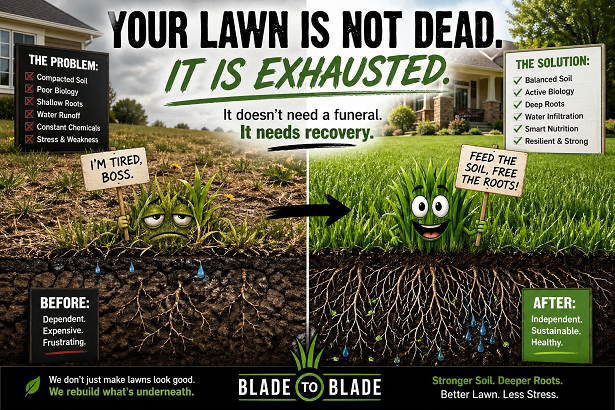
Why your struggling lawn may not need a funeral — it may need recovery.
Every spring, homeowners walk outside, look at their lawn, and immediately assume the worst.
“It’s dead.”
“It’s ruined.”
“We need to start over.”
“The winter killed it.”
“The dog destroyed it.”
“The sun cooked it.”
“The neighborhood children probably had something to do with this.”
And sure, sometimes a lawn really is dead.
But many times, it is not dead.
It is exhausted.
There is a big difference.
A dead lawn has reached the end. An exhausted lawn is still alive, but it has been pushed, starved, compacted, dehydrated, overwatered, chemically stimulated, scalped, ignored, and expected to perform like a championship golf course while living on the soil equivalent of gas station nachos.
At some point, even grass has standards.
The good news is this: an exhausted lawn can recover.
But not if we keep treating exhaustion like starvation, disease, or laziness.
And definitely not if we keep throwing synthetic fertilizer at it like caffeine at a sleep-deprived accountant during tax season.
Most lawns are not failing overnight
When a lawn looks bad, it is easy to blame the last thing that happened.
A dry winter.
A hot week.
A missed watering.
A cold snap.
A dog spot.
A windy day.
A bad mowing.
A Tuesday.
But lawns usually do not fall apart because of one event.
They decline because the system underneath them has been weakening for a long time.
The brown patch you see in April or June may have started months or even years earlier. The visible problem is usually the final symptom, not the original cause.
That is why homeowners get so frustrated. They keep trying to fix what they can see, but the real problem is often underground.
The lawn did not suddenly become dramatic.
It has been sending warning signs.
Thin turf.
Poor recovery.
Weak color without fertilizer.
Water running off instead of soaking in.
Weeds showing up in open spaces.
Heat stress that appears too quickly.
Shallow roots.
Thatch that does not break down.
Soil that feels hard, tight, or lifeless.
These are not random annoyances.
They are the lawn’s way of saying, “Excuse me, we have a management problem down here.”
Unfortunately, most people respond by asking, “What can I spray?” or “What can I throw down?”
The better question is: Why is the lawn so tired in the first place?
A lawn can be green and still exhausted
This is where the traditional lawn care mindset has confused people.
Most homeowners think green means healthy.
Not necessarily.
A lawn can be green because it is healthy.
A lawn can also be green because it has been chemically pushed into a temporary response.
Those are not the same thing.
Think of it this way: if a person is exhausted and you hand them three energy drinks, they may appear functional for a while. They may answer emails, attend a meeting, and even pretend to enjoy small talk.
But that does not mean they are healthy.
It means they are stimulated.
Many lawns are the same way.
Synthetic fertilizer can force color and growth, but that does not automatically mean the soil is improving. It does not mean the roots are deeper. It does not mean the lawn is using water efficiently. It does not mean biology is active. It does not mean the plant is resilient.
It may simply mean the lawn has been pushed again.
And if the soil is not corrected, that temporary push can become part of the exhaustion cycle.
Grow fast.
Get mowed hard.
Need more water.
Become more tender.
Lose resilience.
Fade again.
Repeat.
That is not health.
That is a treadmill.
Exhaustion starts in the soil
If your lawn is struggling, the grass blade is usually not the place to begin.
The blade is the billboard.
The soil is the business.
A tired lawn often has tired soil beneath it. Soil that cannot properly receive water, hold water, move air, cycle nutrients, support biology, or grow strong roots.
And when the soil is not functioning, the lawn has to depend on you for everything.
It needs you to water constantly.
It needs you to feed constantly.
It needs you to kill weeds constantly.
It needs you to rescue it every spring.
It needs you to panic every July.
It needs you to stare at it from the driveway like a disappointed parent.
That is not a healthy relationship.
A functional lawn should not need to be dragged across the finish line every season.
It should be supported by soil that is doing its job.
Healthy soil should act like a reserve system. It should hold moisture, buffer nutrients, support roots, feed biology, and help the lawn handle stress.
Exhausted soil does the opposite.
It turns every weather event into a crisis.
Colorado lawns get blamed for soil problems
In Colorado, it is easy to blame the climate.
And yes, Colorado is not exactly handing out participation trophies to turfgrass.
We deal with dry air, intense sun, wind, alkaline soils, erratic moisture, temperature swings, poor native soil structure in many areas, and summers that occasionally feel like nature is testing our character.
But the climate is not the whole story.
Some lawns handle Colorado conditions far better than others.
Why?
Because the soil is different.
The roots are different.
The watering strategy is different.
The biology is different.
The mowing is different.
The management philosophy is different.
A weak lawn experiences Colorado as an enemy.
A stronger lawn experiences Colorado as a challenge.
There is a difference.
If your soil is tight, low in humus, biologically weak, mineral imbalanced, and poorly structured, then Colorado will expose that weakness quickly.
The answer is not to assume grass cannot work here.
The answer is to stop asking dysfunctional soil to perform miracles.
Watering more is not always the solution
When a lawn looks tired, most homeowners reach for the sprinkler.
That makes sense. Brown grass looks dry. Dry grass needs water.
Sometimes that is true.
But sometimes the lawn is not suffering because you are not applying enough water. It is suffering because the soil cannot use the water properly.
Water may be running off.
Water may be staying too shallow.
Water may be evaporating.
Water may not be penetrating compacted soil.
Water may not be held because humus is too low.
Water may not be reaching roots because the roots are too shallow.
So the homeowner waters more often.
Now the lawn becomes even more dependent.
Shallow watering encourages shallow rooting. Shallow roots make the lawn more vulnerable to heat. Heat stress creates panic. Panic creates more watering. More watering can waste money, reduce oxygen in the root zone, and keep the lawn stuck in weakness.
This is how good intentions create bad outcomes.
It is not because homeowners are stupid.
It is because the traditional system rarely teaches people how soil, water, roots, and biology actually work together.
It teaches them to react.
And reaction is expensive.
Exhausted lawns often have shallow roots
Roots are the real story.
A lawn with shallow roots is living paycheck to paycheck.
It has no reserve.
No reach.
No depth.
No cushion.
When heat arrives, it suffers quickly.
When watering is inconsistent, it wilts quickly.
When nutrients are unavailable, it struggles quickly.
When stress hits, it has nowhere to go.
A strong root system gives the lawn options.
But roots do not grow deeply just because we want them to. They need soil conditions that allow them to explore.
They need oxygen.
They need water movement.
They need space.
They need mineral balance.
They need biological support.
They need proper mowing.
They need watering that encourages depth instead of dependency.
If the soil is compacted or chemically and biologically out of balance, roots are limited.
And when roots are limited, the entire lawn becomes limited.
So if the grass looks tired above ground, ask what is happening below ground.
That is where recovery begins.
Weeds are often symptoms of exhaustion
Weeds are easy to hate.
They show up uninvited, spread aggressively, ruin the look of the lawn, and generally behave like they skipped all social etiquette training.
But weeds are not always the main problem.
Sometimes weeds are the report card.
A thin, exhausted lawn creates openings.
Weak density creates space.
Poor soil structure creates opportunity.
Stress creates vulnerability.
Bare areas invite colonization.
Nature does not like empty space.
If your lawn does not occupy the space, something else will.
This is why simply killing weeds year after year often fails to solve the larger issue. You may remove the weed, but if the lawn is still exhausted, thin, and weak, another weed will eventually take the opening.
A healthier lawn prevents weeds by becoming more competitive.
Not perfect. Not magical. Not immune to reality.
But stronger.
A dense, biologically supported lawn with better roots and better soil function gives weeds fewer opportunities.
That is the goal.
Not endless warfare.
Actual strength.
Thatch is another sign the system may be tired
Thatch is often misunderstood.
People see thatch and assume the lawn needs to be mechanically attacked.
Sometimes mechanical work may be part of the answer. But thatch is often not simply a “too much grass” problem.
It can be a digestion problem.
A functioning soil system should break down organic material. Grass clippings, roots, stems, and plant residues should be cycled by biology.
When biology is weak, organic matter can accumulate faster than it decomposes.
That is not because nature forgot how to compost.
It is because the soil food web is not functioning properly.
In a biological system, organic material is not waste. It is food. But food only becomes value when something can digest it.
If the lawn cannot digest its own residue, that is a sign of exhaustion below the surface.
Once again, the visible issue is pointing underground.
The lawn does not need more drama
The traditional lawn care model often turns everything into an emergency.
Lawn is brown? Push it.
Weeds appeared? Spray them.
Soil is tight? Punch holes in it.
Color is weak? Fertilize it.
Disease shows up? Treat it.
Heat arrives? Water more.
Spring arrives? Panic publicly.
This model can create activity, but activity is not the same thing as progress.
A tired lawn does not need more drama.
It needs recovery.
Recovery is slower, smarter, and more strategic.
It asks different questions.
What is the pH?
What is the base saturation?
Is calcium available and functioning?
Is magnesium creating tightness?
Is humus too low?
Is sulfur deficient?
Is biology active?
Are nutrients present but unavailable?
Is water infiltrating or running off?
Are roots deep or shallow?
Is mowing helping or stressing the plant?
That is how you move from guessing to diagnosis.
And once you diagnose the real constraints, you can stop throwing random effort at the lawn and start removing the obstacles.
Recovery means rebuilding the relationship
A healthy lawn is not just grass.
It is a relationship between the plant, soil, roots, water, minerals, biology, sunlight, and management.
When that relationship breaks down, the lawn becomes dependent.
When that relationship is restored, the lawn becomes more self-supporting.
That is the difference between the traditional synthetic model and a biological soil approach.
The synthetic model often focuses on forcing plant response.
The biological model focuses on restoring function.
It wants the soil to hold water.
It wants roots to explore.
It wants microbes to cycle nutrients.
It wants organic matter to be digested.
It wants minerals to be balanced.
It wants the plant to photosynthesize efficiently.
It wants the lawn to become less needy over time.
This is not about doing nothing.
It is about doing the right things in the right order.
A lawn does not recover because we shout “green up” at it with a spreader in our hands.
It recovers because the conditions for health are rebuilt.
Stop asking an exhausted lawn to perform
This may be the most important mindset shift.
Many homeowners are not managing a healthy lawn.
They are demanding performance from an exhausted one.
They want it to green up fast.
They want it to handle heat.
They want it to use less water.
They want it to resist weeds.
They want it to look thick.
They want it to survive Colorado.
They want it to bounce back immediately.
But the lawn may not have the resources to do that yet.
That does not mean the lawn is hopeless.
It means the lawn needs rebuilding.
You would not ask a person recovering from exhaustion to run a marathon tomorrow morning. At least, not if you wanted to remain friends.
Yet we do that to lawns constantly.
We scalp them.
We overwater them.
We underfeed the soil.
We overstimulate the plant.
We ignore compaction.
We ignore biology.
We ignore mineral balance.
Then we act personally betrayed when the lawn struggles.
The lawn is not betraying you.
It is reporting the condition of the system.
What recovery looks like
A recovering lawn does not always change overnight.
That is frustrating for people trained by quick-response products.
But real recovery has signs.
Water begins to infiltrate better.
The lawn holds moisture longer.
Roots begin to improve.
Color becomes steadier.
Weed pressure begins to reduce as density improves.
The turf handles heat with less panic.
Organic material cycles more efficiently.
The lawn greens up more naturally.
The soil becomes less tight.
The lawn becomes less reactive.
This is what we are looking for.
Not just a temporary flash of green.
We want function.
Because function is what creates long-term beauty.
A lawn that functions well will usually look better, but more importantly, it will cost less emotionally and financially to maintain.
It stops feeling like a seasonal crisis.
It starts acting like a living system.
The Balance Horizon
The goal is to move the lawn toward the Balance Horizon.
That is the point where the lawn begins to work with itself instead of constantly working against you.
The soil receives water.
The soil holds water.
The roots access nutrients.
The biology cycles organic matter.
The turf thickens.
The plant handles stress better.
The lawn becomes more stable.
At the Balance Horizon, you are not just buying green.
You are building capacity.
That is the real difference.
Most lawn programs focus on getting a reaction.
A biological program focuses on creating a lawn that needs fewer reactions.
That is how you move from exhaustion to resilience.
Your lawn may not need a funeral
If your lawn looks rough, thin, tired, patchy, or disappointing, do not automatically assume it is dead.
It may be exhausted.
And exhaustion can be addressed.
But the solution is not always more fertilizer, more water, more chemicals, more panic, or more weekend suffering.
The solution is better diagnosis and better soil function.
Find out what is limiting the lawn.
Correct the soil.
Support biology.
Improve water movement.
Build humus.
Encourage roots.
Mow properly.
Water with intention.
Stop forcing short-term response at the expense of long-term health.
Your lawn does not need to be bullied back into performance.
It needs to be rebuilt.
And once it has the right support underneath it, the grass above ground can finally start acting like it has a future.
Call to Action
If your lawn looks like it is dead, weak, tired, or constantly on the edge of collapse, do not give up on it yet.
It may not be dead.
It may be exhausted.
At Blade to Blade, we help homeowners move beyond temporary lawn fixes and into real soil and turf recovery. Our biological lawn care approach focuses on correcting the conditions that create weak, dependent, high-maintenance lawns.
A stronger lawn does not start with panic.
It starts underneath your feet.
Engage with us: