
Last Updated on February 18, 2026 by Brian Beck
And the people still treating it like “labor” are about to get left behind.
Most people think mowing is simple.
Grass grows. You cut it. End of story.
That’s how it looked for decades—because the only tool we had was brute force: gas, noise, time, sweat, and a weekend sacrifice.
But once you step back and look at what’s really happening, you realize something uncomfortable:
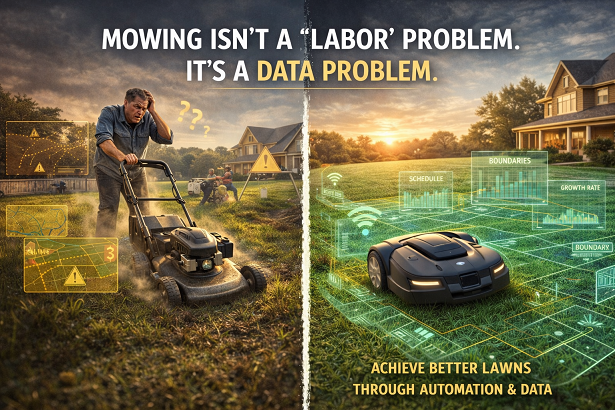
Mowing isn’t a labor problem. It’s a data problem.
And the moment you understand that, everything changes.
Personal-dna
The old model: “show up and wrestle it”
Traditional mowing is built around a flawed assumption:
“The lawn is the same everywhere, every week, so just cut it.”
But lawns aren’t uniform. They’re dynamic.
Your yard has:
-
sunny zones and shaded zones
-
hot strips along sidewalks and driveways
-
wet pockets and dry pockets
-
slopes, pinch points, choke points
-
dog paths, kid traffic, compacted corners
-
growth surges after irrigation or rain
-
seasonal shifts that change everything
So when you mow like it’s one flat, predictable surface, you’re solving the wrong problem with the wrong tool.
It works… but it’s inefficient.
And efficiency is what I care about—because efficiency is where the real money, peace of mind, and long-term turf quality live.
What “data” really means in a lawn
When I say mowing is a data problem, I’m not trying to sound fancy.
I mean something very practical:
A lawn is a map. A schedule. A set of conditions. A set of rules.
If the map is wrong, the outcome is wrong.
If the schedule is wrong, the outcome is wrong.
If the conditions are ignored, the outcome is wrong.
That’s why so many people feel like they’re doing everything… and still struggling.
They’re putting in effort without understanding the system.
Robotics proves it: once the map is right, the lawn becomes predictable
Robotic mowing is not just “a mower without a human.”
It’s a different operating system.
And what does every operating system require?
Inputs. Rules. Data.
Robotic mowing forces you to think like a professional:
-
Where are the boundaries?
-
Where are the hazards?
-
Where are the choke points?
-
What’s the growth rate this time of year?
-
What schedule maintains the canopy without stress?
-
What zones need more time, less time, or different behavior?
Once that’s dialed in, something amazing happens:
The lawn stops being a weekly emergency.
It becomes a managed environment.
And that’s the future: fewer hero moves, more quiet consistency.
Why “data mowing” creates better turf
This is where people underestimate it.
They think the main benefit is convenience.
Convenience is real—but the bigger benefit is turf behavior.
When mowing becomes frequent, consistent, and measured, you get:
-
less shock to the plant
-
a steadier canopy height
-
improved density
-
fewer scalps
-
less need for “catch-up” cuts
-
fewer stress-triggered problems
That’s not a gimmick.
That’s how biology responds to stability.
Plants love consistency. Chaos creates weakness.
The connection nobody talks about: mowing and soil efficiency
Here’s where my worlds collide—robotics and biology.
If you’re trying to push a lawn toward the Balance Horizon (where it starts to manage itself), your goal is to remove the invisible headwinds:
-
stress
-
dysfunction
-
waste
-
constant forcing
Robotic mowing reduces stress above ground.
Biology builds efficiency below ground.
And when you do both, you get the flywheel:
Less stress → better rooting → better water use → fewer inputs → fewer problems → less attention required.
That’s the destination I’m selling.
Not “green.”
Freedom.
The real flex isn’t the robot… it’s the discipline
Here’s the truth:
A robot doesn’t create discipline.
It exposes whether you have it.
If your boundaries are sloppy, it shows.
If your yard is cluttered, it shows.
If your expectations are fantasy, it shows.
But if you embrace the rules—if you treat your lawn like a system—then the robot becomes an amplifier.
And premium customers love this, because premium customers don’t want randomness.
They want:
-
standards
-
predictability
-
clean outcomes
-
less disruption
-
less waste
That’s why this is catching on fast.
The next era of lawn care looks like this
The industry is moving from:
labor + noise + guessing
to:
automation + measurement + efficiency
The winners will be the people who can think in systems, not chores.
And the homeowners who adopt it early are going to feel like they discovered a cheat code:
-
quieter weekends
-
cleaner neighborhoods
-
better turf with less drama
-
less fuel, less maintenance, less hassle
-
a yard that becomes calmer instead of constantly demanding attention
CTA: If you want a lawn that behaves, start treating it like a system
If you’re ready to step out of the “weekly grind” model and into the quiet, efficient future—this is exactly what we do.
We help people:
-
Map the property correctly (boundaries, zones, hazards)
-
Design a mowing plan that reduces stress (not just “cuts grass”)
-
Pair it with soil efficiency so the lawn moves toward Balance Horizon
If you want the calm version of lawn ownership—the one where the yard stops acting like a needy pet—reach out. I’ll show you what your property looks like when it’s managed by rules instead of wrestled by effort.