
Last Updated on February 28, 2026 by Brian Beck
And the fastest way to lose the “war” is to fight the symptom instead of fixing the invitation.
If you’ve ever looked at a lawn that’s suddenly full of weeds and thought, “They’re taking over,” you’re not wrong about the outcome—but you’re slightly wrong about the cause.
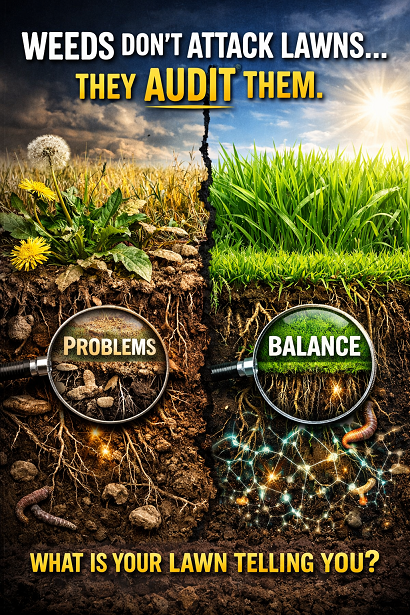
Weeds don’t attack a lawn like an army. They audit it.
They show up when the lawn is leaking opportunity—light hitting soil, shallow water, nutrient spikes, compaction, disease thinning, low biology, or mineral imbalances that make resources present… but not available.
And here’s the uncomfortable truth:
Most weed pressure is a report card.
Not a curse. Not bad luck. Not “your neighbor’s seeds blew in.” (They did… but they can’t thrive unless your lawn gives them a reason.)
What are weeds after?
They’re after the exact same things your grass is after:
-
Light
-
Space
-
Water
-
Nutrition
The difference is strategy.
Grass is designed to win when the system is stable: deep roots, consistent growth, tight canopy, long-term resilience.
Many weeds are designed to win when the system is unstable: fast germination, fast top-growth, aggressive seeding, and the ability to exploit short-term openings.
So when a lawn is thin, stressed, or cycling between “boom and bust,” weeds don’t just survive… they thrive.
The “Weed Invitations” most lawns unknowingly send
In our Biological Program, we see a handful of patterns that consistently invite weeds to move in and set up shop.
1) Thin canopy (light hitting soil)
When sunlight reaches the soil surface, weed seeds get the signal: “Go.”
A dense lawn is a physical barrier. A thin lawn is an open gate.
2) Shallow watering (moist surface = weed nursery)
Light, frequent irrigation keeps the top inch moist. That’s perfect for germination and shallow-rooted opportunists.
Meanwhile, your grass learns a bad habit: shallow roots.
And shallow roots create a fragile lawn that breaks down the moment heat or stress shows up.
3) “Wrong nitrogen” (spike-and-crash feeding)
This is one of the biggest traps in modern lawn care.
Fast nitrogen creates a quick green-up, but it can also create:
-
growth surges that increase stress
-
excess lush tissue that’s disease-prone
-
thatch accumulation
-
a lawn that becomes dependent on constant hits
That’s a roller coaster. And weeds love roller coasters because the grass can’t stay dominant for long.
4) Soil structure problems (compaction + low oxygen)
Compacted soil reduces oxygen, limits roots, and disrupts biology.
When the foundation collapses, weeds don’t “win” because they’re better—they win because the grass can’t compete.
5) Fungal/disease pressure that thins turf
Weeds rarely conquer a thriving lawn.
Most of the time they replace dead or weakened grass.
A lawn that’s constantly wet at the surface, overfed with fast nitrogen, or sitting in low-oxygen conditions is more likely to get thinned by disease—and every thinned area becomes weed real estate.
The biological advantage: grass can live off what’s already there
Here’s the part most people never hear:
A lawn isn’t meant to be “fed” like a houseplant.
A lawn is meant to run like an ecosystem.
Grass has a superpower: it can draw massive energy from the air through photosynthesis—if the soil lets it turn that energy into roots, density, and resilience.
And many nutrients people chase with products are already present in the soil. The problem is often not “lack”… it’s availability.
When soil is biologically functional, nutrients are:
-
cycled instead of dumped
-
buffered instead of spiked
-
made available instead of locked up
-
delivered steadily instead of chaotically
That’s the difference between a lawn that needs constant rescue and a lawn that starts to manage itself—what we call reaching the Balance Horizon.
And here’s what happens near that horizon:
Weeds lose their niche.
Because the lawn stops leaking opportunity.
Beneficial fungi: the quiet force that helps suppress weeds
People hear “fungus” and think disease. But a healthy soil is loaded with beneficial fungi—and they’re one of the most powerful allies in a biological lawn.
Beneficial fungi help the lawn win in three major ways:
1) They build structure
Fungal strands (hyphae) help bind soil particles into stable aggregates. That improves:
-
oxygen flow
-
infiltration
-
root runway
-
drought resilience
A lawn with better structure becomes harder to invade because it stays dense and consistent.
2) They improve nutrient access
Fungi support nutrient movement and availability—especially in soils where nutrients are present but tied up. That means the grass can access what’s already there, instead of relying on constant injections.
3) They help create natural suppression
When a soil has a strong, diverse biological community, it’s harder for opportunistic plants to exploit gaps. Healthy microbial ecosystems tend to reduce the “open niches” weeds depend on.
Bottom line: fungi help the grass dominate.
And when grass dominates, weeds don’t get traction.
How to control weeds without herbicides
The goal isn’t “weed killing.”
The goal is weed prevention through dominance.
Here’s the non-chemical stack that actually works when you run it as a system:
Deep, infrequent watering
Train roots downward. Let the surface dry between cycles.
This reduces weed germination friendliness and builds drought tolerance.
Robotic mowing (frequent cuts = density)
Robotic mowing is a cheat code when it’s used correctly:
-
frequent mowing encourages turf to thicken
-
you avoid scalping
-
canopy stays consistent
-
clippings recycle nutrients in small, steady amounts
A dense canopy is weed prevention.
Stabilize nitrogen (no more spike-and-crash)
Stop feeding like a casino—big wins, big losses.
Steadier nutrition:
-
reduces stress swings
-
reduces disease thinning
-
reduces the openings weeds love
-
supports consistent density
Reduce fungal pressure the natural way
A lot of “weed problems” start as “grass thinning problems.”
You reduce thinning by:
-
avoiding late-day watering that keeps turf wet overnight
-
avoiding excess fast nitrogen
-
improving airflow, drainage, and infiltration
-
supporting biology so the system can recover quickly
Weeds are messengers. The lawn is the message.
If you’re constantly battling weeds, it’s not because weeds are “stronger.”
It’s because the lawn has lost its ability to hold ground.
Herbicides can erase weeds temporarily. But if the invitation remains, the replacements arrive on schedule.
Our Biological Program is built around a different promise:
Fix the invitation, and the weeds lose their footing.
Not through constant chemical war—but through balance, biology, and a turf system that can finally access the resources already present in the air and the soil.
Call to action
If you want real weed control without living on herbicides, start where the truth is objective:
Test the soil.
Find the imbalances. Identify what’s present but unavailable. Restore structure and biology. Stabilize water and nitrogen. Let the lawn become dominant again.
That’s the road to the Balance Horizon—
where weeds stop being a yearly crisis… and start becoming a rare visitor.