
Last Updated on June 25, 2025 by Brian Beck
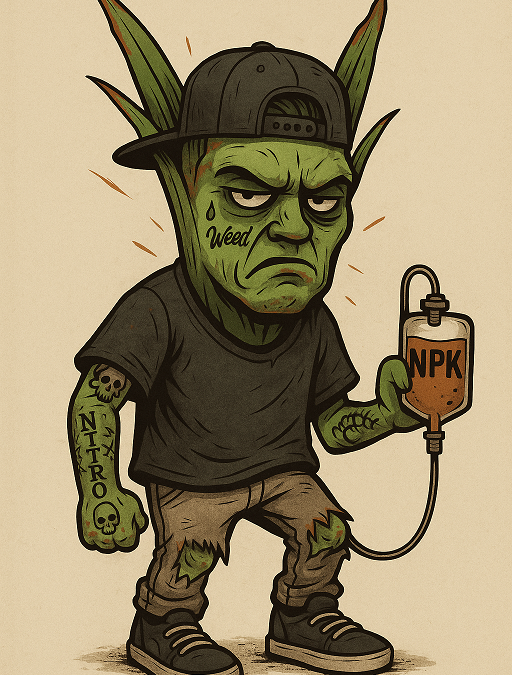
Is Your Lawn a Drug Addict?
Let’s ask a bold question—one that might stop you mid-mow:
Is your lawn chemically addicted?
Now, before you dismiss the idea, consider this: If your lawn needs more and more synthetic fertilizer each year just to look the same… if it struggles without constant feeding… and if it crashes the moment you stop the treatments… then what you’re dealing with isn’t just a maintenance routine.
It’s dependency.
🌱 How Lawns Become Addicted
Just like a person who turns to substances to feel better, your soil system can get hooked on quick fixes. Synthetic nitrogen and other fast-acting fertilizers force green growth fast. It’s an instant reward—a surge of color, density, and performance.
But here’s the catch: those synthetic inputs bypass the natural systems in the soil. They don’t build anything. They just feed the plant directly, skipping the biology and burning through the soil’s organic reserves like a wildfire through dry grass.
Over time:
-
The soil life dies off (microbes, fungi, and earthworms starve without organic inputs)
-
The organic matter declines
-
The soil compacts and loses structure
-
Water doesn’t infiltrate or hold
-
And worst of all… the lawn needs more and more just to look normal
🧪 The Tell-Tale Signs of Dependency
Think about this in human terms:
-
At first, a small dose gives a big effect
-
Over time, that same dose doesn’t cut it anymore
-
Eventually, you’re stuck in a cycle: feed or fail
-
The body (or in this case, the soil) loses the ability to function on its own
If your lawn greens up fast with a spring fertilizer and then crashes 30 days later, you’re seeing the withdrawal phase. And each new application is just masking the symptoms, not solving the cause.
💸 What This Addiction is Really Costing You
The average homeowner doesn’t realize:
-
Only 10% to 40% of synthetic fertilizer is actually used by the plant
-
The rest leaches into waterways, volatilizes into the air, or gets locked up in the soil
-
All that waste? It’s money down the drain. Literally.
Even worse, that chemical dependency destroys natural resilience. You end up spending more on water, more on weed control, more on disease and insect treatments—because the very system that should have handled those problems was killed off by synthetic overload.
💡 So, What’s the Alternative?
If you’ve ever broken a bad habit, you know it takes effort—but the freedom that follows is worth it.
Switching your lawn to a biological fertility program is like starting a rehabilitation plan for your soil:
-
You test the soil—just like a doctor runs a blood panel
-
You feed the biology with compost, natural minerals, and carbon-based materials
-
You rebuild organic matter and microbial life
-
Over time, your lawn becomes self-sustaining, resilient, and healthy
You go from constant inputs to strategic, seasonal care. You stop burning the system and start building it. And the best part? You spend less and get more—more beauty, more function, more pride.
🧠 Final Thought
You don’t have to keep your lawn on life support. You don’t have to keep feeding it synthetic crutches that only mask the real issues.
Ask yourself honestly:
Is my lawn addicted?
Am I fueling the cycle?
Or am I ready to break free and build something better?
Because once you’ve seen what a biologically healthy lawn can do, there’s no going back.