
Last Updated on July 25, 2026 by Brian Beck
When a lawn begins turning brown, most people see one thing:
A lawn that needs more water.
But what is happening inside the grass plant is far more complicated.
Brown grass is not simply a cosmetic problem. It is the visible result of a plant being forced into survival mode. Beneath that fading green color, the plant is making decisions about what it can continue supporting, what it must shut down, and which parts of itself it may need to sacrifice to stay alive.
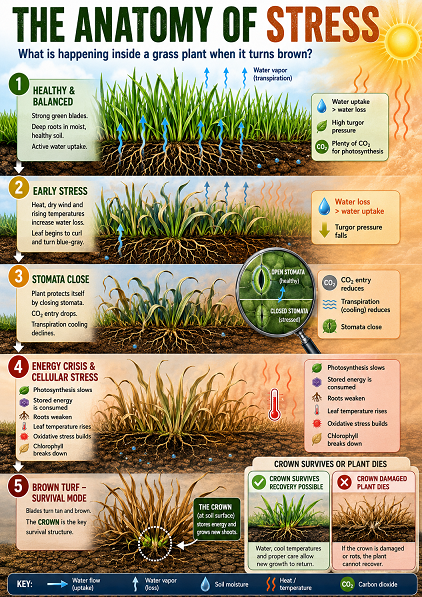
Stress is not random. It has an anatomy.
Understanding that anatomy can help us stop chasing color and start correcting the conditions that caused the stress in the first place.
It Begins With an Imbalance
A grass plant is constantly moving water from the soil, through its roots, up through the plant, and eventually out through microscopic openings in the leaves.
This process is called transpiration.
Transpiration helps move nutrients, maintain cell pressure, and cool the plant. It is similar to the way perspiration cools the human body.
As the temperature rises, the atmosphere pulls moisture from the leaf more aggressively. Wind, low humidity, compacted soil, shallow roots, and high soil temperatures can increase the pressure even further.
Stress begins when the plant loses water faster than the root system can replace it.
The problem may be that there is not enough water in the soil. But it can also mean the soil is preventing the plant from accessing the water that is already there.
A shallow or dysfunctional root system cannot keep up with environmental demand.
The Plant Begins to Lose Pressure
Healthy plant cells are normally filled with water. That internal water pressure, called turgor pressure, keeps the grass blade upright and firm.
As the plant becomes dehydrated, that pressure begins to fall.
The grass may:
- Wilt
- Fold or curl
- Develop a blue-gray appearance
- Hold footprints or mower tracks
- Stop growing
- Lose its normal shine and rigidity
These are often the plant’s first visible warning signs.
The grass is not dead at this stage. It is communicating that its water supply system is beginning to fail.
Unfortunately, many people do not recognize these early signals. They wait until the lawn becomes brown and then attempt to correct the problem with a short burst of shallow watering.
By then, the plant may already be well into its survival response.
The Stomata Close
Grass leaves contain thousands of microscopic openings called stomata.
The stomata allow carbon dioxide to enter the leaf so the plant can perform photosynthesis. They also allow water vapor to leave the plant through transpiration.
As the plant senses that it is losing too much water, it sends out chemical stress signals that tell the stomata to close.
Closing the stomata helps slow water loss, but it creates two serious problems.
First, carbon dioxide can no longer enter the leaf efficiently.
Second, the plant loses much of its ability to cool itself through transpiration.
The plant saves water, but it also shuts down the machinery it needs to manufacture energy.
Photosynthesis Begins to Collapse
Photosynthesis is the process the plant uses to convert sunlight, water, and carbon dioxide into carbohydrates.
Those carbohydrates provide the energy needed to:
- Produce new leaves
- Develop deeper roots
- Recover from mowing
- Fight disease
- Support beneficial soil organisms
- Store energy for future stress
- Survive winter and dormancy
When the stomata close, carbon dioxide becomes limited and photosynthesis slows dramatically.
The plant may still be absorbing sunlight, but it can no longer process that energy normally.
Imagine a solar panel continuing to collect energy while the system connected to it begins shutting down.
Sugar production declines. Root growth slows. Nutrient uptake decreases. New leaf growth stops.
The grass is no longer building strength. It is living off stored energy.
The Plant Starts Spending Its Savings
A healthy grass plant stores carbohydrates in its crown, stems, and roots.
These stored carbohydrates are its emergency savings account.
During heat and drought stress, the plant begins withdrawing from those reserves to stay alive. At the same time, high temperatures increase respiration, meaning the plant may be consuming stored energy faster than it can replace it.
This is one reason repeated stress events can progressively weaken a lawn.
The grass may appear to recover after irrigation or cooler weather, but each period of severe stress can leave the plant with fewer reserves.
Eventually, the plant begins operating with no margin for error.
This is also why applying more fertilizer to a severely stressed lawn can create additional problems. Fertilizer may attempt to stimulate growth at a time when the plant does not have the water, roots, photosynthetic capacity, or stored energy necessary to support that growth.
The lawn does not necessarily need to be pushed harder.
It may need the pressure removed.
The Leaf Loses Its Cooling System
Transpiration is not merely water loss. It is also the plant’s cooling mechanism.
When the stomata close, leaf temperatures can rise above the surrounding air temperature.
At that point, heat can begin damaging:
- Proteins
- Enzymes
- Cell membranes
- Chloroplasts
- Photosynthetic structures
This creates a dangerous cycle.
The plant closes its stomata to save water. Closing the stomata reduces cooling. Reduced cooling causes the leaf temperature to rise. Higher leaf temperatures increase cellular damage and water demand.
This is why heat and drought together are so destructive.
The plant needs water not only for hydration, but also to prevent itself from overheating.
Oxidative Stress Develops
As the plant’s photosynthetic machinery struggles, unstable oxygen compounds begin accumulating inside the cells.
These compounds are called reactive oxygen species.
Under normal conditions, the plant uses antioxidant systems to neutralize them. During prolonged heat or drought, the plant may no longer be able to keep up.
The result is oxidative damage.
Cell membranes begin losing integrity. Proteins and enzymes become damaged. Chloroplasts deteriorate. Cellular contents can begin leaking.
The structure of the leaf itself starts to break down.
At this point, stress is no longer just about a lack of water. It has become a cellular injury.
Why the Grass Turns Brown
The green color of grass comes primarily from chlorophyll.
Chlorophyll captures sunlight and makes photosynthesis possible.
As stress becomes more severe, the plant begins dismantling chlorophyll and shutting down parts of the photosynthetic system.
The lawn may progress through several colors:
Green becomes blue-gray. Blue-gray becomes yellow-green. Yellow-green becomes tan or brown.
The loss of green color means the leaf is no longer functioning normally.
Some of the tissue may be aging and shutting down. Some of it may be completely dehydrated. Some of it may already be dead.
But brown grass does not automatically mean the entire plant is dead.
The Plant Sacrifices the Leaf to Save the Crown
A grass plant’s most important survival structure is not the leaf blade.
It is the crown.
The crown is located near the soil surface and contains the growing points that produce new leaves and shoots.
When conditions become severe, the plant may sacrifice its exposed leaf tissue in an attempt to preserve the crown.
It is biological triage.
The plant redirects its remaining water, energy, and protective resources toward the tissues most necessary for survival.
Think of the brown leaf as a damaged solar panel. The plant may allow that solar panel to fail while attempting to protect the factory that can eventually produce a new one.
This is why a brown lawn can sometimes recover quickly after moisture returns.
The visible leaves may be damaged, but the crown is still alive.
Dormancy Is Not Death
There is an important difference between a dormant lawn and a dead lawn.
A dormant grass plant may have mostly brown leaves, but the crown and growing points remain alive. Metabolism slows dramatically, growth stops, and the plant waits for better conditions.
When water and favorable temperatures return, the crown can begin producing new leaves.
A dead grass plant has suffered irreversible damage to the crown and roots.
Once the crown dies, the plant has no growing point from which to regenerate.
The true dividing line is not simply whether the grass blades are brown.
The real question is whether the crown is still alive.
What Brown Grass Is Really Telling Us
Brown turf is not merely a color problem.
It is evidence that the plant’s water, root, energy, cooling, and soil systems can no longer keep pace with environmental demand.
The sequence looks something like this:
Water loss exceeds water uptake.
The plant loses internal pressure.
The stomata close.
Transpiration and cooling decline.
Photosynthesis slows.
Sugar production falls.
Stored energy is consumed.
Leaf temperatures rise.
Cellular damage increases.
Chlorophyll breaks down.
Leaf tissue is sacrificed.
The crown either survives—or the plant dies.
That is the anatomy of stress.
The Soil Is Part of the Plant’s Survival System
A plant cannot be separated from the soil in which it grows.
A lawn with deep roots, good soil structure, adequate oxygen, balanced minerals, active biology, and increased humus has a much larger margin for survival.
Humus improves the soil’s ability to hold and manage water.
Biological activity helps cycle nutrients and support root function.
Improved soil structure allows water and oxygen to move through the root zone.
Deeper roots give the grass access to a larger reservoir of moisture.
Deep, infrequent irrigation encourages the plant to explore more of the soil profile rather than becoming dependent upon moisture near the surface.
The goal is not simply to keep the lawn green today.
The goal is to build a system that can tolerate tomorrow’s heat.
Stress Is Information
Stress is not necessarily the enemy.
Stress is information.
It reveals where the system is weak.
A lawn that immediately collapses when temperatures rise may be telling us that its roots are too shallow, its soil is compacted, its water is not penetrating deeply, its biology is weak, or its stored energy is insufficient.
The brown color is only the final visible symptom.
The real problem began long before the lawn changed color.
When we understand what the plant is experiencing physiologically, we can stop treating the lawn like a painted surface that must always remain green.
We can begin treating it like a living system.
And when we correct the system, rather than repeatedly covering up the symptoms, the lawn becomes stronger, more efficient, and far more resilient.
Ready to Understand What Your Lawn Is Telling You?
Your lawn’s stress may be showing you exactly where the system is breaking down.
Instead of continuing to chase brown spots, rising water bills, weeds, shallow roots, and repeated disappointment, let us help you understand what is happening beneath the surface.
We can help you identify the obstacles preventing your lawn from becoming healthier, more resilient, and less dependent upon constant intervention.
Engage with us: