
Last Updated on July 21, 2026 by Brian Beck
How to Escape the Front Range Lawn-Care Cycle
Every year, I watch homeowners repeat the same lawn-care cycle.
It begins in the spring with panic.
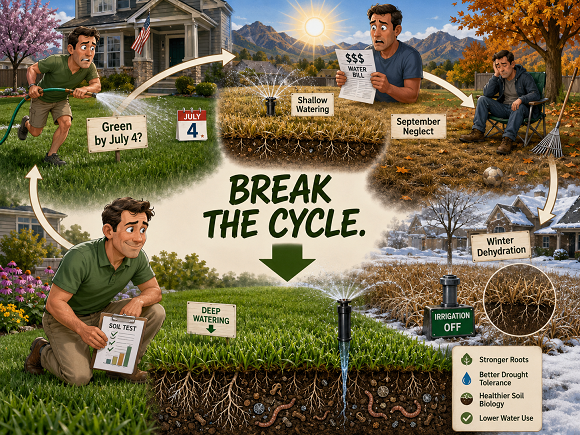
The lawn comes out of winter looking tired, thin, discolored, or damaged, and suddenly the race is on. People begin throwing water, fertilizer, weed control, seed, and money at the lawn in an effort to achieve the sacred status of “green by the Fourth of July.”
The problem is that this is an imaginary race.
There are no clearly defined boundaries. There are no objective measurements. There is no consideration of root depth, soil structure, biological activity, water efficiency, mineral balance, or long-term resilience.
There is only color.
If the lawn is green, everything must be fine.
Unfortunately, color is one of the least reliable ways to determine whether a lawn is actually healthy. A lawn can be artificially pushed into a temporary shade of green while the soil beneath it remains compacted, biologically weak, poorly balanced, and increasingly dependent upon water and outside inputs.
The lawn may look successful.
The system supporting it may be quietly collapsing.
The Summer Heat Exposes the Truth
Once the July heat arrives, the race changes.
The objective is no longer to make the lawn green. The objective becomes keeping it alive.
This is where shallow and frequent watering begins to punish the homeowner.
Many people water for a few minutes every day or every other day. The surface of the soil becomes wet, but the water never moves deeply enough to build a strong root system.
The grass adapts to the environment it has been given.
When water remains near the surface, the roots remain near the surface.
That shallow root structure leaves the lawn almost completely dependent upon the next irrigation cycle. As temperatures rise and evaporation increases, the surface dries quickly. The lawn begins to wilt, discolor, thin out, or become vulnerable to weeds, insects, and disease.
The homeowner responds by watering more often.
The water bill rises.
The roots remain shallow.
The soil remains dysfunctional.
And the cycle tightens.
Instead of building a lawn that can tolerate stress, we unintentionally train it to become more dependent upon us.
By August, Everyone Has Had Enough
By the end of summer, many homeowners are exhausted.
They have spent months chasing color, adjusting sprinklers, fighting brown spots, treating weeds, and opening increasingly unpleasant water bills.
At that point, it is understandable that people begin questioning whether the lawn is worth the trouble.
Unfortunately, this fatigue arrives immediately before the most important month of the lawn-care year.
September is not the end of the season.
September is when we begin building next year’s lawn.
September Is Where the Next Spring Begins
Along the Front Range, September may be the most important month of the year for cool-season turf.
The intense heat begins to ease. Evaporation slows. The grass has an opportunity to recover. Roots can strengthen, soil biology can remain active, and the lawn can begin storing the energy it will need to survive winter and reawaken in the spring.
Instead of taking advantage of this opportunity, many people begin mentally checking out.
They reduce watering too aggressively. They stop paying attention to soil moisture. They assume the lawn is finished for the year simply because the most visible growing season is winding down.
This is the beginning of the end for the following spring.
By the time the irrigation system is shut down—often around the middle of October—the lawn may already be entering winter in a weakened, dehydrated, and stressed condition.
That stress is frequently confused with dormancy.
Dormancy is a natural survival response.
Dehydration is not the same thing.
The Forgotten Two-Month Window
Turning off the irrigation system does not mean the soil immediately freezes or that everything underground stops functioning.
There can still be a valuable window during late October, November, and portions of December when soil temperatures allow continued root development and microbial activity.
The lawn may not be producing dramatic top growth, but important work is still occurring below the surface.
Roots continue adapting.
Microorganisms continue interacting with minerals and organic matter.
The plant continues preparing for winter.
When the irrigation system is shut off and the lawn receives no supplemental moisture during a dry fall, we surrender this window.
The soil gradually dehydrates. Biological activity slows. Roots lose resilience. The lawn enters winter with fewer reserves and less protection.
Then comes the long Front Range winter, when many homeowners do not water the lawn at all.
Winter Dehydration Becomes Spring Failure
Colorado winters can include long stretches without meaningful precipitation.
Wind, sunshine, low humidity, and fluctuating temperatures continue pulling moisture from exposed soil. South- and west-facing areas are especially vulnerable.
As the soil becomes increasingly dry, microbial populations and roots are placed under tremendous stress. Fine roots can be damaged. Biological activity can decline. Soil structure can become less effective at absorbing and holding future moisture.
Then, during late winter or early spring, temperatures begin rising.
Cool-season grass begins waking up.
Its need for water and nutrients increases, but the root system may be too shallow, damaged, or dehydrated to support that demand.
The result is predictable.
The lawn enters spring thin, weak, discolored, and uneven.
The homeowner sees the damage and begins playing catch-up again.
More water.
More fertilizer.
More seed.
More products.
More money.
Another frantic attempt to become green by the Fourth of July.
The cycle begins again.
The Real Cost Is Not Just the Water Bill
When homeowners receive their July and August water bills, they understandably begin questioning whether they can afford to maintain a lawn.
What they may not realize is that the high cost of water is often not simply the cost of owning grass.
It is the cost of supporting dysfunctional soil and a shallow root system.
Poor soil structure limits infiltration.
Low humus reduces the soil’s ability to hold water.
Compaction reduces oxygen and root development.
Mineral imbalances interfere with plant function.
Weak biological activity limits nutrient cycling.
Shallow watering encourages shallow roots.
The homeowner ends up paying to compensate for everything the soil is no longer able to do efficiently.
You are not simply buying water.
You are buying life support for a dysfunctional system.
There Is a Better Way
For the past eight years, we have been working to break this cycle for our customers.
Our biological approach begins by replacing guesswork with objective reality.
We use soil testing to understand what is actually occurring beneath the lawn. We evaluate mineral balance, soil structure, humus, biological potential, and the conditions affecting water movement and root development.
Instead of chasing symptoms, we begin correcting the environment that created them.
We combine those soil corrections with deeper, less frequent watering designed to move moisture farther into the soil profile. Over time, roots are encouraged to follow that water downward.
We focus on building humus because humus improves the soil’s ability to absorb, hold, and manage water.
We support biological activity because healthy soil organisms help cycle nutrients, build structure, and create a more functional relationship between the soil and the plant.
We pay attention to fall and winter moisture because lawn care does not magically end when the irrigation system is shut down.
The goal is not simply to create a greener lawn.
The goal is to create a more intelligent and efficient system.
Stop Renting Your Lawn
Traditional lawn care often feels like renting.
You make another payment every month in the form of water, fertilizer, weed control, repairs, seed, and emergency treatments. The moment you stop paying, the system begins falling apart.
A functional biological lawn is different.
The soil begins doing more of the work.
Roots grow deeper.
Water becomes more effective.
Nutrients are cycled more efficiently.
Stress becomes easier to manage.
The lawn becomes less dependent upon constant intervention.
You begin owning the system instead of endlessly paying to support it.
Break the Cycle
There is a very deep rabbit hole of information beneath every lawn.
We have taken the time to study it, test it, decipher it, and make it understandable for our customers.
There is no reason to continue guessing.
There is no reason to judge the entire health of a lawn by a temporary shade of green.
There is no reason to repeat the same expensive cycle every spring, summer, fall, and winter.
We can measure what is happening.
We can identify the obstacles.
We can correct the dysfunction.
And we can build a lawn that is healthier, more resilient, more water-efficient, and far more enjoyable to own.
Ready to Break the Cycle?
If you are tired of playing catch-up every spring, fighting your lawn all summer, and wondering why the same problems return year after year, we would love to talk with you.
Contact us below to learn how soil testing and our biological lawn-care system can help you stop guessing, reduce dependency, and begin building a lawn that works with nature instead of constantly fighting against it.
Quit renting your lawn. Own it.