
Last Updated on July 20, 2026 by Brian Beck
How Transpiration, Deep Watering, Humus and Biology Build a Heat-Resilient Lawn
When temperatures climb into the 80s, 90s and beyond, your lawn enters a completely different operating environment.
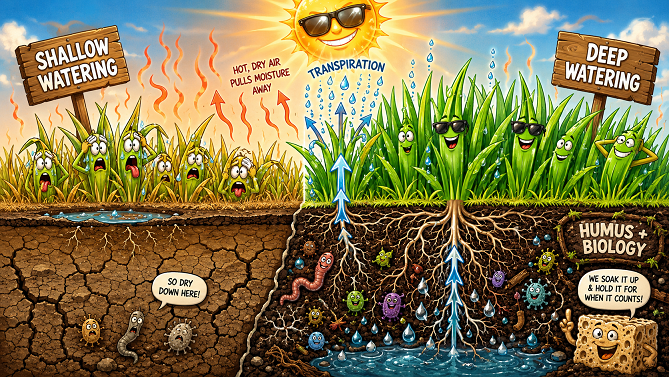
The grass is not simply sitting there waiting for water. It is actively moving water from the soil, through the roots, up through the plant and eventually into the atmosphere. This process is called transpiration, and understanding it may completely change the way you water your lawn.
Transpiration helps explain why a lawn can look healthy one day and begin showing stress only a few days later. It explains why shallow watering creates dependency, why lawns struggle during periods of high heat and why the consequences of poor summer watering may not become fully visible until the following winter or spring.
It also explains why the long-term solution is not simply applying more water.
The solution is to build a lawn that can find water deeper in the soil, use it more efficiently and remain functional when environmental conditions become difficult.
What Is Transpiration?
Transpiration is the movement of water through a plant and its eventual release into the atmosphere as water vapor.
The process begins in the soil.
Grass roots absorb water from the spaces between soil particles. That water enters the root system and travels upward through small water-conducting tubes inside the plant called the xylem.
You can think of the xylem as the plant’s internal plumbing system.
The water moves from the roots, through the crown and into the leaves. Once it reaches the leaf surface, much of it exits through microscopic openings called stomata.
The stomata serve as adjustable doors.
They open so the plant can take in carbon dioxide, which is necessary for photosynthesis. However, whenever those doors are open, water vapor can escape.
That means a plant faces a constant tradeoff:
- It must open its stomata to capture carbon dioxide and produce energy.
- Opening the stomata also allows valuable water to leave the plant.
This water loss is not pointless. Transpiration performs several essential functions.
It helps transport minerals and nutrients from the soil into the plant. It maintains water pressure inside plant cells, helping the grass remain upright. It also cools the leaf surface in much the same way perspiration helps cool the human body.
Transpiration is part of the plant’s natural cooling system.
How Water Moves Upward Through the Plant
A grass plant does not contain a mechanical pump. Instead, water movement is driven by differences in water pressure between the soil, the plant and the surrounding atmosphere.
As water evaporates from the leaves, it creates tension inside the plant’s water-conducting tissues. Because water molecules naturally cling to one another, the loss of water from the top of the plant helps pull additional water upward from the roots.
Imagine a continuous column of water stretching from the soil to the leaf.
As water leaves the top of that column, more water is drawn in from below.
But this system only works when enough water is available in the soil and the roots can reach it.
When the soil surrounding the roots becomes dry, the plant cannot replace the water being lost through the leaves. The internal water column becomes strained, plant cells begin losing pressure and the lawn starts showing stress.
The grass may turn dull green, take on a gray or blue tint or remain flattened after being walked on.
These are not merely cosmetic symptoms.
The plant is telling you that its water supply is no longer keeping up with environmental demand.
Why Grass Uses More Water as Temperatures Rise
Hot air can hold considerably more water vapor than cool air.
As temperatures rise—especially when combined with low humidity, intense sunlight and wind—the difference between the moisture inside the leaf and the moisture in the surrounding air becomes greater.
This creates a stronger atmospheric demand for water.
The air effectively pulls moisture from the plant more aggressively.
Scientists often describe this relationship using the term vapor pressure deficit, or VPD. Homeowners do not need to memorize the formula, but they should understand the principle:
The hotter and drier the air becomes, the harder the atmosphere pulls water from the plant.
A lawn may use a moderate amount of water on a calm 70-degree day. That same lawn may lose water dramatically faster during a sunny, windy 95-degree afternoon with low humidity.
The plant is not choosing to waste water.
It is trying to remain cool, transport nutrients and continue photosynthesis while the atmosphere is demanding moisture faster than the roots may be able to replace it.
Water demand does not always increase forever in a perfectly straight line. Once the plant becomes severely stressed, it may begin closing its stomata to conserve water.
That sounds helpful, but closing the stomata comes with a serious cost.
What Happens When Water Is Not Available?
When the soil cannot supply enough water to keep pace with transpiration, the grass plant enters survival mode.
The stomata begin to close.
This reduces water loss, but it also limits the plant’s ability to absorb carbon dioxide. As carbon dioxide intake falls, photosynthesis slows. The plant produces less energy, root activity declines and growth begins shutting down.
The lawn may then experience several problems at once:
- Leaf temperatures increase because evaporative cooling has been reduced.
- Nutrient movement slows.
- Photosynthesis declines.
- Root growth weakens.
- Cell pressure falls and the leaves wilt.
- The plant begins consuming stored energy reserves.
- Portions of the root system may die.
- The turf may enter dormancy or suffer permanent injury.
During extreme heat, the plant can reach a point where it cannot move water rapidly enough—even when some moisture remains in the soil.
Compacted soil, poor root development, low organic matter, excessive salts and weak soil structure can make the situation even worse.
The lawn may be surrounded by soil that technically contains water, but if the roots are shallow, oxygen is limited or the soil holds water too tightly, the plant may not be able to access it quickly enough.
This is one reason that simply looking at the surface of the lawn can be misleading.
The real battle is taking place underground.
Shallow Watering Creates a Shallow Lawn
Frequent, shallow watering often makes a lawn look temporarily successful.
The top inch or two of soil remains damp. The grass responds quickly, and the homeowner assumes the lawn is being properly hydrated.
But the plant adapts to the environment it is given.
When water is consistently available near the surface, there is little incentive for the roots to grow deeper. The plant develops a root system concentrated in the upper portion of the soil.
That creates dependency.
The surface soil heats up faster, dries out faster and loses more water to evaporation. During high temperatures, shallow roots can quickly find themselves surrounded by dry soil.
The lawn then needs to be watered again.
And again.
And again.
The homeowner may believe the lawn requires large amounts of water because grass is naturally thirsty. In reality, the watering method may have trained the lawn to depend on frequent irrigation.
Shallow watering can also contribute to other problems:
- Reduced drought tolerance
- Greater temperature stress
- Increased surface evaporation
- Weak root development
- Poor access to deeper nutrients
- Increased vulnerability to irrigation interruptions
- Greater dependence on the homeowner or sprinkler system
A lawn with shallow roots has very little margin for error.
If the irrigation system fails during a heat wave, the lawn may begin declining almost immediately.
Why Deep Watering Changes the System
Deep watering means applying enough water, slowly enough, to move moisture well below the immediate soil surface.
For most established cool-season lawns, the objective should be to encourage moisture and root activity into approximately the upper six to eight inches of soil whenever soil conditions allow.
This does not mean flooding the lawn.
It means applying water slowly, deliberately and deeply.
The soil should be allowed to begin drying between watering events. As the upper portion of the soil becomes less comfortable, roots are encouraged to explore deeper areas where moisture remains available longer.
Over time, the plant develops a larger underground reservoir from which it can draw.
A deeper root system gives the lawn access to:
- More soil moisture
- A larger supply of nutrients
- More stable soil temperatures
- Greater protection from surface drying
- Additional time before severe stress develops
Deep watering does not make a lawn immune to drought or extreme heat. It does, however, create resilience.
Instead of failing after one or two hot days, the lawn has a deeper reserve and a larger root system supporting it.
How to Water Deeply
Deep watering should be based on soil penetration, not merely the number of minutes displayed on an irrigation controller.
Every irrigation system is different. Spray heads, rotary nozzles, rotor heads, water pressure, soil texture, slope and compaction all influence how quickly water enters the ground.
A fixed recommendation such as “water for 20 minutes” may be completely inadequate for one property and excessive for another.
The goal is to determine how long your system must operate to moisten the soil to the desired depth without causing runoff.
Use a Cycle-and-Soak Method
If water begins running down the sidewalk or collecting in low areas, the soil is receiving water faster than it can absorb it.
Instead of watering continuously, divide the total watering time into several shorter cycles.
For example, a zone that requires 45 minutes of total watering might be operated for 15 minutes, allowed to rest and then operated for two additional 15-minute cycles.
The resting period gives water time to move downward into the soil.
This is especially important in compacted soils, clay-dominant soils and properties with slopes.
Check the Soil
After watering, use a soil probe, screwdriver or small hand trowel to determine how deeply the moisture has moved.
Do not assume the irrigation reached six inches simply because the surface looks wet.
The surface can appear saturated while the soil only a few inches below remains completely dry.
Your irrigation schedule should be built around what is happening in the soil—not around a generic timer recommendation.
Water During the Cooler Part of the Day
Late-night or early-morning watering generally allows more water to enter the soil before daytime temperatures and wind increase evaporation.
The objective is to have water available in the root zone before the plant faces the highest atmospheric demand of the day.
Water According to Need
Deep watering does not mean watering deeply every day.
The objective is to apply water thoroughly and then allow the lawn to use that water before irrigating again.
The exact interval will change with temperature, wind, soil type, sunlight, root depth and the biological condition of the soil.
A lawn should not be managed by the calendar alone.
It should be managed by observing soil moisture and plant response.
Summer Watering Can Determine Winter Survival
Poor watering decisions made during summer may not reveal their full consequences until winter.
A lawn that receives shallow irrigation throughout the growing season often enters fall with an underdeveloped root system. When irrigation systems are turned off, the plant is left with limited access to deeper soil moisture.
If the winter is dry, windy and relatively warm, the lawn can continue losing water through the leaves and crown even though top growth has slowed.
This is known as winter desiccation.
The plant may be dormant, but it is not necessarily dead or completely inactive. The crown and root system still require moisture to remain viable.
Shallow-rooted turf is especially vulnerable because the upper soil profile dries rapidly during sunny winter days, dry winds and extended periods without snow.
The damage may not become obvious until spring.
Homeowners may then blame winterkill, disease, fertilizer or the lawn-care company. But the failure may have begun months earlier when repeated shallow watering prevented the lawn from building the roots it needed to survive.
Deep summer irrigation helps prepare the lawn for winter by encouraging a larger and deeper root system.
A properly hydrated soil profile entering dormancy also provides a larger reserve against dry winter conditions.
However, a deep root system alone is not the entire answer.
The soil must also be capable of accepting, holding and releasing water.
That is where humus and soil biology become essential.
Humus: The Soil’s Water-Management System
Humus is the stable, highly decomposed portion of organic matter in the soil.
It is not simply undecomposed grass clippings, compost or dead leaves. Humus is created over time as biological organisms process organic material and transform it into more stable forms of carbon.
Humus acts like part sponge, part pantry and part apartment complex.
It helps hold water. It stores nutrients. It provides habitat and food for soil organisms. It also helps bind soil particles into stable aggregates.
These aggregates create a soil structure with a better balance of large and small pore spaces.
The larger spaces allow water and oxygen to enter the soil.
The smaller spaces help retain moisture for later use.
This balance is extremely important.
Soil that is compacted may reject water or allow it to run across the surface. Very sandy soil may accept water quickly but lose it just as quickly. Soil with improved aggregation and humus can often accept water more effectively, store more of it and make it available to plant roots over a longer period.
Humus does not eliminate the need for irrigation.
It makes irrigation more productive.
Instead of water running away, evaporating from the surface or passing rapidly below the root zone, a larger percentage can become part of the soil’s usable water reserve.
Biology Builds the Infrastructure
Humus is not created by purchasing a bag of fertilizer.
It is built through biological processes.
Plants capture carbon dioxide from the atmosphere through photosynthesis. Some of that carbon is used to grow leaves and roots. Some is released through the roots as carbon-rich compounds that feed microorganisms.
Bacteria, fungi and other soil organisms use this carbon as an energy source.
In return, they help cycle nutrients, decompose organic material, create stable soil aggregates and support the formation of humus.
Fungal strands can help connect soil particles and extend the functional reach of roots. Bacterial byproducts help glue particles together. Earthworms and other organisms create channels that improve water movement and oxygen exchange.
This is nature’s operating system.
When the system is functioning properly, the soil becomes more capable of managing water without constant human intervention.
When biology is weak and the soil lacks humus, the homeowner is forced to compensate with more irrigation, more fertilizer and more corrective inputs.
The lawn becomes expensive because the soil is dysfunctional.
Deep Watering and Biology Must Work Together
Deep watering without healthy soil can still be inefficient.
If the soil is compacted, water may run off before it penetrates. If the soil contains little humus, it may not store enough water between irrigation events. If the root system is weak, the plant may not be able to explore the soil effectively.
Biological improvement without proper watering also has limitations.
Microorganisms require appropriate moisture and oxygen. Continually flooding the soil can exclude oxygen, while repeatedly allowing the root zone to become severely dry can reduce biological activity.
The most resilient lawns combine both strategies:
Water deeply enough to develop deeper roots. Build humus and biology so the soil can receive, store and release that water efficiently.
This creates a positive cycle.
Deeper watering encourages deeper roots.
Deeper roots contribute more carbon to the soil.
That carbon supports microbial activity.
Microbial activity improves aggregation and humus formation.
Improved soil structure increases water infiltration and storage.
The lawn then becomes less dependent on frequent irrigation.
The Goal Is Not a Lawn That Never Needs Water
No responsible lawn professional should promise that a cool-season lawn can remain green through extreme heat without water.
Plants require water. Transpiration is part of how they function.
The goal is not to eliminate water use.
The goal is to eliminate waste, dependency and dysfunction.
A resilient lawn should be able to use the water it receives more effectively. It should have roots capable of reaching deeper moisture. Its soil should accept water instead of shedding it. It should contain enough humus to buffer changes in moisture and temperature.
Most importantly, it should not begin failing the moment environmental conditions become difficult.
Listen to What the Lawn Is Telling You
Heat stress is not merely an inconvenience.
It is information.
It reveals the depth of the root system, the condition of the soil, the effectiveness of the irrigation system and the lawn’s ability to regulate itself.
A lawn that immediately collapses during high heat is telling you that something beneath the surface is not working.
The answer may not be more fertilizer.
It may not even be more water.
The answer may be to change how the water is applied and rebuild the soil system responsible for managing it.
Water deeply.
Measure how far the moisture travels.
Allow the roots to follow that water downward.
Build biology.
Build humus.
Create a soil that acts as a reservoir instead of a parking lot.
When these pieces begin working together, the lawn becomes more resilient during summer, better prepared for a dry winter and less dependent on constant rescue.
That is how we move beyond simply keeping grass alive.
That is how we begin building a lawn capable of taking care of itself.
Ready to Build a More Resilient Lawn?
If your lawn struggles every time temperatures rise—or requires constant watering just to remain functional—the problem may be deeper than the surface.
A soil test and biological evaluation can help identify the mineral imbalances, low humus, compaction and biological limitations that are preventing your soil from properly managing water.
At Blade to Blade Lawn & Landscape, our objective is not to teach your lawn to depend on more products and more irrigation.
Our objective is to build a healthier soil system, a deeper root system and a lawn that can withstand the difficult conditions of Colorado’s climate.
Quit renting your lawn and own it.
Is Your Lawn Using Water—or Wasting It?
If your lawn begins struggling every time temperatures rise, requires constant watering to stay green or enters winter already weakened, the problem may not be a lack of water.
The problem may be how that water is being applied—and whether your soil is capable of storing and managing it.
Shallow roots, compacted soil, low humus and weak biological activity can force a lawn into a cycle of dependence. More watering may temporarily hide the symptoms, but it does not correct the underlying problem.
At Blade to Blade Lawn & Landscape, we look below the surface.
Through soil testing, biological soil improvement and proper irrigation strategies, we help homeowners build deeper roots, increase humus, improve water efficiency and develop lawns that are better prepared for Colorado’s heat, wind and dry winters.
Stop repeatedly rescuing a lawn that was never prepared to survive.
Build the soil. Grow deeper roots. Use less water. Create resilience.
Contact Blade to Blade Lawn & Landscape to learn how our biological lawn programs can help you move toward a healthier, more efficient and more self-sustaining lawn.
Quit renting your lawn and own it.
Engage with us: