
Last Updated on April 22, 2026 by Brian Beck
In Colorado, one of the biggest mistakes homeowners make is assuming that every lawn problem needs more fertilizer. The shelves are full of “complete” fertilizers that contain nitrogen, phosphorus, and potassium, so people naturally assume more of all three must mean more growth, more green, and a healthier lawn. But in many established Colorado lawns, that is simply not true. Colorado State University says most established Colorado lawns already have adequate phosphorus and potassium, and CSU also notes that many Colorado gardens do not need added phosphorus or potassium at all.
That matters because Colorado soils are not neutral, forgiving soils. Many are naturally alkaline, often in the pH range of about 7.0 to 8.3, largely because they contain free lime and developed under low-rainfall conditions. In practical terms, that means a nutrient can be present in the soil and still not move efficiently into the plant. Colorado soils often have material in them, but not always the chemistry or biology to make that material easily available.
Phosphorus and potassium are both essential nutrients, but essential does not mean “the more the better.” Phosphorus helps with energy transfer and root development, and potassium plays a major role in water regulation, stress tolerance, and overall plant function. The problem starts when a lawn that already tests adequate gets repeated applications anyway. CSU guidance for Colorado landscapes warns that heavy, unneeded phosphate and potash applications should be avoided, and that many Colorado soils are naturally high in potassium.
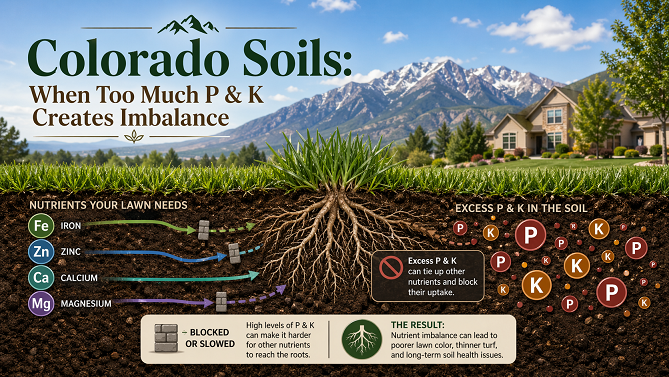
Excess phosphorus is especially deceptive because it may not make a lawn look dramatically worse overnight. Instead, it can quietly interfere with the plant’s ability to take up key micronutrients, especially iron and zinc. Extension guidance notes that excessive soil phosphorus can reduce uptake of iron and zinc even when those nutrients are technically present in the soil. In Colorado, where alkaline and calcareous soils already make iron and zinc harder for plants to access, that imbalance can become even more frustrating. The homeowner sees chlorosis, weak color, or stalled performance and assumes the lawn needs more fertilizer, when in reality the problem may be too much of the wrong kind.
Potassium can create a different kind of bottleneck. Because potassium is taken up as a positively charged ion, too much of it can compete with other cations, especially magnesium and calcium. Multiple extension sources note that excessive potassium can depress magnesium uptake and interfere with calcium as well. So a lawn can sit in soil that contains those nutrients, yet still struggle to move enough of them into the plant in the right proportion. That is how people end up chasing symptoms with one product after another instead of fixing the traffic jam at the root level.
This is one reason “feed it harder” is such a poor strategy in Colorado. When phosphorus is already sufficient and potassium is already adequate to high, adding more can increase salt pressure, distort nutrient relationships, and make the plant less efficient instead of more efficient. CSU specifically advises avoiding heavy phosphate and potash applications when they are not needed because they contribute to soil salts, and CSU’s soil testing guidance says soil tests are the right baseline for tracking phosphorus, potassium, salts, pH, and free lime.
The bigger lesson is this: many Colorado lawns do not fail because they are empty. They fail because they are crowded, bound up, and chemically out of balance. A lawn may have enough phosphorus. It may have enough potassium. It may even have plenty of iron in the soil. But if the nutrient flow is restricted by excesses, alkalinity, free lime, or weak biological activity, the plant still behaves like it is starving. That is why color alone is a terrible measure of lawn health, and why a bagged fertilizer program can keep a homeowner trapped in a cycle of spending without ever creating a truly resilient lawn.
The smarter path for Colorado homeowners is to stop assuming and start measuring. Test the soil. Find out whether phosphorus is already high, whether potassium is already adequate, what the pH is, and whether free lime is part of the story. Then build a program around what is actually missing rather than blindly applying a complete fertilizer because that is what the market has conditioned people to buy. In Colorado, the win is often not adding more nutrients. The win is removing the bottlenecks so the plant can finally use what is already there.
Engage with us: