
Last Updated on February 1, 2026 by Brian Beck
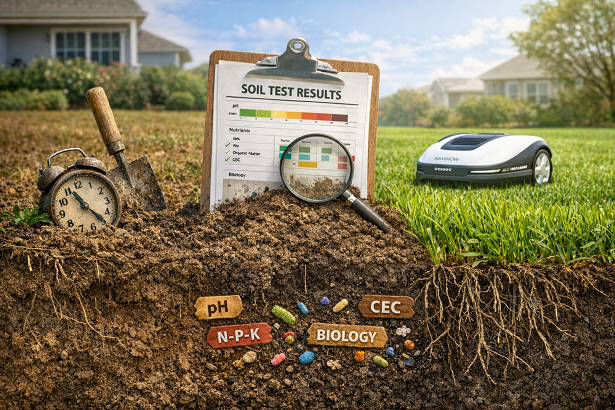
It’s a race against time, biology, and the chemistry under your feet.
The wrong race
Most lawn programs are built on competition and convenience: keeping up with the neighbor, keeping up with a calendar, keeping up with the idea that “more” equals “better.”
But soil does not care about your neighbor’s stripe pattern. Soil does not care what the bag says on the front. And soil definitely does not care that the local lawn company always comes on the second Tuesday of the month.
If you want a great lawn, the race you’re in is not man-made.
It’s natural.
The real race
A healthy, great-looking lawn is a living system with a clock running in the background. That clock has three hands:
-
Time – You can’t “cram” biology. Organic matter builds slowly. Structure improves in stages. Roots expand when the environment allows it.
-
Biology – Microbes are not a switch you flip. They are an ecosystem you cultivate.
-
Balanced chemical structure – Nutrients only behave when the soil has the right framework: pH, base saturation, and mineral balance that lets water, air, and roots work together.
When any one of these is out of sync, your lawn doesn’t fail loudly at first.
It just stalls. It looks tired. It needs constant “help.” And that help gets more expensive every season.
The proactivity paradox
Here’s the irony: most people don’t get proactive until it’s already a problem.
They wait until the lawn is thin, stressed, and full of weeds… and then they want a miracle in 10 days.
That is the opposite of how living systems work.
Proactivity means you act while the lawn still looks “fine.”
Because “fine” is usually the warning light you ignored.
Prepared means you know your state of being
Getting started doesn’t mean buying more product.
Getting started means being prepared.
And being prepared means knowing your state of being – your soil numbers.
Because if you don’t know what is happening in the soil, you are not “managing” anything.
You’re guessing.
Not being informed doesn’t just keep you in the dark.
It keeps you in the cellar.
Enter the soil test: the bedrock foundation
A soil test is your dashboard and your map.
-
It tells you what is actually present (and what is missing).
-
It shows you the constraints that are invisible from the surface.
-
It prevents you from wasting money on inputs that can’t work yet.
-
It gives you a sequence: what to fix first, second, and last.
Everything else – the “perfect schedule,” the shiny new product, the neighbor’s advice – is noise if you don’t have the numbers.
What numbers matter (and why)
A basic soil test can reveal the difference between a lawn that responds quickly and a lawn that stays stuck.
Here are the big rocks:
-
pH – Controls nutrient availability. Wrong pH means “lockout,” even when nutrients are present.
-
Organic matter / carbon – Your buffering system. Your sponge. Your long-term insurance policy.
-
CEC (cation exchange capacity) – How much the soil can hold and trade. Low CEC means you can’t store much.
-
Calcium, magnesium, potassium, sodium – The “structure team.” Too much Mg or Na can tighten soil and kill infiltration.
-
Phosphorus and micronutrients – Often present, but unavailable without the right structure and biology.
-
Salts / EC (electrical conductivity) – Too high and roots struggle; too low and nutrients may not be moving well in certain soils.
If you run a biological test as well, you add another layer: microbial activity, fungal:bacterial balance, and signs of a soil that is trending alive… or trending sterile.
What to do with a soil test
A soil test isn’t a trophy. It’s a starting line.
The goal is not to “max out” every number.
The goal is to build a balanced framework where the plant can do what it was designed to do.
That usually looks like this sequence:
-
Fix structure first (air and water movement).
-
Correct major imbalances (pH and base saturation).
-
Build carbon and humus (the long game).
-
Feed and protect biology (so the system starts paying you back).
-
Then fine-tune with targeted nutrition – not blanket applications.
Stop racing your neighbor. Start racing the clock.
The lawn that wins long-term is not the lawn with the most product applied.
It’s the lawn with the best environment for roots and microbes.
If you want to stop guessing, start with a soil test.
That is the bedrock, foundational platform upon which all success and failure resides.
Everything else is just trying to build a house without looking at the foundation.
Call to action
If you want help interpreting your numbers and building a sequence that actually makes sense, that’s what we do.
We take the soil test, translate it into a plan, and then execute it with a biological approach that lowers the cost of ownership over time.
You don’t need more.
You need the right next step.
— Brian Beck
Engage with us: