
Last Updated on March 24, 2026 by Brian Beck
Most people think they know what a healthy lawn looks like.
They walk outside, see a deep green color, and assume everything is fine.
But color alone is one of the most misleading metrics in lawn care.
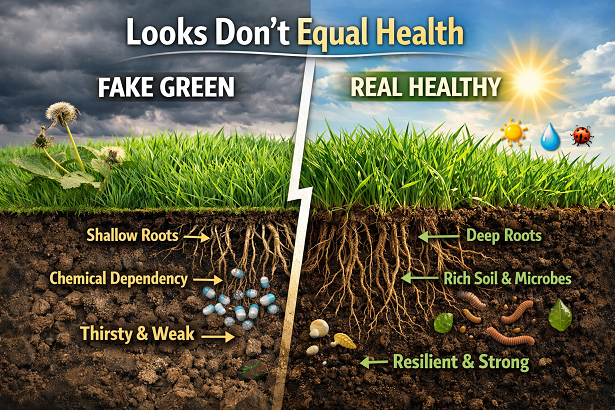
A lawn can be green and still be weak. It can be green and still be thirsty. It can be green and still be chemically dependent, shallow-rooted, disease-prone, weed-prone, and one weather swing away from looking terrible.
That is the illusion the traditional lawn industry has sold for years.
If a lawn is green, people assume it is healthy. In reality, many lawns only look good because synthetic fertilizers are forcing growth and color into the plant. That is not the same thing as health. It is stimulation, not strength.
A grass plant requires far more than a shot of nitrogen to function at a high level. It needs a complete system that works. It needs balanced pH, balanced minerals, adequate carbon, strong microbial life, and proper hydration. Without those things, the lawn may look decent for the moment, but underneath the surface it is often running on borrowed time.
A truly healthy lawn is not judged by color first. It is judged by performance.
Can it photosynthesize efficiently and turn sunlight into sugar? Can it support itself biologically instead of constantly needing rescue? Can it go longer without water because the soil is rich in humus and able to hold moisture? Can it handle heat, cold, and wild swings in temperature without collapsing? Can it resist disease pressure? Does it keep weeds out through density and function instead of depending on endless intervention? Does it allow water to infiltrate instead of running off? Does it manage thatch naturally through biology? Does it green up well in spring and stay active later into the colder months?
Those are real indicators of lawn health.
That is the difference between appearance and function.
The problem with chemical lawn care is that it often teaches people to chase appearance while ignoring the system that creates real performance. Synthetic fertilizers can make a lawn look impressive in the short term, but they do not build the foundation. They do not fix pH. They do not build humus. They do not restore biological life. They do not create balance. In many cases, they create dependency.
That dependency is expensive.
A chemically driven lawn often needs more water because the soil is not holding enough. It needs more inputs because the plant is not cycling nutrients efficiently. It suffers more during stress because the root system and soil biology are weak. It becomes more vulnerable to weeds and disease because it does not have the internal strength to defend itself. So the homeowner ends up buying more products, more services, more corrections, and more time.
That is not a healthy lawn. That is a lawn on life support.
A biological lawn is different because it is built from the soil up.
When the pH is balanced, nutrients become more available. When minerals are in balance, the plant can actually use what is present instead of struggling in a dysfunctional system. When carbon and humus levels are built, the soil acts like a reservoir, holding water and buffering stress. When microbial life is thriving, the lawn starts managing itself better. Organic matter breaks down more efficiently. Nutrients cycle more naturally. Thatch stops becoming a constant problem. Water infiltration improves. Roots go deeper. The plant becomes more stable, more resilient, and less dependent.
This is what people miss when they judge a lawn only by color.
Green is easy to fake.
Function is harder to fake.
A lawn that can stay greener longer with less water, resist stress better, suppress weeds more naturally, manage disease pressure, and perform through unstable weather is showing you something far more important than cosmetic color. It is showing you that the system underneath is working.
And when that system is working, ownership costs go down.
That is the part many people never hear.
A properly developed biological lawn will outperform a chemical lawn because it is doing more with less. It is not relying on repeated force and correction. It is operating from balance. Once certain benchmarks are reached in pH, mineral balance, carbon, biology, and hydration, the lawn begins to behave differently. It becomes more self-managing. It becomes more efficient. It becomes more durable. And it does that for less money over time because you are no longer constantly paying to compensate for dysfunction.
That is the future of lawn care.
Not more products.
Not more dependency.
Not more surface-level color.
Real lawn health is objective. It can be seen in water efficiency, stress tolerance, disease resistance, weed pressure, infiltration, thatch management, seasonal performance, and overall resilience.
So the next time you look at a lawn, ask a better question.
Don’t ask, “How green is it?”
Ask, “How well is it actually functioning?”
Because a lawn that only looks healthy is easy to create.
A lawn that truly is healthy is built on balance, biology, and a soil system that works.
And when that happens, the lawn stops being a burden and starts becoming what it should have been all along: resilient, efficient, and naturally strong.