
Last Updated on February 14, 2026 by Brian Beck
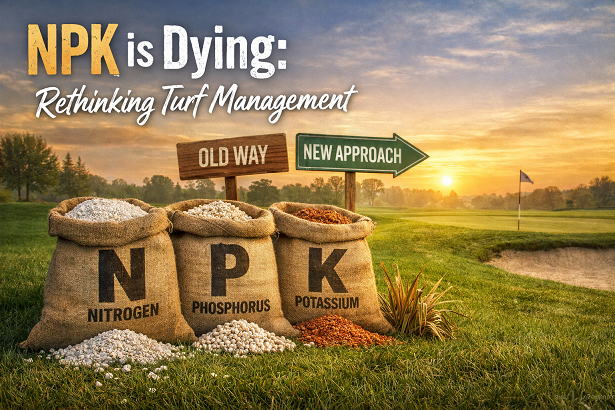
I just listened to a podcast titled “Why NPK Is Dying” and it confirmed something I’ve been watching unfold in real time:
The NPK mindset isn’t failing because nitrogen, phosphorus, and potassium don’t matter.
It’s failing because we turned soil into a sterile container and turf into a chemistry experiment.
We’ve been taught to “do everything right” — the right seeds, the standard NPK, the latest products, the newest spray. And yet, costs climb, resilience disappears, and the lawn becomes a permanent project that never ends.
That’s the trap.
Soil Isn’t a Factory — It’s a Living Digestive System
The podcast hits this point hard, and I’m fully aligned with it:
Soil isn’t a factory. Soil is a living digestive system.
In nature, nutrients don’t fall out of the sky as clean, isolated inputs. They move through life. They’re tied into carbon. They’re carried by organisms. They’re exchanged, cycled, unlocked, and delivered through relationships.
When we ignore that, we can still force a lawn to respond — but the response is often counterfeit. It’s stimulation, not strength. The lawn gets greener, faster… but the soil gets weaker underneath, and the dependency grows.
That’s why so many lawns end up needing:
-
more water
-
more mowing
-
more fungicide
-
more mechanical intervention
-
more “fixes”
-
more money
…and somehow we call that normal.
Turf Is More Vulnerable Than Agriculture (and Here’s Why)
In agriculture, at least the scoreboard is honest: yield and ROI don’t lie forever.
But turf is judged mostly by appearance. That makes turf especially vulnerable to the NPK trap because a program can “look good” while the system underneath is collapsing.
So the industry gets conditioned to chase:
-
color
-
density
-
quick turnarounds
-
symptom control
And we end up building a lawn that requires constant inputs to remain presentable.
That isn’t lawn care. That’s life support.
Here’s the Personal Part: I Translated Agriculture Into Turf
Let me correct something important:
I didn’t come from agriculture. I was already in the turf industry.
But over time, I began learning the deeper principles of agriculture — not the commodity mindset, but the biological and mineral reality that serious growers live by — and I realized something:
The problems I was seeing in turf were the same problems agriculture has been wrestling with… just scaled down and disguised by cosmetics.
So I translated that understanding into turf.
Agriculture teaches you to look for constraints:
-
structure
-
mineral balance
-
carbon and humus
-
nutrient exchange efficiency
-
biology as the delivery mechanism
Turf culture often trains people to look at symptoms:
-
weeds
-
fungus
-
thin spots
-
color
-
“what can I spray?”
When I started applying an agricultural lens to turf, everything changed. I stopped seeing lawns as decorative carpets and started seeing them as living systems with a balance sheet.
Balance Horizon: When the Soil Starts Paying You Back
This podcast reinforces what I’ve been building toward with Balance Horizon:
The goal isn’t to stock the shelves forever. The goal is to build a soil economy.
I use the supermarket analogy because it’s the simplest way to tell the truth:
-
The nutrients in your soil are the shelves.
-
The microbes are the shoppers.
-
The plant is the beneficiary of what they bring back.
-
Humus and biology are the currency that makes the whole store function.
When the system is broken, it’s like having a store full of food but no money, no access, and half the aisles blocked off.
So people do what they’ve been programmed to do:
“Just add more inputs.”
“Just add more water.”
“Just push it harder.”
And the lawn becomes expensive, stressful, and fragile.
But when the soil starts producing its own currency — when carbon builds, structure opens, biology comes alive — the entire economy changes. Suddenly the lawn becomes more efficient, more stable, less thirsty, less needy.
That’s not magic.
That’s the intended design.
The Turf Industry Is About to Split Into Two Worlds
This is my honest opinion:
The turf industry is heading toward a divide.
World #1: Higher numbers, higher solubility, faster stimulation, endless rescue chemistry.
World #2: Structure, biology, mineral balance, carbon cycling — and the earned right to reduce inputs.
I’m betting everything on world #2.
Because the future isn’t selling what you apply.
The future is selling efficiency.
A lawn that behaves better while demanding less.
And once someone experiences that… they don’t go back.
Final Thought
A lawn doesn’t need to be this hard. People have been trained to believe it does. That’s the tragedy — and it’s also the opportunity.
The answer isn’t more force.
The answer is a better system.
If you want help building that system — whether through our service or DIY guidance — follow along. This is what we do. This is what we’re proving. And if you’re tired of chasing, you’re exactly who this is for.
If you’re tired of guessing, tired of chasing symptoms, and tired of paying forever for the same problems to reappear, it’s time to build a system that actually works.
Come follow us and learn what Balance Horizon looks like in the real world.
And if you’re ready to speed this up, choose your path:
-
Want us to do it for you? Reach out for a consultation and we’ll map your constraints and your next moves.
-
Want to do it yourself? Join the DIY community and we’ll teach you how to build efficiency step by step.
Either way, the destination is the same: a lawn that demands less and behaves better.
Click tis link:
To watch that video from RMBA, go here: