
Last Updated on January 2, 2026 by Brian Beck
Most lawn programs are built around one unspoken assumption:
“The grass is the customer.”
So we feed the grass—fast, loud, and often—because green is the only report card anyone sees.
The biological method flips that assumption on its head:
“The soil is the customer. The grass is the symptom.”
And once you accept that, everything gets simpler… even if it gets slower.
Because biology isn’t a hack. It’s a return to how turf was designed to work: roots trading sugars for nutrients, microbes cycling minerals, fungi building structure, and humus acting like the battery and sponge your lawn never had.
A biological lawn isn’t “treated.” It’s trained—and that training follows a predictable path.
Here are the merits of the biological method, and the four steps it takes to adopt it without getting lost, discouraged, or seduced back into the synthetic quick-fix loop.
Why the Biological Method Wins (Even When It’s Not “Instant”)
1) It reduces the cost of ownership
Synthetic programs often look “cheaper” because the first result is quick. But the long-term bill is brutal:
-
more watering (because structure degrades and infiltration suffers)
-
more fertilizer (because nutrients don’t stay put and biology isn’t doing the work)
-
more weed pressure (because the soil environment stays favorable to opportunists)
-
more disease (because the plant is propped up instead of made resilient)
Biology builds a system that keeps its gains.
2) It builds drought tolerance and water efficiency
Biology improves aggregation, infiltration, and moisture holding. When soil becomes more sponge-like, irrigation stops being an emergency response and becomes a controlled input.
You can’t “spray” your way into water efficiency.
You build your way into it.
3) It creates stability instead of dependence
Synthetic fertility is often like renting confidence.
Biology is buying it.
You’re no longer dependent on constant rescue treatments, because the soil ecosystem starts doing what it was always meant to do: cycle nutrients and buffer stress.
4) It makes your lawn harder to knock over
When the soil functions, turf becomes more tolerant of:
-
heat spikes
-
foot traffic
-
mowing stress
-
minor irrigation mistakes
-
seasonal swings
Not perfect. Just less fragile. And that’s the goal.
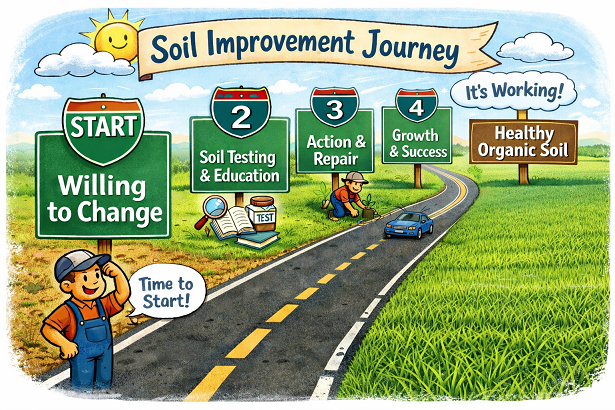
The Four Steps of Adoption
Step 1: Willingness to Change (The Real Starting Line)
Before you change your lawn, you have to change your relationship with control.
Most people don’t leave the synthetic method because it “doesn’t work.”
They leave because they finally realize it works like debt works.
It produces an immediate reward—and a long-term dependency.
Willingness to change is simply admitting:
-
“Maybe I don’t know what I’m looking at.”
-
“Maybe the lawn’s problems aren’t random.”
-
“Maybe my current method is creating the very issues I’m fighting.”
This is the moment you stop asking:
“What can I spray to fix this?”
…and start asking:
“What kind of soil environment would make this stop happening?”
That one mental shift separates a renter from an owner.
Step 2: Soil Testing and Education (Replacing Guesswork with Evidence)
If you don’t test, you’re not managing soil—you’re gambling with it.
A soil test does two critical things:
-
It identifies the real limiting factors.
Not the symptoms. The causes. pH issues, mineral imbalances, low organic matter, poor CEC, nutrient antagonisms—the stuff that makes turf “act weird” even when you’re doing everything “right.” -
It turns emotion into a plan.
When people are frustrated, they’re vulnerable to marketing.
A test gives you clarity and removes the noise.
Education matters here because biology is not a single product. It’s a system of relationships:
-
carbon feeds biology
-
biology unlocks minerals
-
structure improves water dynamics
-
roots deepen
-
stress goes down
-
weeds lose their advantage
If you skip education, you’ll quit too early—because you’ll expect biology to behave like a stimulant.
A soil test is the beginning of truth.
Education is what keeps you from panicking when truth takes time.
Step 3: Action and Repair (Doing the Work That Actually Changes Outcomes)
This is where most people get it wrong.
They start a biological program… but they keep the same mindset:
-
“I want a quick visual change.”
-
“I want one application to do everything.”
-
“I want the lawn to look perfect while the soil is being rebuilt.”
That’s like expecting a gym membership to change your body because you drove past the building.
Repair is not glamorous. It’s corrective. It’s foundational. It often includes:
Correcting the environment
-
addressing pH or buffering issues
-
relieving compaction through biology-driven structure building (not brute-force disruption)
-
improving infiltration and irrigation habits (deep, infrequent, measured)
Feeding the system, not just the plant
-
carbon inputs that support microbial life
-
biology inoculation where appropriate
-
targeted nutrients based on test data (not “blanket advice”)
Removing the handcuffs
Sometimes the lawn isn’t failing because it needs more stuff.
It’s failing because something is blocking function:
-
excess salts
-
poor water practices
-
imbalanced minerals
-
sterile cycles caused by repeated harsh inputs
This is also where patience becomes a strategy, not a personality trait.
You’re not trying to “green it up.”
You’re trying to make it capable.
Step 4: Growth and Success (When “It’s Working” Becomes Obvious)
Success in a biological system is different because it’s not just cosmetic.
It’s functional.
You’ll know it’s working when you notice:
-
improved response to watering (less runoff, better soak-in)
-
deeper rooting and less midday stress
-
fewer “mystery problems” that require emergency fixes
-
reduced need for constant inputs
-
gradual thickening without the rollercoaster
And yes—eventually it looks better too. But the real win is that the lawn becomes less needy.
That’s the part nobody sells, because it doesn’t fit on a label:
“Apply once and forget about your lawn.”
But it does fit in reality:
“Build the soil and the lawn stops begging.”
The Roadmap in One Sentence
Willingness to change gets you out of denial.
Soil testing and education replace guesses with truth.
Action and repair rebuild the environment.
Growth and success show up as stability, resilience, and lower long-term cost.
That’s the system.
Common Pitfalls (So You Don’t Quit Right Before It Clicks)
Pitfall 1: Mixing paradigms
Trying to run a biological program while still leaning on constant synthetic rescue treatments is like planting a garden and then pouring bleach into it “just in case.”
You can’t repeatedly sterilize an ecosystem and then complain it isn’t alive.
Pitfall 2: Expecting a timeline biology never promised
If your soil has been degraded for years, you won’t undo it in weeks.
Biology rewards consistency.
Synthetics reward impatience.
Choose your reward system.
Pitfall 3: Ignoring water
If irrigation is chaotic, everything else is handicapped.
Water is not just hydration—it’s the delivery system for biology and nutrient cycling.
Closing: What to Do Next
If you’re serious about a lawn that costs less, wastes less, and holds up under real life, the next step is simple:
-
Decide you’re willing to change.
-
Run a soil test.
-
Learn what the test is actually telling you.
-
Apply targeted corrections and support biology.
-
Measure progress and stay the course.
You don’t need more tricks.
You need a better foundation.
And once the foundation is right, your lawn stops being a constant project… and starts being a predictable outcome.
Read more: