
Last Updated on January 1, 2026 by Brian Beck
Every action has consequences.
In lawn care, the consequences rarely show up as a receipt you can hold in your hand. They show up as dependency, recurring costs, wasted time, and a lawn that needs “just one more application” to keep it looking acceptable.
So let’s make the invisible visible.
Picture this: cash on your lawn
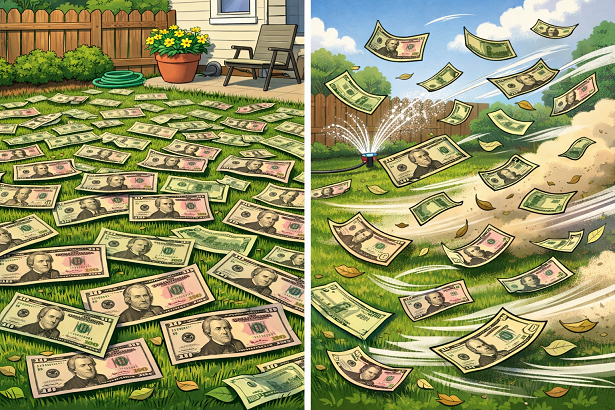
Imagine you step outside and your entire lawn is covered—every square foot—with $20s and $50s.
That sounds ridiculous, but it’s the most accurate way I know to illustrate what’s happening beneath your feet.
Those bills represent value that already exists in your soil:
-
Nutrients that are present but locked up
-
Organic matter potential
-
Water-holding capacity
-
Buffering power (your soil’s ability to resist problems)
-
Microbial “labor” that makes the whole system run
In a biological system, you’re not trying to buy everything your grass needs. You’re trying to activate, recycle, and mobilize what’s already there—and only supplement what is truly missing.
Now for the second part of the illustration.
Now watch the money blow away
Same lawn. Same cash. But this time you watch gusts of wind carry those bills off your property.
That “wind” is what synthetic lawn care creates: avoidable loss.
Not just “loss” as in a little inefficiency—but real, recurring, predictable loss:
-
Fertilizer that leaches, volatilizes, or forces growth you have to mow, water, and defend
-
Water that runs off, evaporates, or never reaches deep roots
-
Herbicide-driven cycles that treat symptoms while the soil environment keeps producing the same pressures
-
Time and attention spent repeating inputs instead of building a system that needs less of you
You never see this money blow away because it’s microscopic: ions, biology, carbon, structure, pore space, root depth, water dynamics.
But the cost is not microscopic. You pay it—over and over.
The synthetic lawn model is waste, dressed up as “normal”
A synthetic program is built on a false premise:
“If it looks green right now, it must be healthy.”
That premise is expensive.
Synthetic salts can create fast color, but they don’t automatically create:
-
stable soil structure
-
deeper rooting
-
biological nutrient cycling
-
resilience to heat, drought, and disease
-
efficient water use
So the system stays fragile. And fragile systems require constant intervention.
That is the consequence.
The biggest cost is the one most people miss: replacement
When you run a lawn like a synthetic factory, you end up paying to replace things you didn’t realize you were losing:
-
Replacing nutrients you already had access to (but didn’t manage correctly)
-
Replacing water your soil could have held (if it had better structure and organic function)
-
Replacing biology you unknowingly suppressed
-
Replacing resilience with more products, more applications, more scheduling, more stress
In other words: you keep buying what you could have been building.
What to do instead: stop guessing and start measuring
The first step to keeping the “money” on your lawn is education—and education starts with soil testing.
Soil testing is not a formality. It’s the dashboard.
It tells you:
-
what’s abundant (and being wasted with unnecessary inputs)
-
what’s missing (so you can target it)
-
what’s imbalanced (so you stop fighting problems you’re accidentally creating)
-
what the soil can realistically do for you—once biology is allowed to work
From there, a biological approach becomes simple in principle:
-
Measure first (soil test)
-
Correct intelligently (targeted inputs, not blanket habits)
-
Build function (biology + carbon + structure)
-
Reduce dependency over time (less fertilizer, less water, fewer interventions)
Bottom line
If you walked outside and saw $20s and $50s covering your lawn, you wouldn’t shrug and say, “Oh well.”
You’d pick them up. You’d protect them. You’d change your behavior.
That’s what this is.
Synthetic lawn care is often the act of watching value blow away—then paying to replace it—because we didn’t know the value was there in the first place.
The consequences are real. The waste is real. The solution is also real.
Start with a soil test. Stop guessing. Stop feeding a system that depends on you staying blind.
If you want, I can turn this into a tighter “no-fluff” version for your website and write a punchy call-to-action section that leads directly into your soil testing offer.
Read more: