
Last Updated on August 21, 2026 by Brian Beck
If you’ve been frustrated with your lawn over the past couple of months because of the relentless heat, understand something:
Your lawn may be even more frustrated than you are.
You’re not crazy, and you’re certainly not alone.
Kentucky bluegrass, which dominates many lawns along Colorado’s Front Range, is a cool-season grass. It performs best under moderate temperatures. Once temperatures climb well into the 80s and 90s, the plant comes under increasing physiological stress.
And when that happens, the cracks in the system begin to show.
Even a lawn that normally looks fantastic can struggle.
I know because it happened to mine.
I Had Brown Spots — So I Did the Obvious Thing
My lawn normally looks pretty darn good. It has to. I’m in the lawn business, so there’s a little pressure there.
But I developed several brown areas that really bothered me.
My first thought was probably the same one most homeowners have:
It needs water.
So I watered it.
And watered it.
I put roughly an hour of water on the area.
A couple of days later?
Almost no improvement.
That’s when things got interesting.
I checked the soil moisture.
It was around 40%.
I normally try to maintain roughly 25–30%.
In other words, there was plenty of moisture present.
The lawn wasn’t simply thirsty.
So I started thinking about something we almost never talk about in lawn care:
Air.
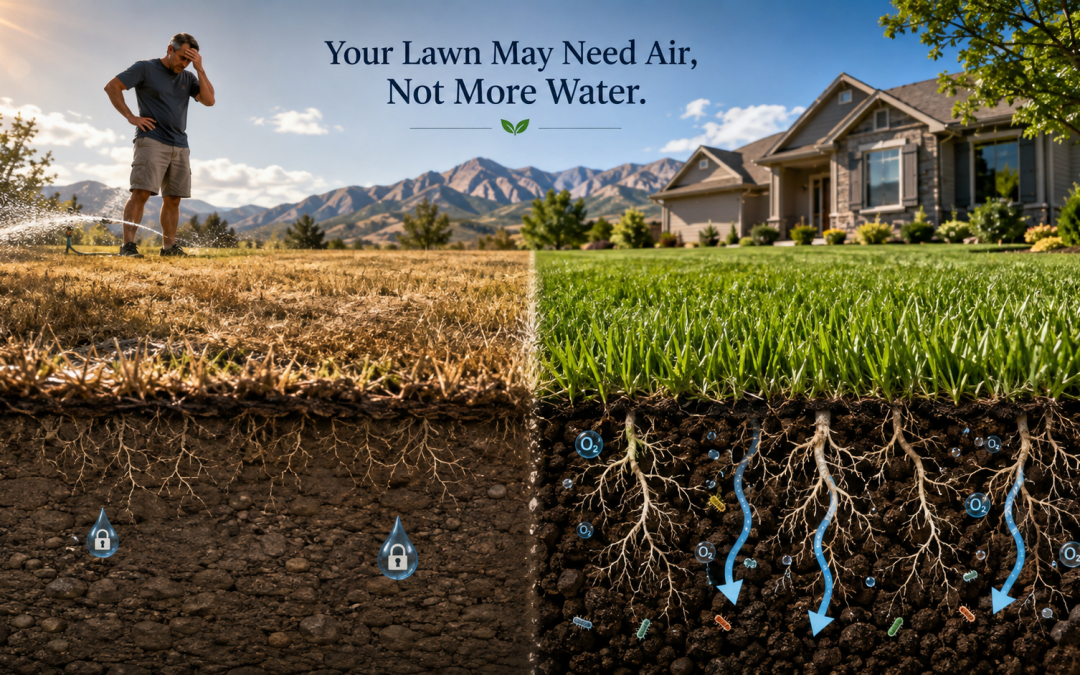
Your Soil Has to Breathe
Soil isn’t supposed to be a solid mass of dirt.
Healthy soil contains pore space.
Those spaces allow water to move through the profile, but they also allow oxygen to enter the root zone and gases produced by roots and microorganisms to escape.
When soil becomes tight, compacted, poorly aggregated or saturated, that exchange becomes restricted.
And soil can become tight in more than one way.
There is mechanical compaction from traffic, equipment and physical pressure.
But soil chemistry also influences aggregation and structure. Calcium, magnesium, sodium, organic matter, microbial activity and other factors can dramatically affect how particles behave.
You can have water in the soil and still have roots struggling because the root environment isn’t functioning properly.
That’s the part I believe homeowners are rarely taught.
So I Tried Something Different
Rather than adding even more water, I treated the area with a combination I’ve been experimenting with to improve soil structure and aggregation.
Then it rained.
Temperatures also dropped roughly 15–20 degrees, which undoubtedly helped relieve heat stress.
But within about three days, the change was dramatic.
Areas that had stubbornly remained brown suddenly recovered.
The lawn looked completely different.
Was it one magic product?
No.
Was it simply the rain?
I don’t believe so.
What I witnessed reinforced something I’ve been studying for years:
Water is only part of the equation.
The physical environment surrounding the roots matters tremendously.
Water Without Oxygen Can Become a Problem
Here’s the irony.
When a struggling lawn turns brown, our instinct is often:
MORE WATER!
But if the soil already contains plenty of moisture, continually adding water can actually occupy more of the pore space that otherwise contains air.
Roots need oxygen for respiration.
So do many of the beneficial organisms involved in nutrient cycling and decomposition.
When gas exchange becomes restricted, root function can decline. Biological processes slow. Nutrient availability can change. The plant’s ability to tolerate heat and other stresses can deteriorate.
Then we see brown grass and assume:
“It needs more water.”
So we water again.
Sometimes we’re treating the symptom while making the underlying environment worse.
Structure Comes First
This is why I keep talking about soil structure.
Structure isn’t simply something we apply out of a bag or spray out of a tank.
It’s something we build.
Healthy soil develops aggregates and pore spaces through the interaction of minerals, roots, organic matter, fungi, bacteria and other biological processes.
That structure creates an environment where:
- Oxygen can move into the root zone.
- Excess gases can escape.
- Water can infiltrate rather than puddle or run off.
- Roots can penetrate deeper.
- Microorganisms can function.
- Nutrients can cycle more efficiently.
- The plant becomes more resilient to heat and drought.
That’s an entirely different philosophy than simply feeding the grass from the top down.
We’re trying to build an environment underneath the lawn that allows the grass to function.
Which Would You Rather Have?
Here’s the simplest analogy I can give you.
If you had to choose between a glass of water and your next breath of air, which one becomes urgent first?
Obviously, grass physiology isn’t identical to ours.
But roots still require oxygen.
And that should change the way we think about lawns.
We spend an enormous amount of time talking about fertilizer.
We talk about irrigation.
We talk about weed killers.
We talk about mowing.
Almost nobody talks about whether the soil underneath the lawn can breathe.
Maybe we should.
Because air is free.
The challenge isn’t buying it.
The challenge is building a soil capable of receiving it.
If your lawn has been struggling through this heat despite all the watering you’ve been doing, there may be a lot more going on underneath your feet than you realize.
And that’s exactly what we help uncover.
Your lawn isn’t just asking for water. It may be screaming for structure.
Want to Find Out What’s Happening Under Your Lawn?
We can help you evaluate your soil, identify the obstacles preventing it from functioning properly, and show you how to start building a healthier biological system from the ground up.
Stop guessing. Start understanding your soil.