
Last Updated on September 29, 2026 by Brian Beck
Your Lawn Is a Marble Cake
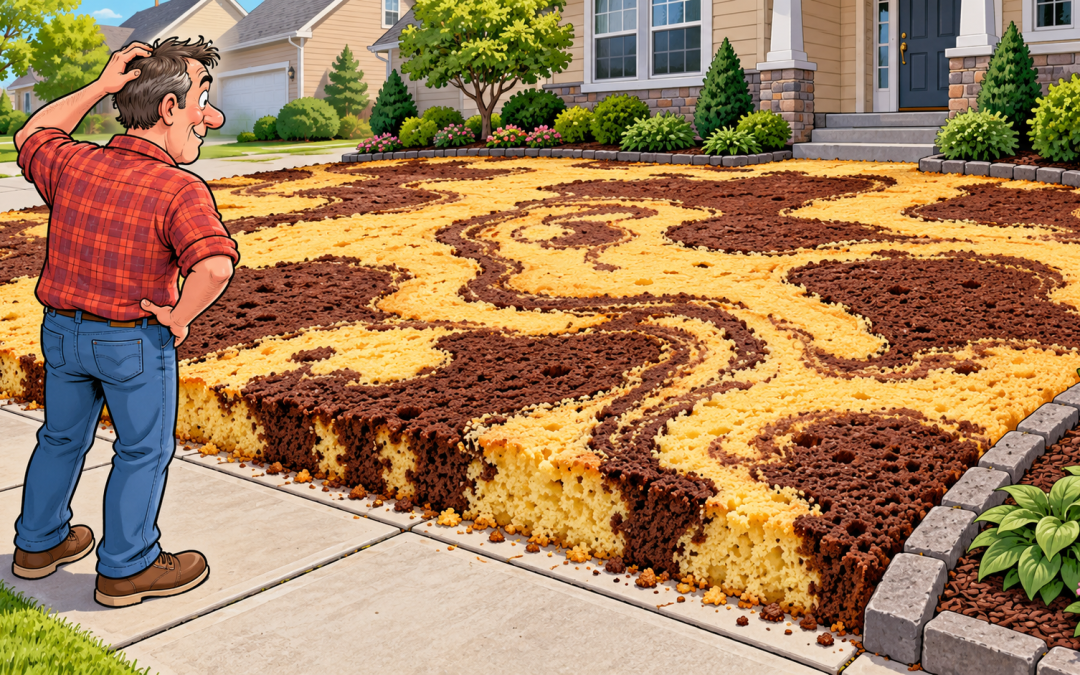
Have you ever cut into a marble cake? From the outside, it looks like one cake. Inside, one slice is mostly vanilla, another has a thick ribbon of chocolate, and the next is a little of both.
A lawn can be like that.
From the sidewalk, it looks like one stretch of grass. Underneath, the soil can change every few feet. One area may be compacted. Another may have more organic matter. A third may dry out faster because it’s shallow, sandy, or exposed to more sun and wind. Some lawns are less like a uniform layer of soil and more like a Frankenstein mix assembled over decades.
That’s one reason a soil test is valuable, but it has limits. A sample tells us about the soil we collected. It does not analyze every square inch of the yard. We use that information to understand the broader pattern, then pay attention to what the lawn shows us.
Heat and drought make those differences easier to see. When conditions are comfortable, the grass may look fairly even. Turn up the stress, and a patch begins to fade while the grass beside it stays green. That spot is a clue.
The temptation is to treat every stressed patch as a separate emergency: add fertilizer, spray something, or run the sprinkler longer. Sometimes a spot does need a specific fix. A buried rock, a sprinkler coverage gap, insect damage, or severe compaction will not disappear because we wished for better biology.
But if we only make the grass green again, we may miss why that patch struggled first.
Our biological approach starts by looking at the conditions below the grass: soil structure and air exchange, water movement, biological activity, organic matter, and mineral balance. Microbes help cycle nutrients and build the relationships that support healthy soil. We also have to remove the obstacles that prevent them from doing that work. The goal is to improve the weaker areas over time so the lawn responds more consistently when the next stressful week arrives.
That does not mean every inch of soil will become identical. It means building a lawn with fewer weak links: soil that supports roots, holds useful moisture, makes nutrients available, and recovers more reliably from heat and dry weather.
A healthy lawn is more than one that looks green on an easy day. Watch what happens when conditions get hard. The first places to struggle may be showing you exactly where to look next.
Is your lawn showing stress spots? Our Balance Horizon Soil Consultation helps connect what you see above ground with what may be happening below it. Let’s read the clues and build a plan to improve the soil over time.
Those Stress Spots Are Telling You Something
If the same patches struggle every time the heat rises, your lawn is giving you a map of where to start. Stop guessing at the surface. Let’s find out what’s happening in the soil and build a plan to make your lawn more resilient, one weak spot at a time.
Request your biological lawn consultation here.
We don’t guess with soil. We test it.