
Last Updated on September 29, 2026 by Brian Beck
Colorado’s Water Future Needs More Than a Smaller Lawn
I believe in conservation. Watering sidewalks, running sprinklers through a rainstorm, and ignoring a broken irrigation system make no sense.
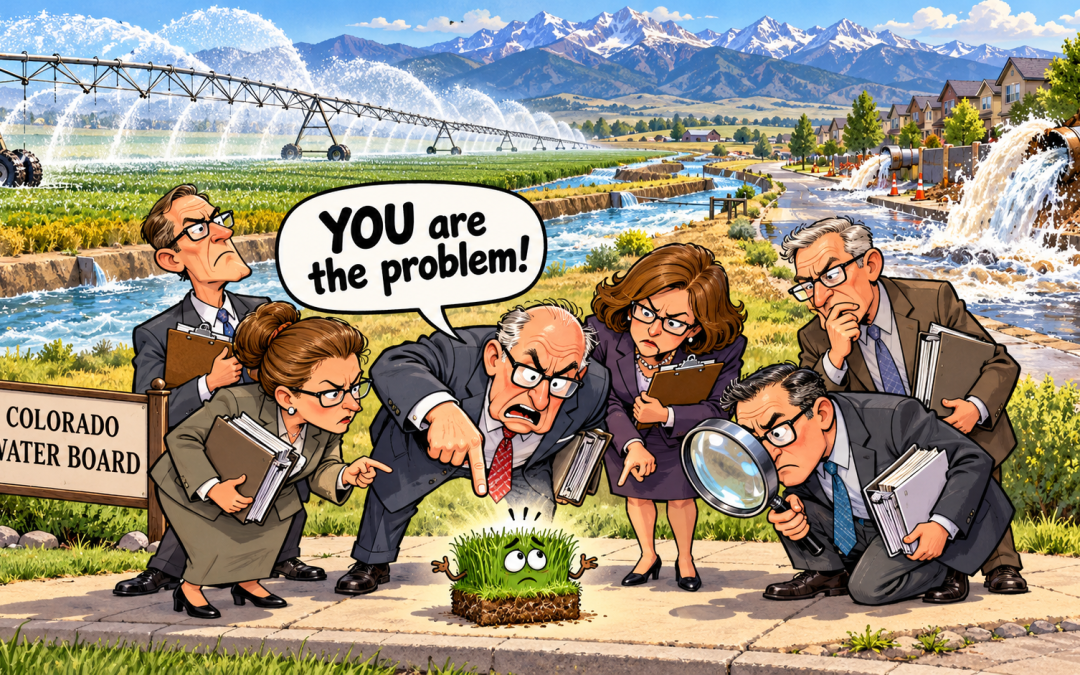
But neither does turning grass into the convenient villain of Colorado’s water story.
When the conversation centers on removing lawns, we need to ask a bigger question: Are we building a more capable water system, or simply asking our communities to accept less from the one we already have?
Turf replacement can be appropriate. It should also face the same scrutiny as every other proposed solution.
Put the size of the problem in perspective
The Colorado Water Conservation Board’s January 2023 turf replacement report contains a revealing statement: municipal water accounts for approximately 7% of statewide water use, with roughly 40% of that going outdoors.
Using that accounting, outdoor municipal use represents approximately 2.8% of Colorado’s total water use.
That includes more than lawns. It includes irrigation for trees, native grasses, water-wise landscapes, parks, and playing fields.
This is the report’s statewide accounting—not a claim that landscaping uses only 2.8% of a city’s supply or a household’s water. Outdoor demand can be a substantial local challenge. Nevertheless, the statewide figure should put the discussion in proportion.
We cannot reasonably treat one portion of that outdoor use as the explanation for the entire state’s water problems.
The report itself challenges the easy answer
The study estimates that replacing 30% of Colorado’s nonfunctional turf—approximately 7,800 acres—could save between 10,000 and 20,000 acre-feet annually.
That is approximately 3.3–6.5 billion gallons. Meaningful savings, certainly.
But its main analysis estimates total conversion costs of approximately $1.7–$3.4 billion at $5–$10 per square foot. Those are modeled costs, not a state funding commitment.
The authors also acknowledge substantial uncertainty about how much turf Colorado has and how much water conversion actually saves here. They warn against borrowing Las Vegas’s results because Colorado’s climate and irrigation season differ substantially.
Those findings should encourage careful comparison before we decide that removal is the best investment.
Imagine removing every living landscape
Take the argument to an absurd extreme: remove every lawn, tree, shrub, garden, and planted public space.
Of course, that would be asinine. It would also leave Colorado with decisions about storage, infrastructure, population growth, agricultural demand, drought preparedness, and the timing and location of available water.
Nobody needs to propose that extreme for it to expose the limitation of the reasoning: eliminating landscape demand would not resolve every other water-system problem.
And real turf replacement should preserve vegetation. A well-designed native garden and a largely exposed gravel yard are very different outcomes.
Green space does work that a water bill cannot measure
People need places to play, gather, rest, and step away from buildings and traffic.
The World Health Organization’s review of urban green spaces identifies benefits that include psychological relaxation, stress relief, physical activity, and social connection. Those findings concern green space broadly, rather than proving that every ornamental lawn is essential. But they make one point clear: living landscapes have value beyond their water consumption.
They also influence heat. Trees and vegetation provide cooling through shade and evapotranspiration. That cooling uses water, but it provides a service to the surrounding community.
A serious conservation policy should evaluate that service, along with irrigation demand.
Urban development changes the water cycle, too
Climate change belongs in the discussion. So does what we build on the ground.
Roads, roofs, and parking lots reduce infiltration and accelerate runoff. Replacing vegetated land with impervious surfaces changes how water moves through a watershed. USGS documents these effects of urbanization.
We should examine development patterns, drainage, soil conditions, and heat alongside lawn irrigation.
Moisture released by plants does not necessarily return as rain to the same watershed. Still, soil, vegetation, and water movement deserve a place in planning. Counting sprinkler gallons alone cannot describe the whole system.
Plan for greater capability
My concern is that removing turf can become a convenient substitute for harder questions about planning and engineering.
The report does not establish that poor planning caused Colorado’s water challenges. But we should demand an explanation of how landscape restrictions fit into a larger strategy—and what additional capability that strategy will deliver.
Colorado’s broader Water Plan does include storage and reuse. The question is how effectively those tools are pursued and combined with conservation.
We need to compare:
- Additional storage where water is legally and physically available.
- Reuse and better operation of existing infrastructure.
- Agricultural improvements that produce verified savings while protecting downstream users.
- Better irrigation and soil management in existing landscapes.
- Targeted replacement where turf provides little benefit relative to its water demand.
New reservoir capacity does not guarantee new annual supply. Likewise, new irrigation equipment does not guarantee an equal reduction in basin-wide consumption. Every option should be measured honestly.
Can we have our cake and eat it, too?
I believe we can preserve valuable green spaces while using water more intelligently. Whether a particular site can do that—and by how much—requires evidence.
Before removing an existing lawn, assess its irrigation, soil condition, use, and maintenance. Compare improvement with replacement. Then measure the result.
Conservation should mean eliminating waste and improving performance. Cutting off the snake’s head may stop it moving, but that is a poor model for building a healthy landscape or a resilient water system.
Colorado deserves a future built around resourcefulness, responsible engineering, and communities worth living in.
Start with understanding your own lawn
At Front Range Biological & Lawn Automation, we start by examining what limits a lawn’s performance: its structure, soil life, mineral balance, and irrigation.
Before deciding your lawn has to go, learn what could help it function better.
Explore the Five Foundations of a Healthier Lawn
Own your grass. Don’t rent it.