
Last Updated on March 28, 2026 by Brian Beck
Most people have been taught to treat a lawn like a weekly emergency.
See a little yellowing? Feed it.
See a weed? Spray it.
See slow growth? Hit it again.
Want darker color? Dump more nitrogen on it.
That mentality has created a lawn industry built on reaction, not function.
And the biggest problem is this: most people are not managing a living soil system. They are managing a dependent plant sitting on top of a chemically stimulated surface. The lawn may look green for a while, but that does not mean it is healthy. It often means it is being propped up.
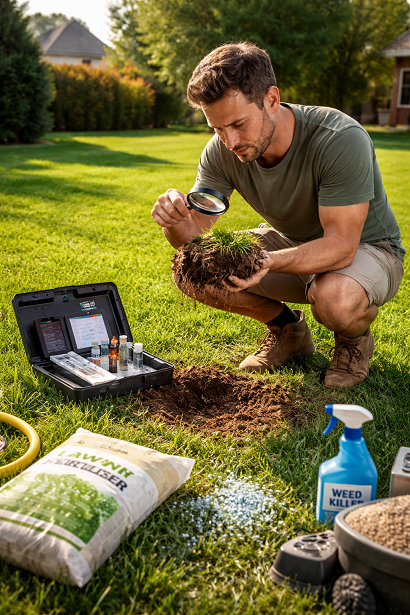
One of the most revealing parts of the recent soil biology discussion I reviewed was how clearly it exposed the weakness in the way many people think about testing. Microbes are living organisms. They reproduce quickly, die quickly, and change with temperature, moisture, oxygen, root activity, and management. When you take a soil sample, throw it in a bag, let it sit in transit for days, and then expect that result to represent what is truly happening in the lawn, you are assuming that life held still for you. It didn’t. The podcast pointed out that microbes can begin dying in transit, that temperatures over about 104°F are harmful, and that sealed bags can dry out, overheat, or suffocate the biology you were supposedly trying to measure.
That does not mean testing is useless. It means testing must be understood correctly.
A living soil is not a static thing. It is moving all the time. Biology rises and falls with season, moisture, stress, root exudates, organic matter, and management. That means one random snapshot does not tell the whole story. Good testing is not about worshipping one number. Good testing is about creating context. It is about testing consistently, in the same conditions, in the same area, over time, and using that information to track direction. Are things improving? Are they collapsing? Did the treatment build life, or did it only create a short spike? Those are the questions that matter.
This is where the synthetic fertilizer conversation becomes uncomfortable for a lot of people.
The podcast used a simple analogy: if you offer a toddler a healthy meal or a box of candy, the toddler picks the candy. Plants behave the same way. When you make nutrients instantly available in a soluble, easy form, the plant takes the shortcut. It slurps up the NPK and reduces its dependence on the microbial workforce that was designed to feed it. That breaks the symbiotic relationship between plant roots and soil biology. In plain English, synthetic fertility can make the plant look better while making the system weaker.
That is why so many lawns are green and still fragile.
They need constant intervention. They burn through water. They struggle in heat. They invite weeds. They build thatch. They lose resiliency. And every year the homeowner is told to do more of the same thing that helped create the problem in the first place. More fertilizer. More herbicide. More rescue applications. More dependency.
The irony is that the lawn is not the enemy. Mismanagement is.
The same discussion made a point that hits home for turf: lawns are one of the largest crops in the United States, yet they are often managed with less understanding than a serious garden or commercial field. People go to a store, buy a high-analysis fertilizer they do not understand, and spread it because they want fast color. Then they add weed killers and more inputs when the lawn becomes unstable. The result is not just a weaker lawn. It can also mean more runoff, more salt loading, more pollution pressure, and more wasted water.
A better lawn starts by asking a better question.
Not, “What do I need to put on it next?”
But, “Why is this lawn unable to function on its own?”
That question changes everything.
Now we start looking at compaction. We start looking at poor soil structure. We start looking at lack of oxygen, lack of carbon, low microbial life, poor water infiltration, and a root zone that has been trained to live off handouts instead of biology. The podcast specifically highlighted compaction and overfertilization as major causes of low microbial life because compacted soil holds less air and water, restricts roots, and gives microbes less habitat to live in.
This is why our biological approach is different.
We are not trying to create a prettier dependency. We are trying to restore function.
That means building soil structure first. It means feeding the biology, not just the leaf. It means creating conditions where microbes can survive, multiply, cycle nutrients, improve infiltration, support roots, and help the lawn regulate itself. It means understanding that real health does not come from forcing the plant harder. It comes from rebuilding the relationship between the plant and the soil. The podcast made this clear too: simply adding microbes is not enough if the soil has no structure and no food source to support them. Biology needs a home, not just an introduction.
So yes, test your soil.
But do not pretend one mailed-in sample is the final word on a living system.
And yes, your lawn may respond to synthetic fertilizer.
But do not confuse response with health.
A healthy lawn should become more resilient, not more needy. It should infiltrate water better, hold moisture longer, resist stress better, cycle its own rough material more efficiently, and need less drama from you over time. That is the difference between a lawn being pushed and a lawn actually functioning.
If your lawn only looks good when you keep hitting it, that is not proof the program works.
That is proof the lawn has become dependent.
CTA
If you are tired of guessing, tired of chasing color, and tired of paying for the same lawn problems year after year, it may be time to stop treating symptoms and start rebuilding the system. A properly functioning lawn should cost less to own, use water more efficiently, rely less on toxic chemistry, and become more stable over time. That is exactly what a biological program is designed to do.
Engage with us: