
Last Updated on May 10, 2026 by Brian Beck
There comes a point where we need to establish a new benchmark.
Not a cute little lawn tip.
Not another “five secrets to greener grass” article written by someone who thinks soil is just brown carpet padding.
A real benchmark.
Here it is:
Almost everything the average homeowner has been taught about lawn care is either incomplete, backwards, or only true inside a failing synthetic system.
That may sound dramatic.
Good.
Because the traditional lawn care world has trained people to look at their lawn through the smallest possible lens: color, fertilizer, weed spray, water, repeat. If the grass is green today, we celebrate. If it is brown tomorrow, we panic. If a weed shows up, we spray it. If the lawn struggles, we add more fertilizer. If that does not work, we water more. If that still does not work, we blame Colorado, the soil, the heat, the dog, the neighbor, or possibly the moon.
But a biological lawn works by a different set of laws.
And once you understand those laws, a lot of what you were taught starts to look less like wisdom and more like a very expensive hamster wheel.
1. The Old Benchmark: Green Means Healthy
This is probably the most dangerous myth in lawn care.
A lawn can be green and still be weak, chemically dependent, shallow-rooted, thirsty, compacted, disease-prone, and one stressful week away from looking like a rejected doormat.
In the traditional system, green is treated as proof.
In the biological system, green is the result of function.
The real question is not, “Is it green?”
The real question is, “Why is it green?”
Is it green because the soil is cycling nutrients, holding water, breathing properly, and feeding the plant naturally?
Or is it green because we force-fed it enough nitrogen to fake a pulse?
One is health.
The other is cosmetic life support.
2. The Old Benchmark: Fertilizer Feeds the Lawn
Traditional lawn care teaches people that fertilizer is the food.
That sounds logical until you realize the plant was designed to operate in partnership with the soil, microbes, fungi, roots, minerals, air, water, and sunlight.
In a biological system, the goal is not simply to dump food on the lawn.
The goal is to restore the system that helps the lawn feed itself.
That means biology, humus, structure, mineral balance, oxygen, and nutrient flow matter more than just throwing nitrogen at the problem and hoping the lawn sends a thank-you card.
Fertilizer may create a response.
Biology creates a functioning economy.
3. The Old Benchmark: More Nitrogen Means a Better Lawn
Nitrogen is the traditional lawn care industry’s favorite hammer.
And to be fair, it works — temporarily.
Nitrogen can make grass green. It can push growth. It can create that quick visual improvement people want. But when nitrogen becomes the entire strategy, the lawn becomes dependent on constant stimulation.
That is not regeneration.
That is caffeine addiction with irrigation.
In a biological system, nitrogen is only one part of the story. The plant also needs calcium movement, phosphorus and potassium balance, sulfur, micronutrients, carbon, microbial cycling, and the ability to actually use what is already in the soil.
A lawn does not need to be whipped into growth.
It needs to be restored into function.
4. The Old Benchmark: Water Fixes Dry Grass
This one costs homeowners a fortune.
Most people think dry grass means, “I need to water more.”
Sometimes that is true. Often, it is not.
Many lawns are not suffering because water is unavailable. They are suffering because the soil cannot properly accept, hold, or move water.
That is a soil problem, not a sprinkler problem.
Poor structure, low humus, compaction, high magnesium, poor calcium movement, and weak biology can all create a situation where water hits the lawn but does not become useful to the plant.
So the homeowner waters more.
Then more.
Then the water bill arrives and everyone gathers around it like it is a medical diagnosis.
In a biological system, the goal is not simply more water.
The goal is better water efficiency.
Healthy soil should act more like a reservoir and less like a driveway.
5. The Old Benchmark: Weeds Are the Problem
Weeds are not usually the problem.
They are the unpaid intern pointing at the problem.
Traditional lawn care sees weeds and says, “Spray them.”
Biological lawn care sees weeds and asks, “Why are they comfortable here?”
Thin turf, compacted soil, poor calcium-magnesium balance, low biology, poor nutrient cycling, and inconsistent watering can all create openings for weeds. Yes, weeds may need to be managed, but killing the weed without fixing the condition is like silencing a smoke alarm while the kitchen is still on fire.
It may feel productive.
It is not exactly brilliant.
In the biological system, dense, healthy, functional turf becomes the weed control strategy.
6. The Old Benchmark: Soil Testing Is Optional
This is one of the biggest differences between guessing and knowing.
The traditional approach often treats soil testing like an extra step for people who have too much time and enjoy spreadsheets.
But without a soil test, you are guessing.
You do not know the pH.
You do not know the base saturation.
You do not know the calcium-to-magnesium relationship.
You do not know the humus level.
You do not know whether nutrients are deficient, excessive, locked up, or fighting each other like relatives at Thanksgiving.
In a biological system, the soil test is not a luxury.
It is the map.
And when you are trying to get somewhere important, a map is generally better than wandering around confidently in the wrong direction.
7. The Old Benchmark: The Product Is the Program
This is where homeowners get trapped.
They ask, “What product do I need?”
That question is understandable, but it is usually too small.
The biological system is not built on one magic jug, one miracle bag, or one secret potion from a wizard in gardening gloves.
Products can help.
But products are not the program.
The program is the process: correcting soil structure, improving mineral balance, building humus, feeding biology, managing water properly, mowing correctly, and giving the lawn the conditions it needs to function.
A product can create a reaction.
A system creates resilience.
8. The Old Benchmark: Fast Results Prove the Program Works
Traditional lawn care has trained customers to expect fast visual gratification.
And to be fair, fast is fun.
Fast is satisfying.
Fast makes people feel like something is happening.
But fast is not always progress.
Sometimes fast is just stimulation. Sometimes fast is cosmetic. Sometimes fast is the lawn equivalent of putting a tuxedo on a guy who needs a hospital bed.
In the biological system, the most important improvements often happen before the homeowner sees the dramatic visual change.
Water starts moving better.
The soil starts breathing better.
Roots begin exploring.
Microbes begin cycling.
Nutrients become more available.
Stress tolerance improves.
The lawn may not immediately look like a golf course, but the foundation is being rebuilt.
That matters.
Because a lawn that only looks better for three weeks is not the same thing as a lawn that becomes easier and cheaper to own for years.
9. The Old Benchmark: The Lawn Is Separate From the Environment
Traditional lawn care often treats the lawn like an isolated green rug.
Spray it. Feed it. Cut it. Water it. Repeat.
But a lawn is not separate from the environment. It is part of a living system.
The soil, atmosphere, sunlight, fungi, bacteria, roots, organic matter, minerals, and water cycle are all connected.
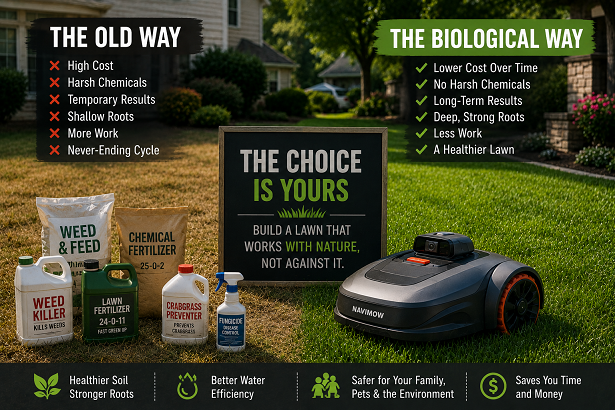
A biological lawn is not just about having pretty grass. It is about reducing dependency, improving efficiency, reducing unnecessary chemical exposure, lowering water demand, and making the lawn less fragile.
That is the part most people miss.
A lawn can either be a burden that constantly demands rescue, or it can become a functioning asset that works with nature instead of fighting it all season long.
10. The Old Benchmark: Lawn Care Is Maintenance
This may be the biggest shift of all.
Traditional lawn care is maintenance.
Biological lawn care is transformation.
Maintenance says, “Keep doing the same things so the lawn does not fall apart.”
Transformation says, “Let’s fix why the lawn keeps trying to fall apart in the first place.”
That is a completely different mindset.
We are not trying to create a lawn that needs constant correction. We are trying to create a lawn that becomes more stable, more efficient, more resilient, and less expensive to manage over time.
That requires patience.
That requires education.
That requires the homeowner to stop measuring success by the standards of the very system that created the dependency.
The New Benchmark
So here is the new benchmark:
Stop asking whether your lawn looks good for the moment. Start asking whether your lawn is becoming less dependent, more efficient, more resilient, and easier to own.
That is the real test.
Because the traditional system has taught people to chase appearances.
The biological system teaches people to build function.
And once function begins to return, appearance follows.
Not as a trick.
Not as a temporary chemical performance.
Not as another band-aid slapped over a deeper problem.
But as the visible result of a lawn that is finally starting to work the way it was designed to work.
And yes, that may require unlearning a few things.
Maybe even a lot of things.
But considering how much money homeowners have spent watering, fertilizing, spraying, guessing, stressing, and apologizing to their neighbors for the crime of having imperfect grass, a little unlearning might be the cheapest improvement they ever make.