
Last Updated on May 10, 2026 by Brian Beck
Why the Short-Term Fix Often Keeps You Stuck
We live in a culture that has trained people to expect fast relief, instant results, and immediate confirmation that something is “working.”
We see it everywhere.
If someone has pain, they want something that makes the pain stop right now. If someone is tired, they want something that gives them energy right now. If someone is overweight, stressed, inflamed, or unhealthy, they often want the pill, the shot, the drink, the supplement, or the shortcut that makes the symptom go away as quickly as possible.
And sometimes those things have their place.
But there is a very big difference between relieving a symptom and solving the problem.
That same mindset has crept into lawn care.
A homeowner looks at their lawn and says, “I want it green now.”
That sounds reasonable on the surface. Everybody wants a beautiful lawn. Nobody wants to look out the front window and see brown patches, thin turf, weeds, stress, and embarrassment.
But the question is this:
Do you want temporary color, or do you want a lawn that actually works?
Because those are not always the same thing.
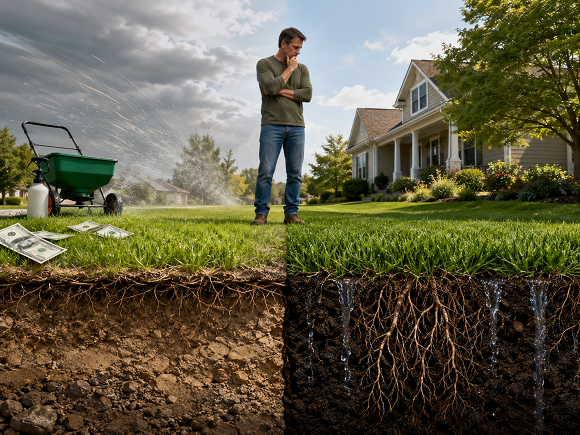
A struggling lawn is usually not suffering from a lack of cosmetic tricks. It is usually suffering from dysfunction. The soil is tight. Water is running off instead of soaking in. The biology is weak. Humus is low. Nutrients may be present, but they are not flowing into the plant efficiently. The lawn is living in a constant state of headwind.
That headwind is expensive.
It means you water more, fertilize more, fight more weeds, battle more disease, experience more stress, and keep reaching for another product to force the lawn to do something it no longer has the natural ability to do on its own.
That is where many customers get stuck.
They are not necessarily unwilling to have a better lawn. They are unwilling to go through the process required to build one.
They want the outcome of healthy soil without the patience required to heal the soil.
And that expectation can actually hinder real progress.
When we use synthetic or quick-fix methods to force a response, we can often create color. But color is not the same thing as health. A lawn can be green and still be dysfunctional. A lawn can look acceptable today while becoming more dependent, more expensive, and more fragile tomorrow.
That is the trap.
It feels like progress because something changed quickly. But in reality, you may have only covered up the evidence of the deeper problem.
A biological lawn program works differently.
We are not trying to bully the plant into a temporary response. We are trying to remove the obstacles that prevent the lawn from functioning properly in the first place.
That means improving soil structure.
That means increasing the soil’s ability to absorb and hold water.
That means rebuilding microbial activity.
That means improving nutrient cycling.
That means creating an environment where the plant can access what it needs without constant artificial force.
This is not always instant. In fact, the most dysfunctional lawns often take the most patience.
And yes, that can be uncomfortable.
There may be a period where the lawn is healing beneath the surface before the homeowner sees the full visual reward above the surface. There may be a season where the most important progress is happening in the soil, not in the color. There may be moments where a customer has to resist the urge to panic, compare their lawn to the neighbor’s chemically propped-up lawn, and reach for the fastest possible answer.
But that patience is not wasted.
It is the difference between continuing to push against headwind forever and finally turning the lawn into something that works with you instead of against you.
Once the soil begins to function, a whole new world opens up.
Water goes farther. Nutrients move better. Roots perform better. Stress tolerance improves. Weeds become less dominant. The lawn becomes more resilient. The cost of ownership begins to drop. The homeowner is no longer constantly reacting, rescuing, correcting, and apologizing for the lawn.
That is real progress.
Not the kind that disappears when the product wears off.
The kind that compounds.
And that is the part many people miss. They think patience means waiting around while nothing happens. But in a biological system, patience is not inactivity. Patience is allowing the right processes to establish themselves so the lawn can become less dependent on outside force.
It is very similar to health.
If someone is unhealthy, they can chase stimulants, suppress symptoms, and look for fast relief. Or they can do the harder work of changing the system that created the problem. One path gives temporary comfort. The other creates transformation.
Lawns are no different.
If your lawn is struggling, the answer is not always more product. Sometimes the answer is a better understanding of what is broken.
That may not satisfy the customer who wants instant gratification. It may not appeal to someone who only wants to keep up appearances for the neighbors. It may not be the right fit for someone who believes every problem should be solved in seven days.
But for the homeowner who wants the truth, the opportunity is enormous.
You can stop wasting money fighting symptoms.
You can stop trying to force performance out of a system that is broken.
You can stop living under the constant pressure of the lawn needing more water, more fertilizer, more chemicals, more repairs, and more excuses.
You can fix the headwind.
And when you do, the lawn begins to change in a way that is much more meaningful than temporary green color.
It becomes functional.
That is the goal.
Not a lawn that looks good for a few weeks because we forced it to respond.
A lawn that becomes healthier, stronger, more efficient, and more enjoyable because the soil underneath it has been restored.
So yes, customer expectations matter.
And sometimes the wrong expectation can stand directly in the way of the very result the customer claims to want.
If the expectation is instant perfection, the process will feel frustrating.
But if the expectation is real progress, real healing, and long-term efficiency, then the biological path begins to make perfect sense.
Because the goal is not to create a lawn that is addicted to rescue.
The goal is to build a lawn that can finally begin to take care of itself.
Engage with us: