
Last Updated on April 24, 2026 by Brian Beck
The mower and the microbes are trying to solve the same problem.
Most people think mowing and soil health are two completely separate subjects.
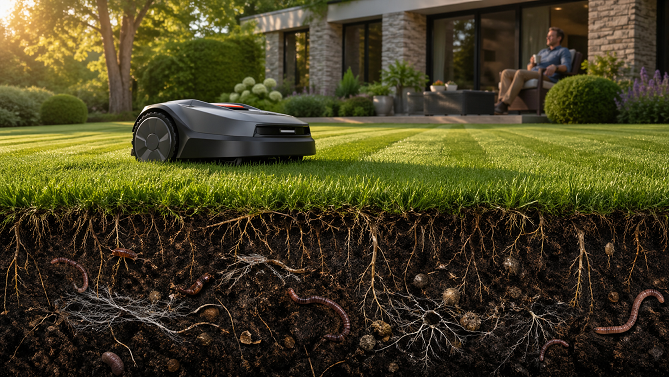
Mowing is what happens above ground. Soil biology is what happens below ground. One is mechanical. The other is microbial. One involves blades, motors, schedules, and maybe a little cussing when the mower will not start. The other involves fungi, bacteria, carbon, humus, roots, minerals, and the invisible workforce living under your feet.
But here is the truth: robotic mowing and biological soil care belong together because they are both trying to move your lawn away from chaos and toward consistency.
And consistency is where the magic happens.
Not the fairy-dust kind of magic. The measurable kind. The kind where the lawn uses less water, handles stress better, grows more evenly, produces fewer weeds, recycles its own nutrients, and stops acting like a spoiled toddler every time the weather changes.
Traditional lawn care has trained people to think in events.
Spring fertilizer event.
Aeration event.
Weed control event.
Emergency watering event.
Disease control event.
Panic-before-the-Fourth-of-July event.
That is not a system. That is a series of rescue missions.
A truly healthy lawn does not need to be rescued all the time. It needs to be supported consistently. That is where robotic mowing and soil biology begin to work like partners.
The old mowing model is rougher than people realize
Most homeowners do not think much about mowing beyond one question: “Does the lawn look cut?”
Fair enough. That is what we were all taught to look for.
But the way a lawn is mowed has a major impact on plant stress, water demand, root behavior, photosynthesis, disease pressure, and nutrient cycling.
The traditional mowing model usually looks like this:
The grass grows too tall.
Then it gets cut hard.
Then it gets stressed.
Then it tries to recover.
Then it grows too tall again.
Then the whole cycle repeats.
This is not gentle lawn care. This is more like letting your hair grow wild and then getting attacked by a blindfolded barber with hedge trimmers.
The plant does not experience that as “maintenance.” It experiences it as stress.
When too much leaf tissue is removed at once, the grass plant loses photosynthetic capacity. Translation: it loses solar panels. And when a plant loses solar panels, it has less ability to make sugar. Less sugar means less energy for roots, microbes, recovery, density, and resilience.
A lawn that is constantly being scalped, shocked, or inconsistently cut becomes more dependent. It needs more water, more fertilizer, more intervention, and more forgiveness.
Unfortunately, most lawns are not getting forgiveness. They are getting another bag of synthetic fertilizer and a lecture about why they should look better.
Robotic mowing changes the rhythm
Robotic mowing works differently because it changes mowing from an occasional violent event into a gentle, ongoing rhythm.
Instead of removing a large amount of grass blade once a week or every ten days, a robotic mower removes tiny amounts more frequently. That matters.
Small, frequent cuts are easier on the plant. The lawn maintains more leaf surface, continues photosynthesizing, and avoids the stress response that comes from being chopped down too aggressively.
The result is not just a lawn that looks more consistently maintained. It is a lawn that is biologically positioned to function better.
And the clippings matter too.
With traditional mowing, clippings can become long, heavy, clumpy, and difficult to break down. They sit on top of the lawn, smother areas, contribute to mess, and sometimes make homeowners think all clippings are bad.
They are not.
Small clippings from frequent robotic mowing are different. They are tiny pieces of organic material that can return carbon and nutrients back into the system. In a biologically active lawn, those clippings become food. They are not waste. They are a contribution.
That is the key phrase: in a biologically active lawn.
Because robotic mowing is not a miracle by itself.
If the soil is compacted, low in humus, biologically weak, mineral imbalanced, and struggling to move air and water, then even the best mowing system is still working on top of dysfunction.
The mower can improve the rhythm. But the soil has to handle the recycling.
Biology turns mowing residue into value
Here is where the underground workforce comes in.
A healthy soil system is supposed to digest organic material. Grass clippings, dead roots, old leaves, thatch, and other plant residues are not supposed to sit there forever like unpaid invoices. They are supposed to be broken down, transformed, and cycled back into the soil.
That process requires biology.
Bacteria, fungi, protozoa, nematodes, earthworms, and other soil organisms all play roles in decomposition, nutrient cycling, soil aggregation, and carbon movement. When that biology is active, the lawn becomes less wasteful.
The plant grows.
The mower trims.
The clippings return.
The microbes digest.
The soil stores and cycles.
The roots feed the microbes.
The microbes help feed the plant.
That is a system.
Compare that with the traditional synthetic model:
The plant is pushed.
The lawn grows fast.
The mower removes a bunch.
The soil biology is weak.
The clippings and thatch do not cycle efficiently.
The homeowner sees problems.
More products are applied.
The dependency continues.
That is not a system. That is a hamster wheel with fertilizer on it.
Robotic mowing and soil biology help break that cycle because they support the lawn in smaller, steadier, more natural increments.
A biological lawn wants steady inputs, not drama
The soil does not improve because we occasionally attack it with big dramatic interventions. It improves when the conditions for life are created and maintained.
That means better water infiltration.
Better oxygen movement.
Better calcium and magnesium balance.
Better humus development.
Better microbial activity.
Better root exudation.
Better carbon cycling.
Better mowing behavior.
Notice that mowing behavior is part of the biological picture.
Why? Because the grass plant is the solar engine of the lawn. It captures sunlight and turns it into sugar. Some of that sugar supports the plant, and some of it goes through the roots to feed soil microbes.
When the lawn is mowed correctly, the plant is better able to keep photosynthesizing and feeding the underground system. When the lawn is mowed poorly, the plant goes into recovery mode and the whole system suffers.
This is why robotic mowing makes so much sense with a biological soil program. It supports the plant’s natural rhythm instead of constantly interrupting it.
The lawn gets calmer
A lawn under stress is loud.
Not literally, of course. If your lawn is yelling at you, that is a different issue and we should probably talk.
But a stressed lawn communicates loudly through symptoms.
It wilts quickly.
It gets patchy.
It grows unevenly.
It gets weeds.
It develops disease.
It needs constant water.
It browns out too fast.
It greens up late.
It checks out early in the fall.
A biologically managed lawn with robotic mowing becomes calmer because the stress load is lower.
The mower is not shocking the plant.
The clippings are returning in a usable form.
The microbes are being fed.
The soil is being supported.
The roots are encouraged to function.
The system begins to stabilize.
That does not mean nothing ever goes wrong. This is still nature, not a plastic carpet. But it does mean the lawn becomes less reactive and more resilient.
And resilience is what most homeowners actually want, even if they do not use that word.
They say they want a green lawn.
What they really want is a lawn that does not embarrass them.
They want a lawn that does not bankrupt them through the water bill.
They want a lawn that does not require panic.
They want a lawn that looks good without feeling like a second job.
They want a lawn that can handle Colorado being Colorado.
That requires function, not just color.
Robotic mowing also supports density
One of the most overlooked benefits of frequent mowing is turf density.
When grass is cut consistently and gently, it can respond by growing more laterally and thickening over time. A denser lawn shades the soil, reduces open space for weeds, protects moisture, and creates a more uniform surface.
That is a big deal.
Nature hates bare soil. If your lawn leaves open space, nature will fill it. Usually with something you did not invite and now have to pretend you are not mad about.
A dense lawn is one of the best forms of weed prevention. Not because it poisons weeds, but because it gives them fewer opportunities.
This is another reason robotic mowing and biology pair well together. Robotic mowing encourages consistency and density above ground. Soil biology supports root function, nutrient cycling, and structure below ground.
Together, they help the lawn occupy its space more completely.
This is not about gadgets. It is about a better system.
Some people look at robotic mowing and think it is just a convenience tool.
And yes, it is convenient. Not having to spend your weekend dragging a mower around in the heat while questioning your life choices is a very real benefit.
But robotic mowing is bigger than convenience.
It is part of a shift away from outdated, input-heavy lawn care and toward systems-based management.
The old model asks, “What can we apply to make the lawn respond?”
The better question is, “What conditions does the lawn need so it can function?”
That is the heart of biological lawn care. It is not about doing nothing. It is about doing the right things in the right direction so the lawn becomes less dependent over time.
Robotic mowing fits that philosophy because it reduces stress, returns organic material, supports consistency, and allows the lawn to operate in a more natural rhythm.
In other words, the mower and the microbes are not separate. They are teammates.
One manages the top.
The other manages the bottom.
The grass plant connects them both.
A living lawn should not be managed like a carpet
This may be the biggest mindset shift of all.
A lawn is not carpet. It is not paint. It is not a green appliance sitting in front of the house.
It is a living system.
And living systems respond best to rhythm, balance, and relationship.
When we treat a lawn like carpet, we obsess over appearance and ignore function. We force color, overwater, mow inconsistently, spray symptoms, and wonder why the lawn never becomes easier to manage.
When we treat a lawn like a living system, we start asking better questions.
Is water getting into the soil?
Is the soil holding that water?
Are the roots deep enough?
Is biology active?
Are nutrients available or locked up?
Is the mowing helping or hurting?
Is the lawn becoming more independent or more dependent?
Those questions lead to better lawns.
Not just greener lawns. Better lawns.
Lawns that are stronger, cooler, denser, more efficient, more resilient, and less expensive to own.
The future of lawn care is not more panic
The future of lawn care is not more fertilizer, more watering, more chemicals, more noise, more labor, and more weekend frustration.
The future is smarter.
It is automation above ground and biology below ground.
It is robotic mowing paired with soil correction.
It is clippings being recycled instead of wasted.
It is roots working with microbes instead of depending on synthetic rescue.
It is a lawn that becomes easier to manage because the system itself is improving.
That is the real opportunity.
Not just a lawn that looks good for a few weeks after being pushed.
A lawn that functions better because the entire system is being supported.
Robotic mowing and soil biology belong together because they both move the lawn in the same direction: away from dependency, away from chaos, and toward a calmer, healthier, lower-cost way to maintain turf.
And frankly, your lawn would probably appreciate it.
It has been through enough.
Call to Action
If your lawn feels like it needs constant mowing, watering, fertilizing, spraying, and rescuing, the problem may not be that you are doing too little.
You may be stuck in the wrong system.
At Blade to Blade, we help homeowners move toward a smarter lawn care model by combining robotic mowing, biological soil care, and practical turf management that reduces stress on the lawn and on the homeowner.
A better lawn is not built through panic.
It is built through rhythm, biology, and consistency.
Engage with us: