
Last Updated on April 21, 2026 by Brian Beck
What the synthetic fertilizer market is teaching us about lawn care, and how to break free
If you want to understand what is wrong with the modern lawn-care model, look at agriculture.
When global fertilizer supply gets tight, energy costs rise, or trade routes get disrupted, agriculture feels it almost immediately. That is happening again right now. Recent reporting shows renewed disruption in global fertilizer markets, with nitrogen prices under pressure and U.S. officials treating fertilizer access as a serious enough issue to push for international coordination. USDA’s April 17, 2026 distributor report also showed elevated wholesale prices for major fertilizer products such as urea, DAP, potash, and liquid nitrogen.
Most homeowners do not think this has anything to do with them.
It does.
Because the average homeowner has been trained into the very same dependency model on a smaller scale.
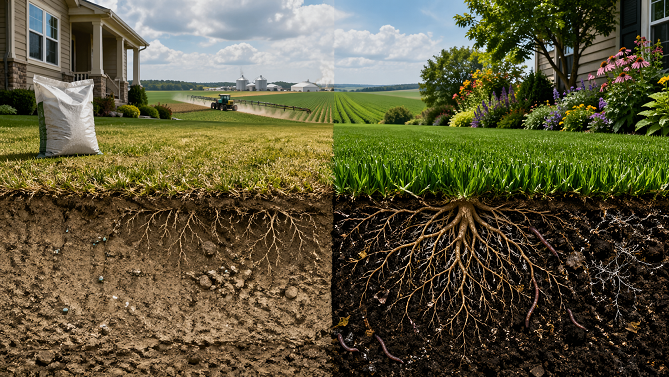
Every spring, the lawn wakes up weak, hungry, shallow-rooted, and unable to function on its own. So the homeowner goes to the store, buys a bag of synthetic fertilizer, throws it down, gets a quick green-up, and thinks the problem has been solved. It has not been solved. It has been temporarily stimulated.
That is not lawn health. That is lawn dependency.
And the lesson from agriculture is simple: any system that must be rescued over and over again by imported inputs is not a strong system. It is a fragile system.
The synthetic lawn is a dependent lawn
Synthetic fertilizer is attractive because it is fast. It gives the appearance of control. It can force color. It can push top growth. It can make a lawn look better for a short window.
But that speed comes with a price.
The more a lawn is driven by synthetic inputs, the more the homeowner becomes tied to a cycle of buying, applying, watering, correcting, mowing, and repeating. The grass may look green, but the soil underneath is often biologically weak, carbon-poor, poorly buffered, and unable to regulate moisture or cycle nutrients efficiently.
That means the homeowner is not managing a living system.
They are managing a dependency.
And when fertilizer prices rise, product availability tightens, or regulations become stricter, the weakness of that model becomes obvious.
The trap is bigger than the bag of fertilizer
The trap is not just cost at checkout.
It is the entire chain reaction that comes with a synthetic-first lawn:
More forced growth.
More mowing.
More irrigation mistakes.
More nutrient loss.
More thatch pressure.
More disease pressure in weak, overstimulated turf.
More frustration every spring when the lawn does not “wake up” the way people hoped.
EPA guidance for homeowners is already moving in the opposite direction of the old habit: apply fertilizer only when necessary, use the recommended amount, do not apply before rain or wind, and avoid fertilizer movement into waterways. EPA also notes that residential over-fertilizing and overwatering can become a meaningful source of nutrient pollution.
In other words, even the mainstream message is telling people to stop treating fertilizer like a reflex.
Here is the part most homeowners have never been told
A lawn is supposed to function through the relationship between soil, roots, microbes, water, and minerals.
It is not supposed to live hand-to-mouth off the next bag of synthetic nitrogen.
That is the great misunderstanding.
The goal should not be to keep forcing the plant from the outside.
The goal should be to restore the soil so the system can begin working from the inside.
That is what a biological approach does.
A biological system is not about abandoning nutrients. It is about putting nutrients back into a functioning context.
It means building humus.
It means increasing microbial activity.
It means improving soil structure.
It means increasing infiltration.
It means holding moisture longer.
It means helping roots go deeper.
It means reducing the lawn’s dependence on emergency feeding and constant correction.
That is not hype. That is what liberation looks like in a lawn.
The biological system offers something synthetic programs never can
Synthetic programs sell response.
Biological systems build resilience.
That distinction matters.
Response is temporary.
Resilience compounds.
A synthetic system says, “Your lawn needs me again.”
A biological system says, “Let’s build the soil until this lawn can do more for itself.”
That is why the biological path is so important for homeowners. It moves the lawn away from panic and toward function. It lowers the emotional temperature. It reduces the spring frenzy. It replaces constant reaction with steady correction and natural performance.
And over time, that can mean lower water use, less volatility, fewer dramatic swings, and less dependence on outside rescue.
This matters even more in Colorado
For homeowners here, this lesson is especially important.
Colorado State University notes that many established Colorado lawns already have adequate phosphorus and potassium, meaning homeowners often apply more of those nutrients than the lawn actually needs when they buy a typical blended fertilizer. CSU also warns that overfertilization can increase mowing requirements and thatch.
So not only can the synthetic model create dependency, it can also cause homeowners to spend money on nutrients that were not even the main problem in the first place.
That is the insanity of the paradigm.
People are buying inputs for symptoms they never properly diagnosed, while the real issue underneath is often poor soil function.
The real goal is not greener grass next week
The real goal is a lawn that becomes more stable, more efficient, and more self-managing over time.
A lawn that infiltrates water better.
A lawn that carries moisture longer.
A lawn that resists stress better.
A lawn that does not need to be shocked into color every few weeks.
A lawn that starts to participate in its own health instead of collapsing without intervention.
That is the difference between dependency and freedom.
Agriculture is showing us, in real time, what happens when a system becomes too reliant on outside fertilizer inputs. Homeowners would be wise to pay attention.
Because the same lesson applies in the front yard.
If your lawn only looks good when you force it, you do not own a healthy lawn.
You own a dependent one.
The way out
The way out is not more panic.
The way out is not chasing the next sale on fertilizer.
The way out is not throwing more product at a weak system.
The way out is to rebuild the soil so the lawn can begin to function the way nature intended.
That means testing.
That means correcting imbalances.
That means feeding biology, not just pushing the plant.
That means valuing water retention, infiltration, carbon, structure, and root depth as much as color.
That means stepping out of the synthetic trap and into a biological framework that creates real stability.
That is where lawn liberation begins.
CTA
If you are tired of the yearly lawn drama, tired of paying for short-term results, and tired of managing a system that always seems to need another rescue, there is a better way.
We help homeowners move out of the synthetic fertilizer trap and into a biological system that builds healthier soil, stronger turf, lower dependency, and a more self-sustaining lawn over time.
Stop forcing the lawn.
Start fixing the system.
Engage with us: