
Last Updated on September 28, 2025 by Brian Beck
From time to time, we’re asked a fair question:
“If you know there are soil problems, why wouldn’t you automatically address them with your basic program?”
It’s a question worth answering — not because there’s anything wrong with our basic soil program, but because it highlights a common misunderstanding of what lawns actually need and how soil dysfunction must be approached.
What the Basic Program Is Designed For
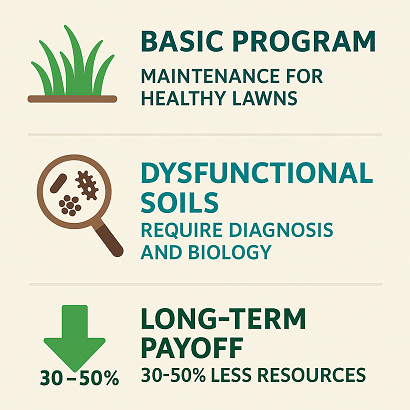
Our basic soil program is built to meet the fundamental needs of a lawn that is already in good shape. That phrase — good shape — is key. When the soil has balance, structure, and a reasonable level of microbial activity, the basic program maintains health and keeps things moving in the right direction.
It’s not meant to be a cure for serious underlying dysfunctions.
Think of it like a balanced lunch: it will sustain someone who is already healthy, but it won’t rescue a starving man whose body is depleted. Expecting a basic meal to lift someone out of malnutrition is unrealistic. In the same way, expecting a maintenance-level program to repair dysfunctional soils is equally unrealistic.
What Over 200 Soil Tests Have Shown Us
After conducting more than 200 soil tests locally, we’ve discovered that the problems in our soils far outweigh what any “basic” program can provide.
-
Compaction, poor humus levels, and low microbial counts are common.
-
Excesses and deficiencies in minerals create nutrient antagonisms that prevent plants from using what’s already there.
-
Biology — the invisible workforce of microbes — is weak or missing.
In short, the dysfunction is microscopic and hidden, and without testing, it cannot be seen.
This is why soil testing is non-negotiable. Just as a doctor wouldn’t prescribe chemotherapy for a headache, we can’t prescribe solutions without first diagnosing the real problems.
Why We Don’t “Fertilize Our Way Out”
One of the biggest misconceptions comes from decades of programming by synthetic fertilizer companies. We’ve been conditioned to believe that problems can be solved by dumping more fertilizer on the lawn. But biology doesn’t work that way.
-
Synthetic nitrogen may make grass green temporarily, but it masks dysfunction rather than solving it.
-
Soil biology and humus formation are the true long-term solutions. These can’t be replaced with a quick chemical fix.
Our approach is different: we treat each soil as an individual. We look at its specific imbalances, deficiencies, and biological weaknesses. Then we build it out of dysfunction step by step, until it can sustain itself naturally.
The Real Benefits of Fixing Soil Problems
Once you recognize the true problem — and commit to solving it biologically — the payoff is significant.
-
Lawns that use 30–50% less water and fertilizer.
-
Turf that stays greener longer and weathers stress better.
-
A system that becomes more efficient over time rather than more dependent on external inputs.
This is the difference between a lawn that merely looks good for a season and a lawn that functions as a healthy, living engine for decades.
The Bottom Line
There is nothing “wrong” with our basic soil program — it simply isn’t designed to cure dysfunction. It’s a maintenance plan for healthy lawns.
When deeper issues exist, we must go beyond maintenance. We must test, diagnose, and apply biology and humus to rebuild the soil’s foundation. Only then can we move from dysfunction to efficiency — and only then can we enjoy the long-term benefits of a lawn that thrives while using fewer resources.
Read more here: