
Last Updated on January 27, 2026 by Brian Beck
Most homeowners think lawn care costs are the check they write.
The monthly mow bill.
The fertilizer plan.
Maybe a sprinkler tune-up.
But that’s not the real number.
The real number is cost of ownership—everything you pay in money, time, stress, rework, water waste, and “why is it still not good?” cycles.
And here’s the part nobody wants to admit:
Traditional lawn care isn’t expensive because it’s thorough.
It’s expensive because it’s inefficient.
Trinity exists to fix that.
Not by doing more…
but by removing the friction that forces you to keep paying forever.
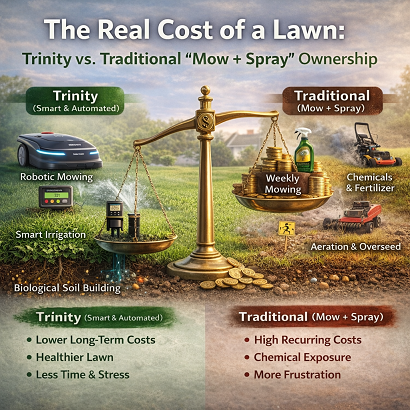
Traditional lawn care sells “tasks.” Trinity sells “outcomes.”
Traditional services are built around tasks:
-
mow once per week
-
spray on a route
-
react when things go wrong
The problem is the task model doesn’t address the system constraints that cause problems in the first place—especially in Colorado: tight soil, moisture volatility, compaction, high pH lockout, shallow roots, and canopy stress.
Trinity is a system:
-
Robotic micro-mowing (consistent density, low stress, clippings returned)
-
Smart irrigation strategy (manage moisture, not a calendar)
-
Biological soil building (structure, nutrient flow, lower long-term inputs)
When those three work together, the lawn stops being needy.
The hidden cost categories most people forget
1) Water waste (the biggest silent bill)
Traditional timer watering creates volatility:
-
too wet windows (disease + shallow rooting)
-
too dry windows (stress + weeds + brown-out)
-
runoff (your money flowing into the street)
Trinity reduces water waste by:
-
improving infiltration and storage (soil function)
-
reducing evaporation (dense canopy)
-
targeting stable moisture ranges (setpoints)
Ownership difference: water becomes a controlled input instead of a gamble.
2) “Rescue” spending (the annual surprise tax)
Traditional lawns have a predictable rhythm:
-
spring green-up, optimism
-
summer stress, brown patches, weeds
-
fall panic: aerate, overseed, fertilizer, “fix it”
That cycle is where the real money leaks:
-
overseed and topdress
-
patch repair
-
disease treatments
-
extra mow visits
-
new products bought in desperation
Trinity reduces rescues because the system stays stable:
-
less scalping stress
-
less moisture shock
-
stronger rooting behavior
-
improved nutrient cycling
Ownership difference: fewer emergencies means fewer surprise bills.
3) Fertilizer and chemical dependency
When soil biology is weak and moisture swings are constant, plants can’t access what’s already present.
So the default solution becomes: apply more stuff.
But input-heavy lawns are like dependent patients:
-
more fertilizer → more growth volatility
-
more growth volatility → more mowing stress
-
more stress → more weeds/disease
-
more weeds/disease → more chemicals
-
and you’re trapped in a treadmill
Trinity targets independence:
-
biology improves nutrient flow
-
consistent mowing reduces stress
-
moisture management stabilizes uptake
Ownership difference: inputs trend down over time instead of up.
4) Time and lifestyle cost (the “weekend tax”)
Traditional ownership includes:
-
listening for the crew
-
moving toys, hoses, chairs
-
rechecking gates
-
dealing with scalps and clumps
-
scheduling around service windows
Robotic mowing flips this:
-
quiet, consistent, no weekly disruption
-
lawn looks “fresh cut” constantly
-
fewer conflicts with your life
Ownership difference: you don’t just buy a better lawn—you buy back time.
5) Equipment and maintenance
Even if you outsource mowing, traditional systems still come with:
-
mower upkeep (if DIY)
-
gas cans
-
blower/trimmer chaos
-
sprinkler head fixes caused by traffic and compaction
-
soil that gets tighter every year
Trinity reduces the mechanical beatdown:
-
less heavy traffic on turf
-
less soil sealing over time (with correction + biology)
-
fewer stress-driven irrigation adjustments
Ownership difference: fewer wear-and-tear costs and fewer “something broke again” moments.
6) Toxic exposure and “feel” cost
Most people don’t price this in, but they feel it:
-
chemical smell
-
pet/kid concerns
-
uncertainty about what’s being applied
-
the nagging sense that the lawn is “managed,” not healthy
Trinity’s promise is simple:
lower ownership cost and lower toxic exposure—because the system relies less on constant chemical correction and more on soil function and stability.
Personal-dna
A simple example: how costs actually stack up
Let’s use an illustrative (not universal) scenario: a typical front/back lawn where the homeowner wants “nice” but keeps getting stuck in the cycle.
Traditional “Mow + Spray” ownership often includes:
-
weekly mow payments (or your time + equipment)
-
fertilizer plan
-
weed control
-
extra watering to keep it alive in heat
-
annual aeration/overseed
-
periodic disease/insect rescues
-
repairs from thin turf (patching, sodding, etc.)
Trinity ownership shifts the spend:
-
robotic mowing subscription/service or managed system
-
moisture strategy (often with smarter control and calibration)
-
biological soil building to increase function
-
fewer rescues, less volatility, reduced long-term inputs
The point isn’t that Trinity costs “nothing.”
The point is the money moves from recurring dysfunction to building a stable system.
That’s why Trinity wins on cost-of-ownership: it reduces the need for constant correction.
The bottom line: the cheapest lawn is the one that stops needing you
A healthy lawn is not one you constantly “support.”
A healthy lawn is one that:
-
infiltrates water
-
holds moisture
-
cycles nutrients
-
grows consistently
-
stays dense
-
resists weeds
-
and doesn’t punish you for missing a week
That’s not luck. That’s design.
Call to action
If you want a real cost-of-ownership breakdown for your property, we’ll map it quickly:
-
what you’re currently spending (including hidden costs)
-
your biggest constraint (soil, water, mowing stress, or all three)
-
the most efficient Trinity path to get off the treadmill
Because the goal isn’t to “have a lawn service.”
The goal is to own a lawn that costs less to own—year after year—while looking better and requiring less drama.
Personal-dna