
Last Updated on January 21, 2026 by Brian Beck
There’s a specific kind of frustration that shows up in my business again and again.
It’s not the hard lawns.
It’s not the ugly soil reports.
It’s not even the customers who’ve been sold the same synthetic routine for 10 years straight.
It’s this:
People want a biological result… but they keep measuring it with a synthetic yardstick.
And that mismatch—between expectations and reality—is where most “failures” are born.
The synthetic system trains your brain (and it’s not your fault)
Synthetic lawn care is basically an instant-gratification machine.
You throw something down.
You get a quick flush.
Color pops.
Everyone high-fives.
Then the lawn crashes, the soil degrades a little more, and you’re told the solution is… another bag.
So customers understandably learn to expect:
-
fast green-up = “health”
-
more product = more improvement
-
watering whenever = “good enough”
-
results on a calendar = “normal”
That’s what the synthetic industry sells: a timeline.
Not a system.
Biology doesn’t care about your timetable
Here’s the part that annoys people (and honestly, sometimes annoys me when I’m trying to explain it clearly):
Biology runs on sequence, not speed.
If your soil is already weak—and most soils around here are—your lawn isn’t starting from neutral. It’s starting from debt.
And when you combine:
-
synthetic expectations
-
already-poor soil
-
bad hydration habits (feast-or-famine watering, guessing, shallow sprinkling, overwatering at the wrong time)
…you can get a lawn that appears to “not respond.”
But the truth is usually simpler:
The program didn’t fail. The foundation was never built.
The lawn is the last thing to change
This is the part I wish everyone understood before they spend another dollar chasing green:
The lawn is a reflection.
A report card.
A symptom.
The biological program is about building what the lawn has been missing the whole time:
-
a functioning microbial workforce
-
carbon and energy reserves in the soil
-
structure that lets air and water move correctly
-
nutrient flow that doesn’t require constant emergency inputs
You don’t “force” that in two weeks.
You earn it through steps.
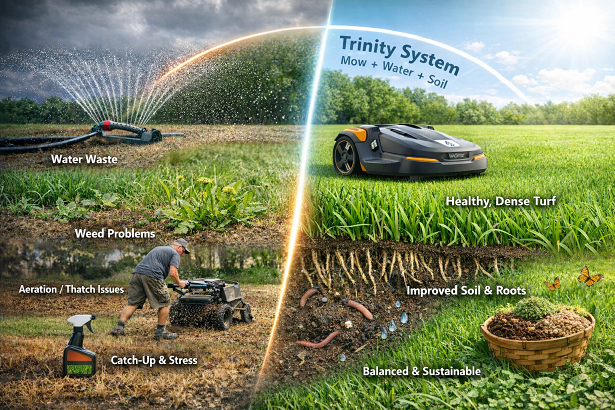
Bad watering habits can sabotage a good program
This one is huge, and it’s where well-intentioned homeowners accidentally kneecap the whole process.
If the soil is kept too dry, biology goes dormant.
If the soil is saturated constantly, oxygen drops and biology suffers.
If watering is inconsistent, roots stay shallow and the lawn remains fragile.
So the customer says, “The biology didn’t work.”
But what actually happened is the soil never had stable conditions to run the biological engine.
You can’t build a high-functioning lawn on a hydration rollercoaster.
What success actually looks like in a biological system
The irony is that biology gives you better results than synthetics… but it doesn’t always look flashy at first.
Early wins often look like:
-
water soaking in better
-
less runoff
-
soil that’s easier to probe
-
a lawn that stops panicking as quickly when weather swings
Then comes:
-
deeper rooting
-
fewer weeds taking advantage of weakness
-
more consistent color without constant “hits”
-
resilience you can actually feel under your feet
That is real progress.
Not “neon green for ten days.”
The rule I wish every customer would adopt
If I could tattoo one idea onto every lawn owner’s brain, it would be this:
Stop asking, “How fast will I see results?”
Start asking, “What step are we on?”
Because the biological program isn’t a product. It’s a process.
And if you follow the steps—soil correction, microbial support, proper hydration, consistency—you stop gambling on temporary outcomes and start building something permanent:
An efficient soil that produces a high-functioning lawn.
My invitation (and my challenge)
If you want synthetic speed, I can’t help you.
Because I’m not interested in selling you the same cycle that caused the problem.
But if you want a lawn that becomes easier every season—less needy, less fragile, less expensive to maintain—then lean in.
Follow the steps.
Get your watering under control.
Let biology do what it’s designed to do.
The soil always tells the truth.
And if you build it right, the lawn will eventually have no choice but to show it.
—
Brian Beck — building a smarter lawn system through biology, automation, and efficiency.