
Last Updated on August 15, 2025 by Brian Beck
We’ve all seen it before: someone wants a greener lawn, healthier turf, better yields—fast. They hear about a “miracle” treatment or a “one and done” application and think they’ve found the holy grail. This is the green pill of lawn care: the seductive but dangerous belief that you can shortcut nature’s timeline and still get lasting results.
In this case, the green pill isn’t just the promise of speed—it’s the ignorance of how a biological soil program actually works. It’s the idea that there’s some magic bag of fertilizer, some secret spray, that can replace a living, balanced soil system.
How We Got Hooked on the Green Pill
Our lawn and landscape culture has been built on decades of advertising that equates instant color with real health. Synthetic fertilizers and pesticides have been marketed as cures rather than temporary crutches. The result? We’ve been trained to think if it’s not immediate, it’s a failure.
This impatience skips right over the fundamentals: soil biology takes time to establish. Microbes need to cycle nutrients. Fungal networks need to knit together. Organic matter needs to accumulate. But when people ignore this and demand quick results, they settle for chemical “green-ups” that are nothing more than green paint on a rusting car.
The Cost of Green-Pill Thinking in Soil
When you avoid a biological approach because it “takes too long,” you get:
-
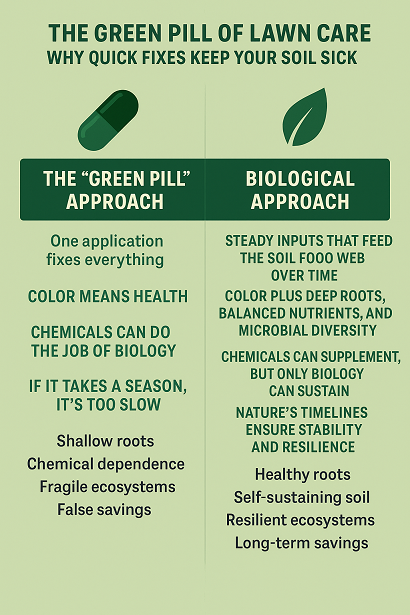
Shallow roots – Synthetic surges push top growth at the expense of root development, making turf vulnerable to drought and heat.
-
Chemical dependence – The lawn needs repeated doses to stay alive because the soil food web is missing.
-
Fragile ecosystems – Without microbes, organic matter, and structure, the soil can’t regulate water or resist pests on its own.
-
False savings – You save a little now, but end up spending more on constant inputs, irrigation, and repairs.
It’s the same as building a house on sand. It might look fine on day one, but the first heavy rain or drought will test the foundation—and it will fail.
What the Green Pill Promises vs. What Soil Really Needs
| Green Pill Promise | Reality That Works |
|---|---|
| “One application fixes everything” | Steady inputs that feed the soil food web over time |
| “Color means health” | Color plus deep roots, balanced nutrients, and microbial diversity |
| “Chemicals can do the job of biology” | Chemicals can supplement, but only biology can sustain |
| “If it takes a season, it’s too slow” | Nature’s timelines ensure stability and resilience |
The Parasite That Feeds on Impatience
The chemical green-pill industry thrives on this impatience. They sell you relief, not repair. And because the lawn never becomes self-sustaining, you keep buying, season after season. They profit from dysfunction while your soil gets weaker.
Choosing the Bulletproof Alternative
A biological program isn’t flashy, but it works—permanently.
-
Start with a soil test. Know what’s missing in both chemistry and biology.
-
Feed the microbes. Compost teas, humic acids, and balanced carbon/nitrogen inputs give life a foothold.
-
Reduce chemical stress. Every synthetic input has a cost to biology—use only when necessary.
-
Be patient. Real transformation takes seasons, not weeks. But once the soil is alive, it will hold nutrients, store water, and fight disease naturally.
With a little patience, you can build a soil ecosystem that doesn’t flinch in summer heat, doesn’t collapse under heavy rain, and costs far less to maintain long term.
The Bottom Line
The green pill is a lie dressed up in a bright bag or slick sales pitch. Don’t confuse a quick green-up with a healthy lawn. Skip the shortcuts, feed the soil, and give biology time to work. What you’ll end up with is more than color—it’s a living, bulletproof system that serves you for years instead of months.