
Last Updated on May 31, 2026 by Brian Beck
One of the most common arguments in lawn care, agriculture, and even golf course management is this:
“Nitrogen is nitrogen. The plant doesn’t know the difference.”
At first, that sounds logical.
After all, nitrogen is an element. Grass needs nitrogen. Fertilizer supplies nitrogen. The lawn turns green. So, from that narrow perspective, it seems reasonable to say that synthetic nitrogen and organic nitrogen are basically the same thing.
But that argument is only partly true.
And the part it leaves out is the part that matters most if your goal is not just temporary green color, but long-term soil health, water efficiency, root strength, biological activity, and resilience.
The better statement would be this:
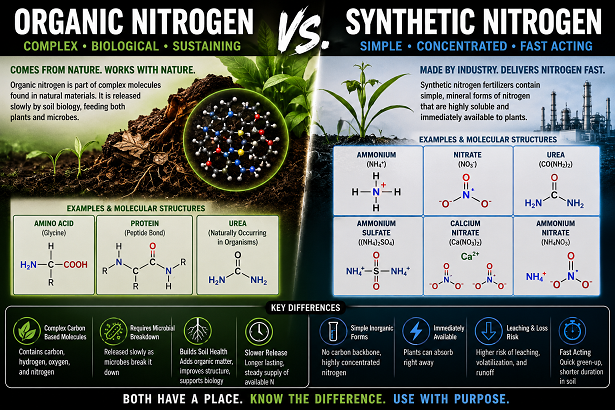
At the point of plant uptake, grass usually absorbs nitrogen primarily as nitrate or ammonium. But how that nitrogen gets there, what comes with it, how quickly it moves, what it does to the soil, and whether it supports or bypasses biology are very different questions.
That is where the “nitrogen is nitrogen” argument starts to fall apart.
The Vitamin C Example
A helpful way to understand this is to compare it to vitamin C.
A lot of people think vitamin C is simply ascorbic acid. But ascorbic acid is only one isolated component. In nature, vitamin C comes in a much more complex package with bioflavonoids, enzymes, minerals, cofactors, fiber, water, and other compounds that affect how the body receives and uses it.
So, is there vitamin C activity in ascorbic acid?
Yes.
But is isolated ascorbic acid the same thing as eating an orange, a kiwi, or another whole food source?
No.
That is the distinction.
Synthetic nitrogen is more like the isolated compound. It is concentrated, direct, fast, and designed to create a quick response.
Organic nitrogen is more like the whole food package. It is tied to carbon, proteins, amino acids, residues, composts, manures, meals, and biological materials that soil organisms must process. It does not just deliver a nutrient. It participates in a system.
That does not mean synthetic nitrogen cannot grow grass. Of course it can.
The question is whether it builds the soil system underneath the grass.
Where the “Nitrogen Is Nitrogen” Argument Is Correct
To be fair, the people making the “nitrogen is nitrogen” argument are not completely wrong.
Plants do not read fertilizer bags. Roots do not ask whether the nitrogen came from a factory, compost, feather meal, blood meal, manure, fish, urea, ammonium sulfate, or calcium nitrate.
Most plants take up nitrogen mainly in two mineral forms: nitrate and ammonium.
That means organic nitrogen usually has to be broken down by microbes before most of it becomes available to the plant. Synthetic fertilizers often arrive closer to the finish line because they are already in mineral form or quickly convert into mineral form.
So yes, when a nitrate ion reaches the root, the plant is not asking whether that nitrate came from a synthetic fertilizer or from organic matter that was mineralized by biology.
But that is not the whole story.
That is like saying the only thing that matters about food is the calorie.
Technically, your body can get calories from a candy bar or from a balanced meal. But nobody serious about health would argue that both create the same long-term result simply because both contain calories.
The source, the package, the timing, and the biological response matter.
The same is true in soil.
Synthetic Nitrogen: Fast, Direct, and Highly Controllable
Synthetic nitrogen is usually designed for speed and control.
That is its strength.
It can create a quick green-up. It can be applied at a precise rate. It can be timed for predictable response. In high-management systems, like golf courses, it can be used with a level of precision that creates very consistent results.
That is why synthetic nitrogen is so widely used.
But there is a tradeoff.
Highly soluble nitrogen can create sharp pulses of plant-available nitrogen. If the timing is off, if the soil is compacted, if the lawn is overwatered, if rain hits at the wrong time, or if the soil lacks the ability to hold and buffer nutrients, that nitrogen can move, volatilize, leach, burn, acidify, or push growth in ways that do not improve the soil.
It can feed the plant quickly while doing very little to improve the soil’s long-term ability to feed the plant.
That is the hidden weakness.
A lawn can get greener and still not become healthier.
A lawn can respond and still remain dependent.
A lawn can look improved while the soil underneath remains tight, low in humus, biologically weak, poorly buffered, inefficient with water, and vulnerable to stress.
That is why I do not judge a lawn simply by whether it got green after an application.
A response is not the same thing as recovery.
Organic Nitrogen: Slower, More Complex, and Biologically Connected
Organic nitrogen behaves differently because it is usually tied to carbon-containing materials.
That carbon matters.
Organic nitrogen may be found in proteins, amino acids, plant residues, manures, composts, fish products, feather meal, blood meal, biosolids, microbial biomass, and soil organic matter. Before most of that nitrogen becomes available to the plant, microbes have to process it.
That process is called mineralization.
In simple terms, soil biology breaks down organic material and gradually converts nitrogen into forms the plant can use.
This is the part that many conventional fertilizer arguments ignore.
Organic nitrogen does not just ask, “How do we get nitrogen into the plant as quickly as possible?”
It asks a bigger question:
“How do we strengthen the system that supplies nitrogen, stores nutrients, buffers water, supports roots, and builds resilience over time?”
That is a completely different philosophy.
Organic nitrogen can feed the plant, but it can also feed the soil biology that feeds the plant.
That is the difference.
The Soil Is Not Just a Delivery Medium
Traditional lawn care often treats soil like a place to hold roots while fertilizer does the real work.
That is a mistake.
Soil is not just a sponge, a container, or a platform.
Soil is a living system.
It contains minerals, air, water, organic matter, fungi, bacteria, protozoa, nematodes, roots, root exudates, insects, enzymes, and carbon compounds all interacting at the same time.
When that system is healthy, nutrients cycle better. Water infiltrates better. Roots explore deeper. Stress tolerance improves. Disease pressure can decline. Inputs become more efficient. The lawn starts to work with nature instead of constantly needing to be forced.
When that system is weak, the lawn becomes expensive.
It needs more water.
More fertilizer.
More weed control.
More disease control.
More correction.
More chasing.
More intervention.
That is what I call the headwind.
A lawn can be green and still be fighting a headwind.
Synthetic nitrogen can temporarily push the lawn forward, but it does not necessarily remove the headwind.
Organic nutrition, when used correctly inside a biological program, is aimed at reducing the headwind by improving the soil system itself.
Synthetic Nitrogen Can Create Green Without Building the Engine
One of the biggest problems with synthetic lawn care is that it can create the illusion of success.
The lawn greens up.
The customer is happy.
The company looks like it did its job.
But underneath the surface, very little may have changed.
The soil may still be compacted.
The humus level may still be low.
The microbial system may still be weak.
The roots may still be shallow.
The water demand may still be high.
The pH may still be creating nutrient availability problems.
The soil may still have poor structure.
That means the lawn has not been fixed.
It has been stimulated.
There is a big difference.
Stimulation is temporary.
Function is long-term.
Synthetic nitrogen is very good at stimulation.
Organic nutrition is much better suited to building function.
Organic Does Not Mean Magic
Now, this needs to be said carefully.
Organic nitrogen is not automatically perfect.
Not all organic sources behave the same way. Fresh manure is different from finished compost. Poultry litter is different from feather meal. Blood meal is different from yard-waste compost. Some organic materials release nitrogen quickly. Others release very slowly. Some can contain salts. Some can overload phosphorus. Some can even temporarily tie up nitrogen if the carbon-to-nitrogen ratio is too high.
So this is not a simplistic argument that says:
Synthetic bad. Organic good.
That is too shallow.
The real issue is purpose.
If the purpose is to force a fast color response, synthetic nitrogen can do that.
If the purpose is to build soil organic matter, increase biological activity, improve nutrient buffering, support soil structure, and move the lawn toward long-term efficiency, synthetic nitrogen alone is not enough.
A biological system needs carbon.
It needs microbial activity.
It needs organic matter.
It needs nutrient cycling.
It needs structure.
It needs air and water movement.
It needs roots that are not simply being pushed from above, but supported from below.
That is the larger picture.
Why This Matters for Home Lawns
Golf courses and commercial turf managers often make the “nitrogen is nitrogen” argument because they are managing turf under a very different model.
They may spoon-feed nutrients.
They may test constantly.
They may irrigate precisely.
They may have trained staff watching turf daily.
They may use growth regulators, fungicides, wetting agents, and highly controlled fertility programs.
That is not the same reality as a typical residential lawn.
Most home lawns are growing in disturbed soil. The original soil has often been scraped, compacted, graded, mixed with construction debris, stripped of organic matter, and then expected to perform like a natural ecosystem.
Then synthetic fertilizer is applied year after year, often without solving the underlying soil limitations.
That is why so many homeowners are stuck in the same cycle.
Green-up.
Fade.
Water more.
Fertilize again.
Fight weeds.
Treat disease.
Patch damage.
Repeat.
The lawn never becomes more efficient because the soil never becomes more functional.
That is the problem we are trying to solve.
The Better Way to Think About Nitrogen
Instead of asking, “Is nitrogen nitrogen?” we should ask better questions.
How quickly does this nitrogen become available?
Does it come with carbon?
Does it feed biology?
Does it build organic matter?
Does it improve nutrient-holding capacity?
Does it support roots?
Does it increase or reduce dependency?
Does it help the soil become more efficient over time?
Does it move the lawn closer to resilience, or just force another temporary response?
Those are the questions that matter.
Because in the real world, nitrogen is not just a number on a bag.
It is part of a chain of events.
Synthetic nitrogen often enters the system close to the plant-available stage. That makes it fast and controllable, but also more vulnerable to loss and misuse.
Organic nitrogen enters the system earlier in the biological process. That makes it slower and less immediately predictable, but it also gives soil life something to work on, something to convert, something to store, and something to build from.
That is why the pathway matters.
The Goal Is Not Just Green Grass
At Blade to Blade, our goal is not simply to make grass green.
Green is easy.
You can push green.
You can buy green.
You can fake green for a little while.
The real goal is a lawn that becomes stronger, more efficient, more resilient, and less dependent over time.
That means we care about what is happening below the surface.
We care about humus.
We care about microbial activity.
We care about water efficiency.
We care about soil structure.
We care about nutrient cycling.
We care about root depth.
We care about reducing the hidden cost of ownership.
Because the homeowner is not just paying for fertilizer.
They are paying for the entire condition of the lawn.
If the soil is dysfunctional, they pay for that dysfunction through water, inputs, weeds, stress, disease, chemicals, repairs, and frustration.
That is the cost nobody sees when the only question is, “Did the lawn turn green?”
The Bottom Line
So, is synthetic nitrogen the same as organic nitrogen?
At the final point of plant uptake, nitrogen may enter the plant in similar mineral forms.
But that does not make the systems the same.
That is the half-truth.
Synthetic nitrogen is usually a direct plant-feeding tool. It is fast, concentrated, controllable, and capable of producing a quick response.
Organic nitrogen is part of a biological process. It is usually tied to carbon, microbial activity, mineralization, nutrient cycling, and long-term soil improvement.
One is mainly about feeding the plant today.
The other is about helping rebuild the soil’s ability to feed the plant tomorrow.
That difference matters.
Because the best lawn is not the one that needs to be constantly pushed.
The best lawn is the one that becomes functional enough that it no longer has to fight against itself.
That is the purpose of biological lawn care.
Not just green grass.
A stronger system.
Call to Action
At Blade to Blade, our goal is not to simply make your lawn flash green for a few weeks.
Our goal is to identify the obstacles in your soil that are creating waste, weakness, water dependency, and frustration — then help move your lawn toward a healthier, more efficient biological system.
Because a green lawn is nice.
But a lawn that becomes stronger, more resilient, less wasteful, and less dependent is far more valuable.
Engage with us:
Hi Brian, awesome post! Lots to ‘digest’ here. 😉
Appreciate you!