
Last Updated on August 26, 2025 by Brian Beck
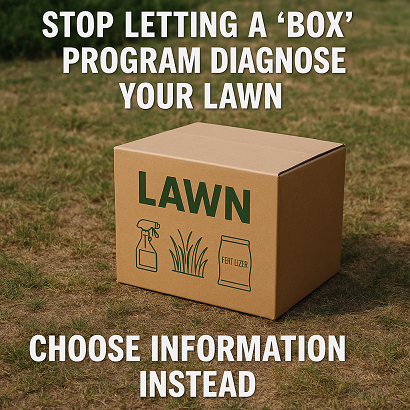
There’s a growing trend in lawn care: a national company ships you a one-size-fits-all “box,” tells you it’s tailored, and assures you everything will be fine. No site visit. No soil test. No context. Just trust the box.
Would you take a medical diagnosis from a doctor in another state who never met you and ran zero lab work? Hell no. So why are we doing that to our soil?
Why a shipped “solution” can’t fix local problems
Your lawn is a living system rooted in local realities. Mail-order plans skip most of them for convenience:
-
Soil chemistry and biology vary block to block. pH, salinity, C.E.C., organic matter, calcium–magnesium balance, and microbial life determine what your grass can actually use. A box can’t infer that.
-
Water quality and availability differ. Municipal water, well water, hardness, bicarbonates, and seasonal restrictions all change irrigation efficiency—and nutrient availability.
-
Microclimate and exposure drive stress. South-facing slopes, reflected heat from hardscapes, shade patterns, wind, and elevation alter evapotranspiration and disease pressure.
-
Compaction, thatch, and drainage dictate oxygen. Without oxygen and pore space, roots suffocate and microbes stall—even if you “feed” the lawn.
-
Pest and disease cycles are regional. Fungus outbreaks, insect windows, and weed species are not uniform across states, let alone neighborhoods.
-
Mowing practices change outcomes. Turf density, cut frequency, and clippings management influence water use, disease, and thatch—far more than a bagged “boost.”
When you leave most of that out, you don’t get a plan—you get a guess.
The hidden costs of convenience
-
Over- and under-fertilization: Miss the soil’s actual need and you burn roots, feed weeds, or push weak, thirsty growth.
-
Water waste: Programs that ignore soil carbon and density end up prescribing more irrigation than necessary—or at the wrong times.
-
Recurring disease: Generic timing invites recurring fungus and insect issues that could have been prevented with local data and proper cultural practices.
-
Higher cost of ownership: Chasing symptoms (more products, more water, more “fixes”) is always more expensive than solving root causes.
The doctor analogy isn’t cute—it’s accurate
Health decisions rely on tests. So do resilient lawns. If a remote physician can’t responsibly prescribe without labs, a remote lawn service can’t responsibly prescribe without a soil test, site assessment, and an understanding of how you water and mow.
What a real lawn care plan looks like
Serious, matter-of-fact lawn care isn’t flashy. It’s disciplined:
-
Test first. Comprehensive soil analysis: pH, C.E.C., organic matter/humus, macros/micros, salts, and (ideally) indicators of biological activity.
-
Assess the site. Sun/shade, slope, compaction, thatch, irrigation hardware and coverage, water quality, and local disease/pest history.
-
Set the hydration protocol. Deep, timed watering that matches soil texture, slope, and weather—not a generic “X minutes per zone.”
-
Build density with smart mowing. Frequent cuts for consistent height and denser turf; automated mowing can help dramatically.
-
Correct, then feed. Balance calcium/magnesium, manage sodium, address phosphorus/potassium ratios, then support biology (humic substances, carbon inputs, microbials where appropriate).
-
Monitor and adapt. Re-test, ground-truth the plan, adjust rates and timing, and document changes through the season.
This is how you lower the true cost of ownership: fewer surprises, less waste, stronger turf.
A serious plan—with a ray of hope
If you’ve been burned by glossy promises and tidy boxes, you’re not alone. You weren’t wrong to want simple; you were misled into thinking complex systems can be solved without real information.
Here’s the hopeful truth: once you measure, the lawn stops being a mystery. With a soil test, a site review, and a hydration and mowing plan aligned to your property, you’ll see fewer emergencies, steadier color, and better water efficiency. You’ll spend less time “fighting fires” and more time enjoying a lawn that actually fits your climate and soil.
If you’re ready to move past guesses
-
Get a current soil test (not last year’s).
-
Map your irrigation reality (pressure, coverage, scheduling).
-
Commit to mowing frequency that builds density, not just height.
-
Use inputs to correct imbalances first, then support biology—don’t just chase green.
Skip the box. Choose information. Your lawn—and your wallet—will thank you.