
Last Updated on January 27, 2026 by Brian Beck
Most people think mowing is a cosmetic task—like trimming hair.
Cut it. Bag it. Blow it. Done.
But that mindset is exactly why so many lawns stay stuck in the same loop year after year:
brown out, weed pressure, disease, water waste, and a lawn that constantly needs rescuing.
Here’s the truth nobody in the traditional lawn world explains:
Mowing isn’t just about height. It’s about biology.
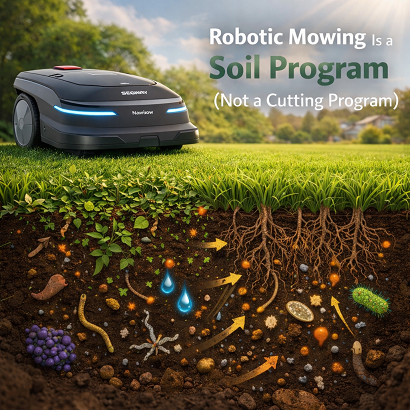
And robotic mowing—when it’s done right—is not a “cutting service.”
It’s a soil program.
The once-per-week mow is a stress cycle
Weekly mowing creates a predictable pattern:
-
Grass grows too tall.
-
You remove too much at once.
-
The plant panics.
-
Roots shrink.
-
Density drops.
-
Weeds move in.
-
You water more to compensate.
-
The lawn becomes dependent.
That’s not lawn care. That’s lawn management by damage control.
And in Colorado—where sun is intense, humidity is low, and soil often has structural issues—weekly mowing amplifies stress. It’s like taking a dehydrated athlete and asking them to sprint every seven days.
Micro-mowing changes the plant’s behavior
Robotic mowing flips the system.
Instead of one big traumatic haircut, you get tiny cuts, frequently. The plant doesn’t go into panic mode because you’re not removing a massive portion of leaf tissue.
That changes everything:
-
Less stress response
-
More stable growth
-
More consistent density
-
Less scalping
-
Fewer “recovery weeks”
-
Better color stability
But here’s where it gets interesting:
When you micro-mow consistently, you don’t just change how the lawn looks…
you change what it’s doing below ground.
Clippings are not waste—they’re food
Traditional mowing treats clippings like trash.
Robotic mowing treats clippings like nutrition.
Those tiny clippings fall back into the canopy and begin breaking down, creating a steady trickle of organic material. That’s not just nitrogen recycling (though it helps). It’s much bigger:
Clippings feed:
-
beneficial bacteria and fungi
-
soil protozoa (the nutrient releasers)
-
micro-arthropods
-
the whole “soil workforce” that turns dead material into plant-available nutrition
When you constantly return small amounts of fresh plant material, you create a regular food supply that helps the soil move from “dead and dependent” toward active and self-sustaining.
That’s why I call robotic mowing a soil program.
Because it doesn’t just remove grass.
It builds the engine.
A healthier canopy improves the soil microclimate
Most homeowners don’t realize the lawn surface is a climate zone.
A dense, properly managed canopy:
-
shades the soil
-
reduces evaporation
-
softens temperature spikes
-
reduces runoff and water repellency
-
protects microbial life from UV and heat
A thin, scalped, stressed lawn does the opposite:
-
bakes the soil
-
dries faster
-
drives hydrophobic conditions
-
increases irrigation demand
-
punishes biology
So robotic mowing isn’t only about “cutting more often.”
It’s about keeping the canopy at a state that protects the soil and helps it function.
Robotic mowing improves root exudates (the soil’s paycheck)
Plants “pay” microbes with carbon through root exudates—sugars, organic acids, and compounds that recruit beneficial organisms.
When grass is repeatedly stressed (like with big weekly cuts), it often reduces that carbon flow.
But when growth is stable and predictable, plants can “afford” to invest more into the soil.
That means:
-
better microbial activity
-
better nutrient cycling
-
stronger root development
-
improved soil aggregation over time
This is why lawn health is never just above ground.
The plant and the soil are in a trade relationship.
Robotic mowing helps stabilize that relationship.
Weed control becomes preventative instead of reactive
Weeds love dysfunction.
Thin turf, bare soil, stress gaps, inconsistent growth—those are invitations.
A consistently micro-mowed lawn becomes:
-
denser
-
more uniform
-
harder for weeds to establish
You stop “fighting weeds” and start removing the conditions that create them.
That’s not theory. That’s what happens when turf behaves like turf is supposed to behave: thick, competitive, and steady.
The catch: robotic mowing isn’t magic if the system is broken
Let’s be clear:
Robotic mowing won’t fix:
-
compacted clay with no structure
-
poor calcium-to-magnesium balance
-
high pH lockout
-
low humus/carbon buffering
-
bad irrigation habits
What it will do is make your improvements compound faster once the system is aligned.
That’s why in Trinity we don’t treat robotic mowing as a standalone “cool gadget.”
We treat it as part of a stack:
-
Robotic mowing stabilizes growth and returns nutrients
-
Smart irrigation maintains consistent soil moisture
-
Biological soil building restores structure and nutrient flow
When those three work together, the lawn stops being needy.
The real promise of robotic mowing
The promise isn’t “you don’t have to mow.”
The promise is:
your lawn stops being a weekly emergency.
No more:
-
loud, disruptive crews
-
scalping and recovery cycles
-
random clumping and mess
-
“did they even show up?” scheduling chaos
Instead, you get a lawn that looks consistently dialed in—because it’s managed the way turf actually wants to be managed.
Call to action
If you’re curious whether your lawn qualifies for robotic mowing as part of the Trinity system, reach out.
We’ll look at:
-
layout and boundaries
-
turf type and density
-
irrigation reality (not the “timer fantasy”)
-
and the soil constraints that actually control results
Because the truth is simple:
Robotic mowing isn’t a cutting program.
It’s a soil program—disguised as a mower.
And once you experience a lawn that stays healthy without drama, you’ll never go back to the weekly compromise.