
Last Updated on March 22, 2026 by Brian Beck
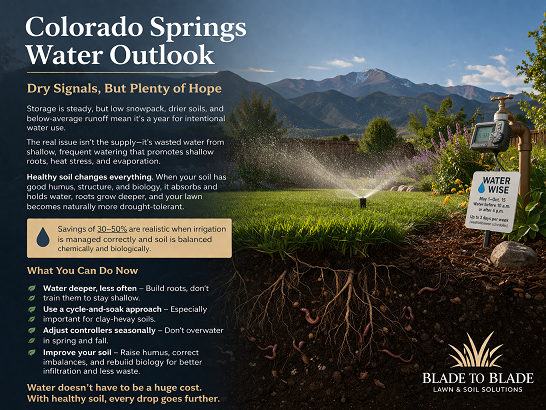
If you live in Colorado Springs, you are right to be thinking about water right now. The current outlook is mixed. Colorado Springs Utilities says system-wide storage is still strong at 77% of capacity, equal to about three years of demand in storage, but it also reports snowpack in its mountain watersheds is at or near record lows, soil moisture is below normal in the Colorado and Arkansas basins, and runoff is expected to be significantly below average this season. Its latest report also showed Arkansas Basin snowpack at just 45% of normal as of March 2, and February in Colorado Springs was unusually warm and dry, with only 0.05 inches of moisture and temperatures 8.4°F above normal.
That means this is not a year for panic, but it is a year for intentionality. The good news is that Colorado Springs is not starting from an empty tank. The city’s drought ordinance uses projected storage below 1.5 years of demand on April 1 as the trigger for a formal shortage evaluation, and current storage is well above that level. Standard Water Wise Rules still apply, including watering up to three days per week and, from May 1 through Oct. 15, watering before 10 a.m. or after 6 p.m. to reduce evaporation.
Here is the bigger issue for most homeowners: the real problem is often not the water supply itself. It is the way water is being used. A lot of people still water shallow and often, which keeps roots close to the surface and makes turf more vulnerable to heat stress. CSU guidance notes that deeper roots allow plants to reach a larger water supply and go longer between irrigations, and CSU irrigation materials also note that leaving controllers on summer settings can overwater lawns by about 40% in spring and fall. In fact, Colorado Master Gardener guidance says community-wide lawn watering is roughly double what Kentucky bluegrass actually needs, with some homeowners applying far more than necessary.
This is where the soil side of the conversation matters. When soil has good humus, good structure, and active biology, water behaves differently. USDA NRCS says organic matter improves plant-available water storage and helps soil take in and hold water by improving structure and aggregation. CSU Extension says organic matter improves water-holding in sandy soils, improves aggregation and pore space in clay soils, and serves as food for bacteria, fungi, and other beneficial soil life. In simple terms, a lawn with balanced chemistry and functioning biology can use water better because more of that water actually enters the soil, stays in the root zone, and remains available to the plant.
That is why there is real hope here. Water does not have to be a huge cost forever. The answer is not to starve the lawn. The answer is to stop wasting water and start making the soil work. On overwatered properties, savings in the 30% to 50% range are a realistic goal when irrigation management is corrected and the soil is rebuilt chemically and biologically, because the starting point is often far more wasteful than homeowners realize. Better soil function means better infiltration, deeper rooting, less evaporation loss, better drought tolerance, and more value from every gallon applied.
What homeowners should do now
Water deeper and less often, not with constant shallow sips. Let the lawn use the water in the root zone instead of training roots to live on the surface. On tighter or clay-heavy soils, use a cycle-and-soak approach so water has time to move in rather than run off. Adjust controllers seasonally instead of letting spring lawns get watered like it is mid-July. And most importantly, start improving the soil itself by raising humus, correcting imbalances, and rebuilding biology so your irrigation becomes more effective instead of more expensive.
The message for Colorado Springs this year is simple: yes, water matters, and yes, people should pay attention. But no, this does not have to become a story of fear and runaway cost. A lawn with broken soil will always be expensive to maintain. A lawn with functioning soil can become dramatically more efficient. If your water bill feels like it is getting ahead of you, the answer may not be more water. It may be better soil.
Engage with us: