
Last Updated on March 21, 2026 by Brian Beck
What if the presence of pests, disease, or weeds is not actually the problem?
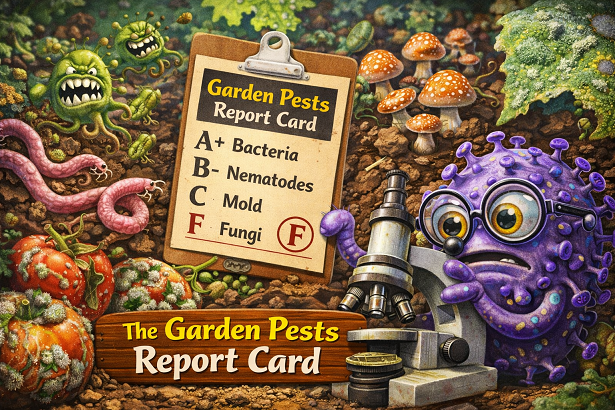
What if it is the report card?
For decades, people have been taught to look at lawns, crops, and landscapes as if they are under attack. If there are weeds, spray them. If there are insects, kill them. If there is disease, apply another product. The whole system has been built around fighting symptoms.
But that way of thinking misses the bigger issue.
A weak lawn is not usually suffering from a pesticide deficiency. It is not failing because it did not receive enough rescue chemistry. More often than not, it is struggling because the soil system underneath it is out of balance and the biology that was meant to support the plant has been damaged, ignored, or shut down.
That is where the real conversation needs to begin.
We Have Been Trained to Fight the Wrong Battle
Modern lawn care and agriculture have often taken on a war mentality. War on weeds. War on bugs. War on disease. War on nature itself.
The problem with that approach is that it trains people to react to visible symptoms without asking why those symptoms showed up in the first place.
If a lawn is constantly being attacked by disease, insects, stress, and decline, that should tell us something. It should tell us the plant is vulnerable. It should tell us the soil is not doing its job. It should tell us the biological engine underneath the turf is not functioning the way it should.
The pest is not always the root cause. Many times, it is the messenger.
A Sick System Will Keep Producing Sick Results
Think about human health for a moment.
If someone is living on processed food, poor sleep, chronic stress, and no exercise, medication may help with the symptoms for a time. It may even be necessary in certain situations. But if nothing changes at the foundational level, the person stays on the same path that created the problem.
Lawns are no different.
You can keep spoon-feeding soluble fertilizers, spraying fungicides, and chasing every outbreak with another application, but if the soil is compacted, biologically weak, low in humus, out of mineral balance, and unable to regulate itself, the lawn remains vulnerable.
That is why so many people feel trapped. They keep spending money, but they do not actually break the cycle.
Soluble Fertility Creates Dependency
One of the most important ideas in this discussion is that highly soluble fertility can create dependency.
When a plant is constantly flooded with quick, easy nutrition, it no longer has much reason to build a strong relationship with the biology in the soil. It stops “working” with the microbes the way nature intended. The communication between plant and soil begins to weaken.
It is not unlike ultra-processed food for people.
The plant gets fed, but it is not truly functioning the way it was designed to. Over time, that weakens resilience. It weakens self-regulation. It weakens immunity. Then when the system gets stressed, the lawn needs another input, then another, then another.
That is how dependency is built.
The lawn starts looking like it needs constant rescue, when in reality it needs restoration.
Healthy Plants Are Harder to Attack
A truly healthy plant is much harder to break down.
When nutrition is balanced and the microbiome is active, plants become stronger, more efficient, and more resilient. They are better able to regulate nutrient uptake. They produce stronger root systems. They handle environmental stress better. They are less inviting to insects and less vulnerable to disease.
This is one of the biggest things people miss.
The goal should not just be to kill what is bothering the lawn today. The goal should be to build a lawn that is fundamentally harder to bother in the first place.
That is a completely different mindset.
The Two Pillars: Nutrition and Biology
At the center of all of this are two major pillars:
First, mineral and nutritional integrity.
Second, microbiome integrity.
If the soil is chemically out of balance, the lawn will struggle. If the microbial life is weak, the lawn will struggle. If both are off, the lawn may survive for a while, but it will usually live in a stressed, pre-disease condition where it is always one weather swing, irrigation mistake, or pest cycle away from trouble.
That “pre-disease” state is where many lawns live.
They are not dead, but they are not truly healthy either.
And when a lawn stays in that condition long enough, the visible symptoms begin to appear: weeds, fungus, insects, shallow roots, poor color, poor drought tolerance, more water use, and more inputs.
The Fastest Way to Rebuild Soil Is Through Living Plants
Another powerful point is this: the fastest way to rebuild soil is not simply by dumping on amendments and hoping for the best.
The fastest way to rebuild soil is with living, photosynthesizing plants.
Healthy plants pump sugars and carbon compounds into the soil through their roots. Those root exudates feed microbes. Those microbes cycle nutrients, improve structure, and help create the living system the plant depends on.
In other words, healthy plants feed healthy soil, and healthy soil supports healthy plants.
That is the cycle we want.
This is also why the biological approach is so important. We are not just trying to make grass green. We are trying to rebuild the system that makes strong turf possible.
You Do Not Have to Choose Between Results and Biology
One of the biggest objections people have is that moving away from the traditional chemical-heavy system means slower results or lower performance.
That does not have to be true.
The real goal is not to recklessly remove every input and hope for the best. The real goal is to intelligently reduce dependency while rebuilding function. That means supporting biology, correcting imbalances, and making smarter decisions about what is applied, when it is applied, and why.
In the early stages, money may simply get redirected.
Less waste on symptom-chasing.
More investment in soil function.
More emphasis on biology.
More focus on resilience.
More return over time.
That is how you begin getting off the treadmill.
What This Means for Your Lawn
If you are constantly dealing with lawn problems, the question should not only be, “What do I spray?”
The better question is, “Why is my lawn vulnerable?”
Why is it attracting pressure?
Why is it struggling to regulate itself?
Why does it need so much intervention?
What is broken in the soil?
What is being shut down biologically?
What is this lawn trying to tell me?
That is where real progress starts.
The appearance of a pest, disease, or weed is often not just bad luck. It is often the lawn showing you that something deeper needs attention.
Final Thought
Pests are not always the enemy. Many times, they are the report card.
They are showing us the current condition of the system.
If we keep treating symptoms only, we stay trapped in the same cycle. But if we begin rebuilding the soil, supporting biology, balancing nutrition, and restoring natural function, the lawn becomes more capable, more efficient, and far less dependent on constant rescue.
That is the difference between managing problems and creating health.
And health is always the better long-term investment.
CTA
If your lawn seems stuck in a cycle of stress, weeds, disease, rising water use, or constant product dependence, it may be time to stop chasing symptoms and start looking at the soil.
That is exactly what our biological program is built to do.
We help uncover what is actually driving dysfunction in the soil so you can reduce inputs, lower the cost of ownership, improve resilience, and grow a lawn that functions the way it was meant to.
If you want to know what your lawn’s report card is really saying, reach out to us. We would be happy to help you read it.
Engage with us: