
Last Updated on September 15, 2025 by Brian Beck
Most people think about lawn care in terms of fertilizer. Spread a bag of product, water it in, and hope the grass greens up. For decades, that’s been the standard approach. But in reality, fertilization as we know it often misses the bigger picture.
That’s why we’re introducing a new concept: nutrient flow efficiency.
What Is Nutrient Flow Efficiency?
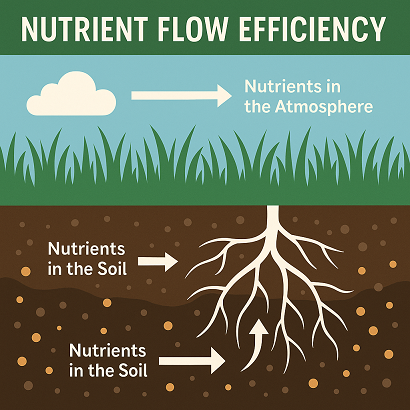
Nutrient flow efficiency is about more than adding nutrients—it’s about how effectively the resources that are already available move through the soil and into the plant.
Your lawn doesn’t just depend on what comes out of a bag. The atmosphere contains nitrogen. The soil already holds phosphorus, potassium, and a whole range of trace minerals. But if the soil biology isn’t functioning—if microbial life is weak or missing—those nutrients are locked away, unavailable to the grass.
It’s like having a full refrigerator with no way to open the door.
Why Fertilizer Alone Falls Short
The word “fertilization” suggests we can fix every lawn problem by pouring on more product. But often, that leads to:
-
Excess costs: Buying fertilizer year after year without addressing the root issue.
-
Soil stress: Repeated chemical inputs can compact the soil and reduce organic matter.
-
Weak biology: Overuse of synthetics damages microbial life, making the lawn more dependent on outside inputs.
In short, fertilizer can make grass greener in the short term, but it doesn’t build a lawn that can sustain itself.
How Nutrient Flow Efficiency Works
By focusing on nutrient flow efficiency, we look at the engine of your lawn—the living system below the surface.
-
Soil microbes break down organic matter, unlocking nutrients.
-
Humus and organic material hold onto water and minerals, delivering them steadily to the roots.
-
Balanced biology allows the plant to tap into atmospheric nitrogen and other natural resources.
Instead of chasing short bursts of green, we build a system that sustains itself season after season.
The Benefits for Your Lawn
When nutrient flow efficiency is working, you can expect:
-
Healthier, deeper roots that resist stress.
-
Reduced watering needs because soil holds more moisture.
-
Fewer weeds and pests as the turf grows dense and balanced.
-
Lower costs over time, as dependence on chemical fertilizers decreases.
This isn’t about doing more—it’s about doing things smarter.
Moving Toward a Biological Fertility System
Nutrient flow efficiency is just one piece of our larger biological fertility system. This system is designed to restore the natural balance of your soil so that your lawn can thrive without constant artificial crutches.
Think of it as moving from a lawn that survives to one that truly functions.
Final Thoughts
Your lawn already has access to a wealth of resources—it just needs help using them. By shifting from a fertilization mindset to nutrient flow efficiency, we open the door to healthier soil, stronger plants, and a more sustainable landscape.
It’s time to stop chasing short-term green and start building long-term health.