
Last Updated on July 1, 2026 by Brian Beck
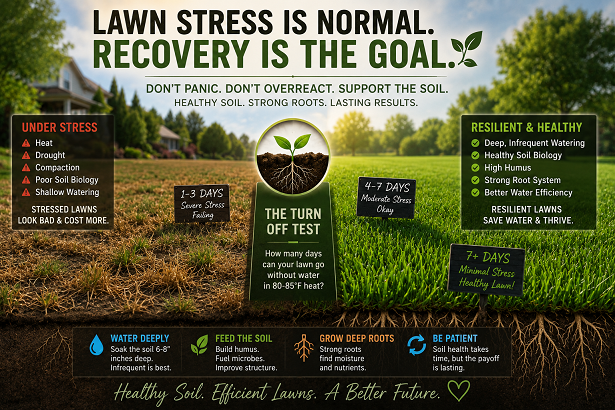
We’ve been looking at lawn stress all wrong. Rather than something to fight, stress is a signal—maybe even a friend. Once you see soil’s reality, you’ll realize stress is the lawn’s way of alerting us. What we see on top is a mirror of what’s happening below. We can’t fix what’s above without addressing what’s beneath.
Our goal is nutrient efficiency. The biological method restores what synthetic fertilizers damaged: the soil-root relationship. History—both geological and how we’ve treated the soil—left us with costly, dysfunctional soils. But we can fix it. I’ve relied on testing to uncover microscopic issues. Because the truth is, what we can’t see is what matters most.
Inorganic fertilizers give a quick reaction that looks like success. But the biological approach reverses damage. It brings life back to the soil, creating a living engine. This transforms excesses into usable nutrients for the plant.
Since the dawn of soil, plants and microbes have exchanged sugars for nutrients. That’s how soil is meant to behave. We’ve defiled it with synthetics, masking problems instead of solving them. Once we correct that, we restore soil to its intended state—yielding a healthier, resilient lawn.
The benefits? Early natural greening, fewer weeds, and reduced water use. As humus builds, soil acts like a sponge and a currency, empowering microbes. In short, stress isn’t the enemy. It’s the key to a lawn you’ve never experienced before—starting from below.
Engage with us: