
Last Updated on June 23, 2026 by Brian Beck
Most homeowners believe the secret to surviving a heat wave is more water.
Nature disagrees.
Over the past several weeks, many lawns across Colorado Springs have shown signs of stress. Brown patches have appeared. Thin areas have become more noticeable. Some lawns seem to dry out almost immediately after watering.
The natural response is to apply more water.
But what if the problem isn’t how much water you’re applying?
What if the problem is how much water your soil can actually keep?
The Most Important Part of Your Soil Might Only Be 2%
According to soil science, healthy topsoil is made up of approximately:
- 45% minerals
- 50% air and water
- 2% plant and animal remains
- 2% humus
- Less than 1% living organisms
At first glance, 2% doesn’t sound very important.
But that tiny fraction may be one of the most important components in your entire lawn.
Humus acts as nature’s storage system.
It helps the soil retain water, hold nutrients, support beneficial microbes, and create the conditions plants need to thrive.
In many ways, humus is what transforms dirt into functioning soil.
The Hidden Problem Beneath Many Lawns
Most lawns don’t fail because they lack grass.
Most lawns struggle because they lack function.
Years of construction disturbance, soil compaction, synthetic fertilizer dependency, excessive tilling, and poor organic matter levels gradually reduce the soil’s ability to operate efficiently.
The result is a lawn that constantly feels thirsty.
A lawn that constantly needs another fertilizer application.
A lawn that requires more work every year just to maintain the same appearance.
Sound familiar?
That’s because many homeowners are unknowingly fighting a hidden headwind.
The Bucket With Holes
Imagine trying to fill a bucket that has holes drilled into the bottom.
You can pour water into it all day long.
But if the bucket can’t hold water, you’ll never get ahead.
Many lawns function exactly the same way.
When the soil lacks organic carbon and humus-related compounds, water moves through the soil more quickly, nutrients are less efficiently retained, and the lawn becomes more vulnerable to heat and drought stress.
The homeowner thinks they need more water.
The lawn actually needs better soil.
Where Humate Comes In
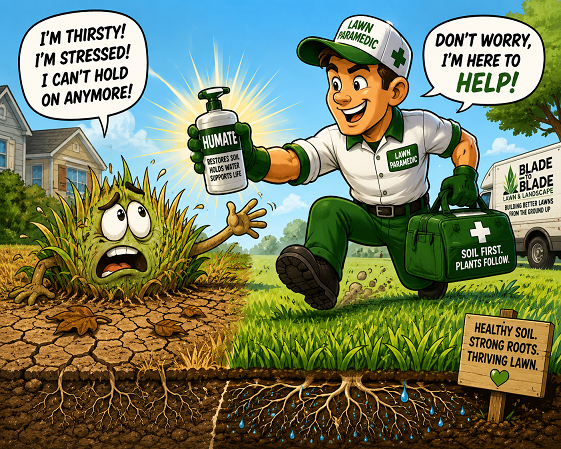
Humate is one of the tools we use to help restore soil function.
Think of humate as concentrated soil-building carbon.
Humate contains valuable humic substances that help improve the soil’s ability to hold onto nutrients and water while supporting biological activity underground.
A simple way to think about it is this:
Water is the groceries.
Nutrients are the food.
Humate is the shelves.
Without shelves, everything gets piled on the floor and becomes difficult to organize and use.
Without humate and organic carbon, nutrients and water move through the soil less efficiently.
Humate helps create places for those resources to stay until the plant needs them.
Why This Matters During Heat Waves
When temperatures climb into the 90s and beyond, grass loses water rapidly through its leaves.
The plant immediately begins pulling more water from the soil.
If the soil has poor structure, low carbon, and limited water-holding capacity, the roots quickly run out of supply.
That’s when homeowners begin seeing:
- Brown patches
- Footprinting
- Wilting
- Slower growth
- Increased disease pressure
- Poor recovery after stress
The answer is not always more water.
Often the answer is improving the soil’s ability to hold the water you’re already applying.
The Biological Difference
For years, the lawn industry has focused almost entirely on feeding grass.
Our biological program focuses on feeding the soil.
Because healthy soil creates healthy grass.
Humate helps support that goal by:
- Improving water retention
- Increasing nutrient efficiency
- Supporting beneficial microbes
- Improving soil structure
- Helping reduce nutrient loss
- Building resilience during periods of heat and drought
Over time, these improvements help reduce the hidden costs of lawn ownership.
Less wasted water.
Less dependency on corrective inputs.
Less stress.
More consistency.
The Goal Is Not Survival
Most lawn programs are designed to help your lawn survive.
Our goal is to help your lawn function.
When a lawn begins functioning properly, something remarkable happens.
Water goes further.
Nutrients work harder.
Roots grow deeper.
The lawn becomes more resilient.
And ownership becomes easier.
That’s what we call reaching the Balance Horizon.
A point where the lawn begins working with you instead of against you.
Ready to Build a Better Sponge?
If your lawn struggled during the recent heat wave, now is the perfect time to improve what is happening below the surface.
Ask us about our Humate Recovery Application or our Soil Testing and Supercharge Program.
We’ll help identify the hidden headwinds in your soil and create a plan that improves water efficiency, strengthens soil structure, and builds long-term resilience.
Because healthy lawns don’t just receive water.
Healthy soils keep it.
Call Today
Contact Blade to Blade Lawn & Landscape to learn how humate can help your lawn recover from heat stress, improve water retention, and build a stronger foundation for the future.
Quit renting your lawn and start owning it.
Engage with us: