
Last Updated on February 5, 2026 by Brian Beck
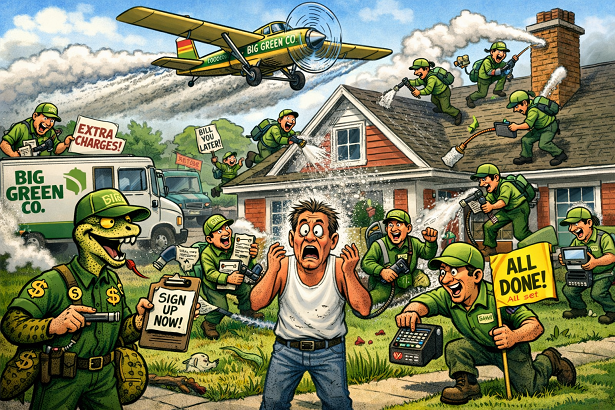
The other day I did something I probably shouldn’t do if I want to stay in a good mood: I started reading reviews for a large national lawn care company.
You know the type. Big brand. Big trucks. Big promises. Big marketing budget.
And after about twenty minutes of scrolling, I thought, “Okay… this is not a handful of bad experiences. This is a pattern.”
So we took it a step further.
We ran a few hundred of their customer reviews through AI to get an objective feel for what people were actually saying at scale—without cherry-picking, without emotion, without the one-off horror stories that every company can get.
It wasn’t good.
Read the output from AI:
Overwhelming negative sentiment with a repeating pattern: people feel they paid for results and/or professionalism, but experienced poor outcomes, poor communication, and billing/control issues.
There are a few positives, but they’re mostly tied to specific individuals (a standout technician or a manager who stepped in), not to a consistently reliable system.
BOOM!!! What customers are saying (the repeating themes)
1) “I didn’t get results”
This is the most common core complaint:
-
Weeds not controlled (crabgrass is a major recurring example)
-
Lawn looks the same or worse
-
“My neighbors’ lawns look better and they do nothing”
-
“I could do this myself for less”
Translation: People expected a “problem solved” outcome, but the service feels generic, inconsistent, or mis-scoped for the issues they’re facing.
2) “They damaged my lawn / plants”
Many reviews describe:
-
Burned grass, dead patches, stripes (“zebra” patterns)
-
Over-application, wrong product, or poor timing (spraying before rain, during heat, etc.)
-
Damage to shrubs/trees/flowers
Translation: Customers are concluding either misapplication or carelessness, and they don’t believe the company owns mistakes.
3) “The technicians don’t communicate or aren’t knowledgeable”
Repeated points:
-
Techs don’t knock, don’t talk, don’t explain
-
Conflicting diagnoses (“water too much / not enough”)
-
Customers say they had to teach the techs about weeds
-
“They’re there 5–10 minutes” on large properties
Translation: The service feels like a route spray with minimal diagnosis, not “professional lawn care.”
4) “Scheduling and follow-through are broken”
Common pattern:
-
Missed appointments, last-minute cancellations
-
“Marked complete” when customers claim nobody showed
-
Long gaps between visits despite promised cadence (4–6 weeks becomes 8–9+)
Translation: People feel the company operates on its schedule, and the customer experience is unpredictable.
5) “Billing, auto-renew, and cancelation issues”
This one is loud:
-
Charges for services not requested
-
Work performed after cancelation
-
Confusing plan terms (annual = 9 months, etc.)
-
Collections threats / surprise bills
-
Refunds are hard, slow, partial, or tied to “stay a customer”
Translation: Even when the lawn outcome is bad, what really enrages people is loss of control (cancelation friction + surprise charges).
6) “Sales promises don’t match delivery”
A frequent sequence:
-
Sales rep promises: soil test, full customization, “guaranteed,” weeds gone quickly, add-ons included
-
Technician arrives and says: “we don’t do that here” or performs a basic spray only
Translation: Customers perceive a marketing-to-operations gap: selling a premium experience, delivering a standardized route service.
The few positives (and what they mean)
The positive reviews tend to sound like:
-
“Johnnie did amazing—professional, attentive, lawn looks great”
-
“Manager came out, took accountability, fixed the situation”
-
“Some branches used to be good”
Translation: There are pockets of good service—but it’s person-dependent (a great tech/manager), not system-dependent.
What this dataset implies (the “story behind the story”)
If you zoom out, it reads like customers are reacting to a model that can feel like:
-
Standardized applications applied across many lawns
-
Limited diagnosis / limited scope, with heavy dependence on the homeowner’s watering + conditions
-
Operational fragmentation (local crews + national call center + inconsistent notes)
-
A cancellation/billing workflow that leaves people feeling trapped or ignored
What the Reviews Were Really Saying (In Bulk)
When you read reviews one at a time, it’s easy to think: “Maybe that customer is just angry,” or “Maybe it was a bad branch,” or “Maybe it was a new technician.”
But when you look at hundreds of them together, the themes stop being anecdotes and start looking like a system.
The big repeat offenders were exactly what you’d expect:
-
No results (or results that disappear as fast as they show up)
-
Weeds still everywhere
-
Damage (burning, streaking, dead spots, overspray, collateral plant injury)
-
Rushed visits (the “they were here for five minutes” special)
-
Poor communication (no one explains anything, no one calls back)
-
Scheduling chaos (missed appointments, surprise visits, “completed” when no one came)
-
Billing/cancelation friction (charges that feel automatic, refunds that feel impossible)
That’s the part that stuck with me: the emotion in the reviews wasn’t just “my lawn looks bad.”
It was: “I feel taken advantage of.”
The Question I’ve Asked for Years
Here’s what really hit home.
For years I’ve asked people—especially the ones who weren’t our customers yet, and who had experience with these big national services:
“If you don’t like your provider… why do you keep using them?”
And the answers were unbelievably consistent:
-
“They were the only ones that contacted us.”
-
“They send us so much marketing material it’s hard to say no.”
Think about that.
Not: “They solved my problem.”
Not: “They educated me.”
Not: “They earned my trust.”
Not: “They produced consistent results.”
Just:
They called.
They mailed.
They stayed in your face long enough to become the default.
Nobody’s Holding a Gun to Anyone’s Head
Look—everyone has a choice.
No one is holding a gun to anyone’s head.
And yet people stay in systems where they:
-
aren’t getting results,
-
aren’t treated well,
-
don’t feel heard,
-
and don’t even know what’s being applied to their property half the time.
So I asked myself the real question:
Why Would Someone Stay in a System That Isn’t Working?
I’ll let you answer that question.
Because if you’ve ever stayed with a service you didn’t like, you already know the reasons. You can feel them:
-
It’s easier to stay than to change
-
You don’t want to admit you’ve wasted time or money
-
You keep hoping next visit will be different
-
You’re busy, overwhelmed, distracted
-
You assume, “This is just how lawn care is”
-
You don’t know what “good” looks like, so you tolerate “normal”
And the marketing doesn’t help. When you’re flooded with postcards, door hangers, promotions, “limited time” offers—it creates pressure. It creates noise. It creates a sense of inevitability.
That’s not lawn care.
That’s consumer inertia management.
Here’s My Point
If you’re paying for lawn care and you’re not getting results—stop normalizing it.
You’re not crazy for expecting:
-
clear communication,
-
consistent service,
-
a plan that makes sense,
-
and measurable improvement over time.
And if you’re stuck in a loop where your lawn never really gets better, you don’t need another “application.”
You need:
-
a real diagnosis,
-
hydration that matches your soil,
-
and a soil system that can actually hold and cycle what you’re putting down.
If You’re Not Happy, Don’t Stay “Because They Called”
If your current provider isn’t producing outcomes and you don’t feel taken care of, you don’t owe them your loyalty.
You owe yourself honesty.
If you want, we’ll help you evaluate what’s actually going on—no hype, no pressure, no “sign today” nonsense. Just clarity: what your lawn needs, what’s been missing, and what a realistic timeline looks like when you fix causes instead of chasing symptoms.
Because your lawn isn’t supposed to be a yearly ritual of hope, frustration, and repeating the same mistakes.
And you’re allowed to choose better.
Engage with us: