
Last Updated on February 1, 2026 by Brian Beck
Most people try to build a great lawn the way a beginner tries to “learn music”: pick one instrument, turn it up, and hope the volume covers the flaws.
So we chase nitrogen. We chase a “weed killer.” We chase a single magic microbe. We chase a new fertilizer ratio. We chase a new irrigation schedule.
And sometimes… it works—briefly.
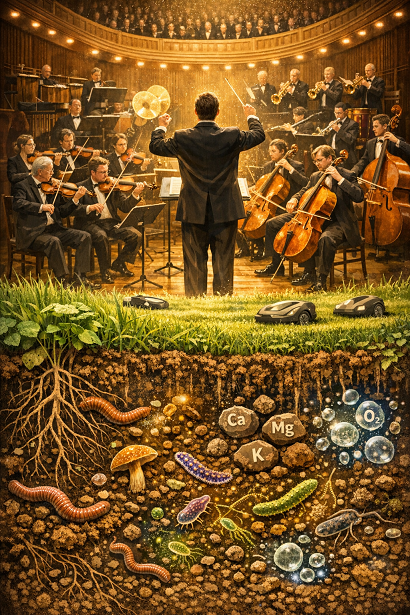
That’s like a three-piece band at a small venue. It can be fun. It can even be impressive. But it will never create the depth, power, and precision of a full orchestra pulling off a masterpiece like Ludwig van Beethoven’s Ninth.
That is what your lawn should be: a masterpiece built on timing, harmony, and balance—where no one section can carry the whole performance.
Personal-dna
Why “One Thing” Can’t Carry Your Lawn
A lawn is a living system. And living systems don’t reward brute force—they reward coordination.
If you only feed nitrogen, but the soil can’t hold nutrients… you get a short surge and a fast crash.
If you only “kill weeds,” but the soil biology is weak and the structure is tight… the weeds come right back because the underlying dysfunction never changed.
If you only add microbes, but the soil has no carbon “food” and no habitat… you’re basically releasing musicians into an empty concert hall with no chairs, no lights, and no sheet music.
The outcome isn’t a better lawn. It’s louder chaos.
The Sections of the Soil Orchestra
1) The Strings: Biology (the constant movement)
Strings carry most of the music—just like biology carries most of the nutrient cycling.
-
Bacteria and fungi are your string section: always active, always processing.
-
Protozoa and nematodes are like the “supporting players” that keep energy flowing through the food web.
-
Roots are both musician and audience: they respond instantly when the performance is right.
When strings are weak, you feel it as:
-
slow recovery
-
dull color that won’t hold
-
patchy density
-
constant dependence on inputs
2) The Brass: Minerals (power and structure)
Brass doesn’t play everything—but when it enters, you know it.
Minerals are that way:
-
calcium influences structure and aggregation
-
magnesium affects tightness/dispersion in many clays
-
potassium governs water regulation and stress response
-
micronutrients do “small” jobs that become huge when missing
You can’t fake mineral balance with more nitrogen. That’s like trying to replace trombones with extra violins. Wrong tool.
3) The Woodwinds: Water + Air (subtle, but decisive)
Woodwinds add tone, clarity, and nuance. In soil, that’s oxygen and water movement.
If water can’t infiltrate and oxygen can’t circulate, biology suffocates and roots shrink their ambition.
This is why some lawns look “hungry” even when they’re fed:
-
nutrients can’t move properly
-
roots can’t explore
-
biology can’t breathe
4) The Percussion: Management Rhythm (timing makes it musical)
Percussion is not the whole song—but if the timing is off, the whole orchestra sounds wrong.
Your timing levers include:
-
mowing frequency and height
-
irrigation timing and depth
-
spacing out amendments instead of dumping everything at once
-
seasonality (cool-season vs warm-season behavior)
This is also where robotic mowing is a cheat code: it acts like a metronome for the lawn—steady rhythm, less shock, more consistency.
The Conductor: You (or your system)
A conductor doesn’t play every instrument. They make sure every section enters at the right moment, at the right intensity, in harmony with the rest.
That’s exactly how soil management works.
A healthy lawn isn’t built by “doing more.”
It’s built by doing the right things, in the right order, at the right tempo.
Which usually means:
-
stop trying to force quick outcomes
-
stop over-correcting every symptom
-
start building the system that makes “good turf” the natural result
Tuning the Orchestra: Balance Before Brilliance
Even a world-class orchestra sounds awful if instruments are out of tune.
In lawn terms, “tuning” looks like:
-
getting structure right (so water and air behave)
-
getting mineral relationships in a usable range
-
building carbon/humus so the soil can buffer mistakes instead of punishing them
When that tuning starts to happen, you often notice the early wins before you see the “Instagram green”:
-
infiltration improves
-
the lawn holds moisture better
-
stress tolerance increases
-
you need less “rescue” behavior
That’s the orchestra warming up—and it matters.
The Big Takeaway
A feel-good lawn can be built with a few inputs.
But a truly elite lawn—the kind that stays dense, resilient, and stable—comes from a full orchestra:
-
biology cycling nutrients
-
minerals supporting structure and metabolism
-
water and oxygen moving properly
-
management rhythm staying consistent
-
and a conductor (a plan) keeping it all in harmony
That’s not just “better turf.”
That’s a masterpiece.
If You Want the Orchestra Without the Guessing
If you want, I can turn this into a practical “conductor’s score”:
-
what to measure first (and why)
-
what to fix first (and why)
-
how to space changes so the system improves without shock
Because once you hear what a real orchestra sounds like, you stop settling for less
Engage with us