
Last Updated on July 30, 2025 by Brian Beck
For over a century, homeowners, farmers, and landscapers have been on a relentless quest—chasing nitrogen. It’s the holy grail of green growth, the engine behind lush lawns, productive gardens, and vibrant crops. But while billions are spent every year applying synthetic nitrogen fertilizers, few realize that the most abundant source of nitrogen is actually floating freely all around us. Literally.
The Irony of the Nitrogen Hunt
Nitrogen makes up nearly 78% of the air we breathe. That’s right—the sky is full of it. And yet, we pour bags of synthetic fertilizer onto our lawns and fields, paying a premium to force-feed plants with something they’re technically surrounded by.
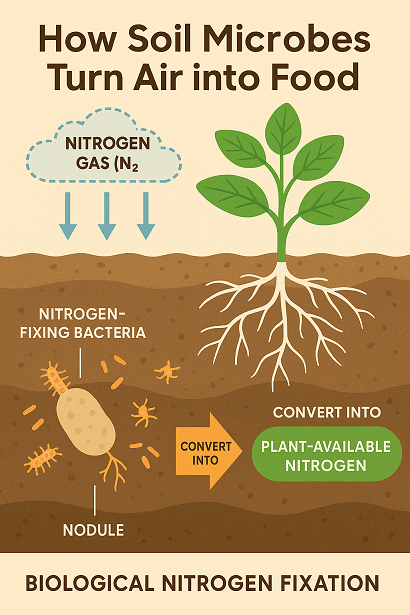
But here’s the catch: atmospheric nitrogen (N₂) is locked in a tight, stable form that most plants can’t use directly. It’s like having a vault of treasure in your backyard—but no key to open it.
Unlocking the Vault: How Nature Taps Into Free Nitrogen
Enter soil biology—specifically, a group of microscopic heroes called nitrogen-fixing bacteria. These specialized microbes possess a superpower: the ability to convert atmospheric nitrogen into ammonium (NH₄⁺), a plant-usable form of nitrogen.
This natural process, known as biological nitrogen fixation, happens constantly in healthy soils. These microbes form symbiotic partnerships with plants—especially legumes like clover, beans, and peas—trading usable nitrogen in exchange for plant sugars.
Some of the most famous nitrogen-fixers include:
-
Rhizobium (associated with legumes)
-
Azospirillum and Azotobacter (free-living in the soil)
-
Frankia (symbiotic with non-legume plants like alder trees)
With the right biology, your soil becomes a living nitrogen factory.
Synthetic vs. Biological: A Question of Cost and Consequence
Synthetic nitrogen fertilizers are like giving your lawn an energy drink. The grass perks up fast—but the soil suffers. Over time, excess synthetic nitrogen:
-
Destroys microbial diversity
-
Increases soil acidity
-
Leaches into waterways, causing environmental damage
-
Creates dependency that grows costlier with each season
Biological nitrogen, on the other hand, is self-renewing, slow-releasing, and sustainable. Once your microbial population is thriving, you can tap into an endless reservoir of free nitrogen—all without lifting a finger or opening your wallet.
How to Start Tapping the Sky
Here’s how you can turn your lawn or garden into a nitrogen-capturing system:
-
Build Soil Biology
Apply biological inoculants like mycorrhizal fungi, beneficial bacteria, and compost teas to kickstart microbial activity. -
Add Organic Matter
Feed your soil with compost, mulch, and carbon-rich materials. Microbes need energy too—and carbon is their fuel. -
Minimize Synthetic Inputs
Stop drowning your soil in salts and let nature’s systems take over. Transition slowly, but intentionally. -
Integrate Legumes
Clover in your lawn, cover crops in your garden—these plants actively fix nitrogen while also improving soil structure. -
Maintain Moisture
Microbial life thrives in a well-hydrated environment. Water deeply and infrequently to support long-term biological activity.