
Last Updated on August 9, 2026 by Brian Beck
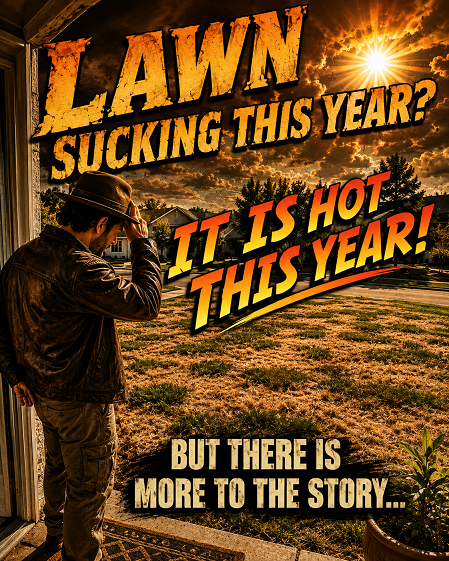
The heat may not be creating the problem. It may be revealing it.
If your lawn looks terrible right now, you’re not alone.
Across Colorado, we’re seeing lawns develop brown patches, thin areas, discoloration and places that simply seem to be giving up.
The obvious explanation is:
It’s hot.
And that’s certainly part of it.
Kentucky bluegrass is a cool-season grass. Once temperatures climb into the mid-80s and beyond, the plant comes under increasing physiological stress. Stack prolonged heat on top of that, and even a healthy lawn can struggle.
But after spending much of the past year digging deeper into soil chemistry, soil biology and how plants respond to extreme environmental stress, I’ve become increasingly convinced of something:
Heat doesn’t always kill lawns. Sometimes heat reveals what was already wrong with them.
And that distinction could become extremely important this fall.
Your Lawn Entered Summer With Baggage
We need to remember what happened before summer ever arrived.
We came through a warm, dry winter that placed tremendous stress on many Colorado lawns.
That matters.
A lawn doesn’t magically reset itself when spring arrives. If the root zone enters spring dehydrated, biologically sluggish, poorly structured or unable to efficiently cycle nutrients and move water, the lawn may look reasonably good when temperatures are mild.
Then the heat arrives.
Suddenly the weaknesses become visible.
Think of summer heat as a stress test for your lawn.
A treadmill stress test doesn’t necessarily create a heart problem. It increases demand on the body enough to expose problems that may have been difficult to see while the body was resting.
Your lawn can behave remarkably similarly.
At 65°F, everything may appear fine.
At 95°F, the truth starts coming out.
Those Brown Spots May Be Trying to Tell You Something
This is where things get interesting.
When homeowners see brown areas developing, the natural reaction is to assume the grass simply needs more water.
Sometimes it does.
But what if the problem isn’t simply how much water you’re applying?
What if the grass isn’t effectively getting that water in the first place?
Compaction, poor soil structure, shallow rooting, inadequate carbon, weak biological activity, mineral imbalances and poor nutrient cycling can all influence how efficiently the soil and plant function under stress.
As temperatures rise, the plant depends heavily on its ability to move water through the soil, into the roots and ultimately through the plant.
When that system begins struggling, transpiration can decline. The plant loses its ability to cool itself effectively. Photosynthetic activity declines. Chlorophyll begins breaking down.
Eventually we see the symptom:
Brown grass.
But the brown grass isn’t necessarily the beginning of the problem.
It may be the warning light on the dashboard.
What Looks Like Bad News May Actually Be a Gift
I know that sounds strange.
Nobody looks at a brown patch in their front lawn and thinks:
“Fantastic!”
But those stressed areas may be showing us exactly where the lawn is weakest.
Instead of simply condemning the lawn, those areas give us an opportunity to ask:
Why did this particular part of the lawn fail first?
That is an entirely different question than:
What fertilizer should I put on it?
The first question investigates the system.
The second treats the symptom.
And I’ve become much more interested in the first question.
Because if we can understand why those areas are struggling now, we may have an opportunity to improve the conditions responsible for the failure before winter arrives.
We’ve Seen This Movie Before
This is the part that concerns me.
Colorado has experienced this combination before:
Hot summer. Dry conditions. Stressed lawns. Followed by an unforgiving winter.
During the 2021–2022 period, many lawns entered winter already compromised. Dry winter conditions compounded the problem, and homeowners didn’t necessarily understand the extent of the damage until the following spring.
By then, the conversation had changed.
We weren’t talking about helping stressed grass recover anymore.
We were talking about replacing dead lawns.
I don’t want to see us repeat that cycle.
And that’s why I’m raising the alarm now instead of next April.
Don’t Wait Until Spring to Find Out
If your lawn has brown patches right now, don’t immediately assume it’s dead.
And don’t automatically assume the solution is simply another fertilizer application or turning the irrigation controller up.
Investigate.
Your lawn may be showing you something incredibly valuable.
Where does the soil hold water?
Where doesn’t it?
How deep are the roots?
What is happening with soil structure?
Is nutrient cycling functioning?
What does the soil chemistry look like?
Is the biological system capable of supporting the plant when environmental demand becomes extreme?
Those brown areas may be a map showing us exactly where to start looking.
The Clues Are Underground
One of the biggest changes in my thinking over the past several years has been learning to stop looking exclusively at the grass.
The grass is often just the messenger.
The real story is happening underneath it.
Our goal isn’t simply to make a lawn greener for a few weeks.
We want to improve the soil environment so the lawn becomes more resilient, more efficient with water and nutrients, and better capable of surviving the increasingly difficult conditions Colorado throws at it.
That takes investigation.
It takes understanding.
And sometimes it takes a brutal stretch of summer weather to expose what we couldn’t see before.
So if your lawn is struggling right now, don’t automatically condemn it.
Pay attention to it.
The heat may have just given you an early warning.
And if we listen to that warning now, we may have an opportunity to prevent a much more expensive conversation next spring.
Don’t Wait for Spring to Tell You What Summer Already Revealed
If you’re seeing unusual brown areas, declining turf or a lawn that simply isn’t responding the way it should, this is the time to investigate what’s happening below the surface.
Front Range Biological & Lawn Automation uses soil testing and our biological approach to identify the conditions that may be limiting your lawn and develop a strategy for improving the system—not simply masking the symptoms.
Knowing is half of the struggle.
And right now, your lawn may be trying to tell you exactly what you need to know.
Schedule your soil evaluation and let’s find out what your lawn is telling us before winter arrives.
Your lawn may already be trying to tell you what’s wrong.
Let’s find out what it’s saying before winter arrives.
👉 Request information or schedule your soil evaluation here: