
Last Updated on August 11, 2026 by Brian Beck
For decades, lawn care has been built around a surprisingly simple formula:
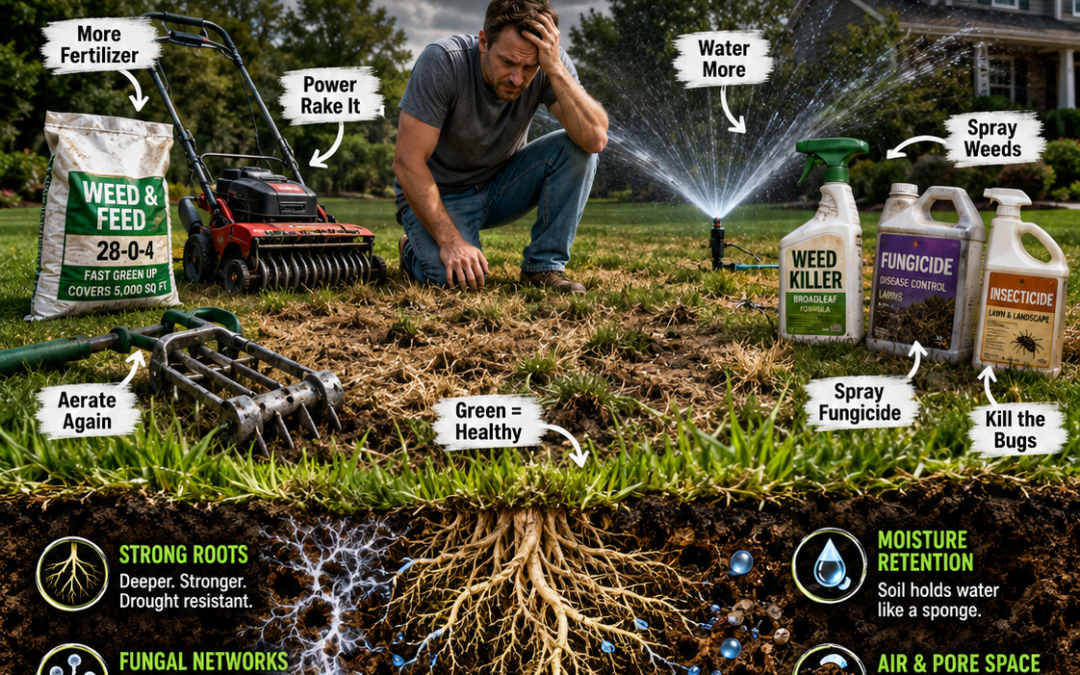
See a problem. Buy a product. Kill something. Feed something. Water something. Repeat next year.
But what if many of the things we consider “normal lawn maintenance” are actually symptoms of a system that isn’t functioning very well?
At Front Range Biological & Lawn Automation, we look at the lawn differently. Instead of asking, “What product does the lawn need?” we first ask:
“Why can’t the soil and plant do more of this work themselves?”
Here are eight lawn-care assumptions worth challenging.
1. “My lawn has to receive fertilizer every spring or it won’t green up.”
Grass certainly needs nitrogen—but fertilizer isn’t the only place nitrogen comes from.
The atmosphere is roughly 78% nitrogen, although grass cannot directly use atmospheric N₂. Nitrogen must first be converted into plant-available forms. Microorganisms are enormously important in that process through decomposition, mineralization, nutrient cycling, and, in certain plant-microbe relationships, biological nitrogen fixation.
A biologically active soil is therefore very different from an inert growing medium waiting for another bag of fertilizer.
The goal shouldn’t necessarily be zero fertilizer.
The goal should be a soil ecosystem efficient enough that fertilizer stops being the lawn’s life-support system.
2. “I need to power rake because I have too much thatch.”
Perhaps—but ask the next question:
Why isn’t the thatch decomposing?
Thatch forms when organic material accumulates faster than the soil ecosystem can break it down. Microorganisms are central to decomposition. Poor aeration, waterlogged conditions and practices that suppress decomposer activity can slow that process.
That doesn’t mean every lawn with thatch has “dead soil,” but excessive thatch should make us investigate biological activity and growing conditions—not simply rip the material out every year.
Healthy decomposition turns yesterday’s plant material into tomorrow’s soil organic matter.
3. “If I don’t water constantly, my lawn turns brown.”
Then perhaps your real problem isn’t the sprinkler.
Compaction restricts root development and oxygen movement. Weak soil aggregation reduces infiltration. Low organic matter reduces the soil’s ability to capture and retain water. Shallow roots then leave the plant dependent upon frequent irrigation.
Healthy soil does something incredibly valuable:
It stores resources.
USDA soil-health guidance specifically associates functioning soils with greater organic matter, improved aggregation, better infiltration and increased water-holding capacity.
A lawn that requires constant rescue watering may be telling us something about the soil underneath it.
4. “I have weeds because I haven’t used enough weed killer.”
Weeds aren’t arriving because your lawn forgot its herbicide.
They exploit opportunities.
Compaction, thin turf, disturbed soil, improper irrigation, mowing practices, fertility conditions and available seed all influence which plants establish.
That doesn’t mean a dandelion is a laboratory soil test or that every weed proves one specific mineral deficiency. But weeds can absolutely tell us something about the environment we’ve created.
Killing the weed may remove the symptom.
Correcting the condition that gave it an opportunity changes the system.
5. “My lawn has disease because I didn’t apply fungicide.”
Fungicides have legitimate uses. But lawn disease is more complicated than the absence of a fungicide.
Plant pathology revolves around the interaction between a susceptible plant, a pathogen and environmental conditions favorable to disease.
Excess moisture, poor drainage, thatch, stress, irrigation practices and weakened plants can all influence disease development depending on the pathogen.
So instead of asking only:
“What kills the fungus?”
We should also ask:
“What created an environment where this organism gained the advantage?”
Even CSU recommends cultural management as the first line of defense against some common Colorado turf diseases.
6. “My lawn is dark green, therefore it is healthy.”
This may be the biggest illusion in lawn care.
Green is a color. Health is a function.
Chlorophyll gives plants their green appearance, and its chemistry involves magnesium, nitrogen and carbon. But color alone tells us surprisingly little about root development, water efficiency, disease resistance, nutrient cycling or stress tolerance.
A lawn can look spectacular while being remarkably dependent upon fertilizer, irrigation and chemical intervention.
One of the most important measures of plant performance is its ability to capture sunlight through photosynthesis and convert that energy into carbohydrates that power growth, roots, defense and biology.
Don’t just ask:
“How green is it?”
Ask:
“How well does it function?”
7. “I have to aerate every year because that’s just what lawns require.”
Mechanical core aeration works. We use it and believe it has tremendous value.
But if the soil repeatedly recompacts, we should be interested in why.
Roots, fungi, bacteria, organic compounds and other soil organisms participate in the formation and stabilization of soil aggregates. Those aggregates create pore spaces where water and oxygen can move and roots can expand.
Mechanical aeration creates holes.
A functioning biological system helps create structure.
So instead of viewing aeration as an annual ritual forever, we should be working toward a soil that becomes progressively better at maintaining its own structure.
8. “I found insects, so I need an insecticide.”
First question:
Which insect?
A lawn isn’t supposed to be sterile.
Colorado State University notes that some turf-dwelling mites help break down thatch and recycle nutrients while others prey upon pest insects and mites. Only certain species cause significant turf damage.
That’s why Integrated Pest Management focuses on identification, monitoring and treating actual pest problems instead of assuming every insect deserves chemical warfare.
Broad pesticide use can also affect organisms we actually want—including beneficial insects and pollinators.
The objective shouldn’t be to create a biological vacuum.
It should be to create an ecosystem where the desirable organisms have the advantage.
Maybe We’ve Been Asking the Wrong Question
Traditional lawn care often asks:
What should I apply?
Biological lawn care asks:
Why is the lawn unable to perform this function on its own?
Why won’t it hold water?
Why isn’t organic material decomposing?
Why are weeds finding an opportunity?
Why does disease repeatedly gain an advantage?
Why does the soil keep recompacting?
Why can’t the plant tolerate stress?
That change in thinking is enormous.
We’re not suggesting fertilizers, pesticides, aeration or irrigation suddenly have no place. We’re suggesting that constantly needing more intervention should make us curious.
A healthy lawn shouldn’t simply look better. It should function better.
And that begins below your feet.
Stop Guessing. Start With the Soil.
At Front Range Biological & Lawn Automation, our biological soil program is designed to identify the mineral, structural and biological obstacles preventing your lawn from functioning the way it should.
Before buying another product to treat another symptom, find out what your soil is actually telling you.