
Last Updated on September 25, 2025 by Brian Beck
Every spring and fall, homeowners are reminded — often by utilities or lawn services — that aeration is a must. The process of pulling plugs from the lawn to reduce compaction and allow water and nutrients to penetrate deeper into the root zone is, at first glance, a logical solution. And indeed, mechanical aeration does have its benefits.
But is it really the long-term answer to lawn health and water efficiency? Or is it just another temporary patch in a system that ignores the living biology of the soil?
The Benefits of Mechanical Aeration
Let’s give credit where it’s due. Mechanical aeration can:
-
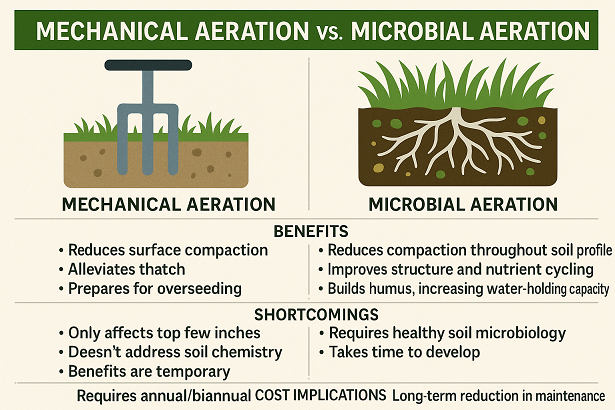
Relieve surface compaction: By punching small holes in the soil, aeration briefly opens channels for air and water to move downward.
-
Alleviate thatch: When plugs are left on the lawn, microbes get easier access to thatch material, helping break it down.
-
Prepare for overseeding: Seed-to-soil contact improves in freshly aerated ground.
These benefits, however, are short-lived. Within weeks or months, soils tend to reconsolidate, compaction returns, and the cycle of “aerate again” begins.
The Shortcomings of Mechanical Aeration
Despite its popularity, mechanical aeration has significant limitations:
-
It only affects the top few inches
Aeration plugs rarely go deeper than 2–4 inches, leaving the majority of the soil profile untouched. Compaction and poor structure deeper in the profile remain unchanged. -
It doesn’t address soil chemistry
Mechanical tines cannot alter pH, balance minerals, or supply humus — the organic glue that gives soil its water-holding capacity and structure. -
It’s disruptive
Aeration can expose soil to drying, invite weed seed germination, and, if performed under the wrong conditions, damage turf instead of helping it. -
It’s temporary
Because aeration doesn’t build structure, it doesn’t last. Compaction always returns unless something more permanent takes its place.
The Biological Alternative: Microbial Aeration
Nature already has a solution to compaction and oxygen flow — microbes. When soil biology is thriving, organisms like bacteria, fungi, protozoa, and nematodes continuously “tunnel,” digest, and build structure far more efficiently than any machine.
-
Fungi weave networks of hyphae through soil, stabilizing particles and creating microscopic channels.
-
Bacteria produce glues and gels that bind soil into stable aggregates, creating pore space for water and air.
-
Protozoa and nematodes cycle nutrients and keep the system balanced.
-
Earthworms and arthropods create macropores that reach deep into the soil profile.
This living system never sleeps. While mechanical aeration lasts a season, microbial aeration works every day of the year.
The Power of Humus: The Missing Ingredient
Even more important than holes in the ground is the formation of humus — the stable, carbon-rich substance created when microbes fully digest organic matter.
Humus is the master key to soil health:
-
Water carrying capacity: Every 1% increase in humus allows soil to hold up to 20,000 gallons more water per acre. This dwarfs any water “savings” achieved by mechanical aeration.
-
Chemical balance: Humus stabilizes pH, buffers mineral excesses, and makes nutrients available without constant synthetic input.
-
Resilience: Humus-rich soils resist compaction, heat stress, and drought naturally, without the need for repetitive machine intervention.
In short, mechanical aeration pokes holes; humus builds highways.
Conclusion: Choosing Biology Over Machinery
Mechanical aeration has its place as a stopgap measure, especially in heavily compacted turf. But if our goal is long-term efficiency, resilience, and cost savings, the future is not mechanical — it’s biological.
By fostering microbial life and building humus, we create a self-sustaining soil engine that aerates itself, balances its chemistry, and dramatically improves its water-carrying capacity.
Instead of renting machines every year, what if we invested in the living system that never stops working for us?
The debate isn’t whether we should aerate — it’s whether we should keep poking temporary holes, or start building living soil that stays open forever.
Pulled from an article from Denver water:
https://www.denverwater.org/tap/there-no-debate-you-really-do-need-aerate
Read more:
Thanks, Brian. Well done! I’m not aerating now!
You won’t have to. I have not for years! Trust the biology and it will work for you…
Thank you,
Brian