
Last Updated on April 23, 2026 by Brian Beck
Let’s get something straight right out of the gate:
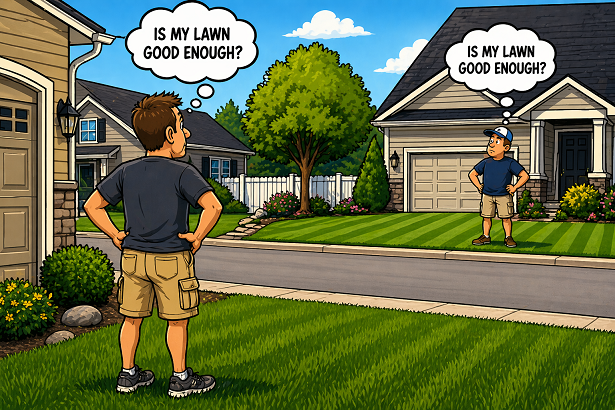
Your neighbor’s lawn is not a benchmark of health.
It’s a visual performance.
And like most performances, it’s curated, propped up, and—more often than not—completely disconnected from reality.
The Great Lawn Comparison Trap
Every spring and summer, it happens like clockwork.
You step outside.
You look at your lawn.
Then you look at your neighbor’s lawn.
And suddenly, without a soil test, without context, without a single piece of useful data—you’ve decided:
“Their lawn is better than mine.”
Based on what?
Color? Density? The fact that it looks like a golf course from 20 feet away?
That’s like deciding who’s healthier based on who has better lighting in their Instagram photos.
Appearance Is the Last Thing to Change
Here’s the part most people get backwards:
A lawn’s appearance is the last thing to reflect reality—not the first.
By the time a lawn looks good or bad, the real story has already been written underground:
- Soil structure
- Biology
- Mineral balance
- Water movement
- Root depth
But none of that is visible from the sidewalk, so we default to judging what we can see—color and uniformity.
Which is exactly how people get fooled.
The Synthetic Illusion
Let’s talk about your neighbor’s “perfect” lawn for a second.
That deep green color?
Could be nitrogen. Lots of it.
That fast growth?
Also nitrogen.
That uniform look?
Regular chemical inputs forcing consistency.
What you’re seeing is not necessarily a healthy system—it’s often a highly managed dependency loop.
A lawn on life support.
- Needs constant feeding
- Needs frequent watering
- Needs intervention at the first sign of stress
Miss a step? It falls apart.
That’s not health. That’s maintenance pressure disguised as success.
Meanwhile… The Quiet Lawn Next Door
Now let’s talk about the lawn that doesn’t win the neighborhood beauty contest.
Maybe it’s not the darkest green.
Maybe it’s not perfectly uniform.
But:
- It absorbs water instead of shedding it
- It holds moisture longer
- It handles heat without panic
- It doesn’t explode with weeds the second conditions shift
- It doesn’t need to be “rescued” every 3 weeks
That lawn is functioning.
And here’s the uncomfortable truth:
Function will always outlast appearance.
The Real Scorecard (That Nobody Uses)
If you actually want to evaluate a lawn properly, stop looking at it like a paint job and start looking at it like a system.
Ask better questions:
- How deep are the roots?
- How well does the soil absorb and retain water?
- Is the lawn dependent on constant inputs?
- How does it perform under stress?
- Does it improve over time—or reset every season?
Because a lawn that looks incredible for 90 days and struggles for the other 275 isn’t impressive.
It’s expensive.
Why This Matters (More Than You Think)
This isn’t just about pride or appearances.
This is about:
- Water usage
- Cost of ownership
- Time and labor
- Chemical exposure
- Long-term sustainability
The comparison game pushes people toward short-term cosmetic wins…
while quietly locking them into long-term inefficiency.
And most don’t even realize it.
The Truth About a Great Lawn
A truly great lawn isn’t the one that wins the visual contest in June.
It’s the one that:
- Requires less intervention over time
- Becomes more resilient each season
- Uses resources efficiently
- Recovers quickly from stress
- And yes… eventually looks great too
But that last part?
That’s a byproduct, not the goal.
The Bottom Line
If you’re judging your lawn based on your neighbor’s, you’re playing the wrong game.
You’re comparing:
- Your reality
to - Their highlight reel
And then wondering why it doesn’t match.
A Better Approach
Stop chasing what looks good.
Start building what works.
Because when the soil is right, the biology is active, and the system is balanced…
The appearance takes care of itself.
And unlike your neighbor’s lawn—it doesn’t come with strings attached.
If you’re ready to stop guessing and start understanding what’s actually going on beneath your lawn, that’s where real progress begins—and where most people finally separate themselves from the crowd.
That’s the difference between managing a lawn… and owning the system behind it.
Engage with us: