
Last Updated on March 7, 2026 by Brian Beck
There are certain words that, for some people, seem to come with baggage.
Words like organic, natural, and sustainable can immediately trigger assumptions, emotions, or even skepticism. Some hear those words and think ideology. Others hear marketing. Still others think of something vague, soft, or unrealistic.
That is not why we use them.
We do not operate in this territory because of politics, trends, or because we are trying to belong to some cultural camp. We operate here because, after years of observation, experience, and results, we came to a simple conclusion:
This way is more logical. More responsible. More effective. And yes, in many cases, more moral.
Not moral in the self-righteous sense. Moral in the plain sense of stewardship, wisdom, and restraint.
If there is a way to care for a property, a lawn, a soil system, and the living environment around a home that reduces unnecessary toxicity, supports lasting function, and works with the created order rather than against it, why would we not pursue it?
That is really what this comes down to.
Let’s demystify the words
Sustainable
Sustainable simply means a system can continue without constantly robbing tomorrow to pay for today.
A sustainable landscape is not one that looks good for five minutes after an application and then crashes without the next one. It is not a system that becomes more dependent, more expensive, and more fragile over time. It is one that gets stronger, more stable, and more efficient as the foundational functions improve.
In other words, sustainability is not a slogan. It is the difference between a system that must be rescued over and over again and one that begins to carry itself properly.
Organic
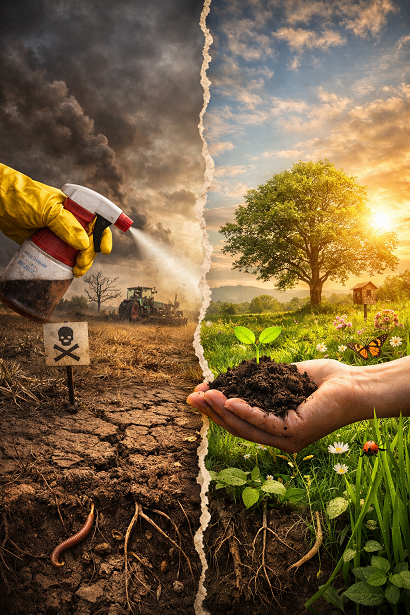
Organic, in the practical sense, means working with carbon-based life and biological processes rather than trying to bully the land into submission through isolated chemical reactions.
Soil is not dead matter. It is not a sponge to be soaked with products until appearances improve. It is a living economy. It has structure, biology, energy exchange, nutrient cycling, moisture relationships, and communication between microbes and roots.
To work organically is to recognize that life is already designed with mechanisms, and that our job is not to replace those mechanisms but to support them.
Natural
Natural does not mean careless, lazy, or ineffective. It does not mean letting everything run wild and hoping for the best.
Natural means aligned with how the system was designed to function.
A natural approach asks better questions. Instead of asking, “What can I spray to make this symptom disappear?” it asks, “Why did this condition show up in the first place?” Instead of chasing the visible problem, it looks for the invisible dysfunction that gave rise to it.
That is a much more honest way to work.
The real issue: symptoms versus causes
One of the biggest reasons we changed direction is because we saw too much that was unnatural, yet strangely accepted as normal.
We saw programs that managed appearance but not health. We saw repeated interventions that created dependence rather than resilience. We saw fundamental problems left untouched while symptoms were constantly chased around the property like a shell game.
Green today. Trouble tomorrow. Apply again. Repeat.
That is not wisdom. That is dependency dressed up as maintenance.
When the soil is compacted, when the biology is weak, when water movement is poor, when nutrient relationships are out of balance, when roots are shallow, when the system has no real buffering capacity, no amount of symptom-chasing can honestly be called a solution.
It may create a temporary effect. But temporary effect and true correction are not the same thing.
Why results matter
Some people hear words like organic or natural and assume the goal is philosophical purity.
It is not.
The goal is results that are real.
We care about function. We care about reducing waste. We care about avoiding unnecessary exposure for families, children, pets, and the environment around the home. We care about building a property that performs better under stress, requires fewer emergency corrections, and costs less to own over time.
That is not idealism. That is practicality.
The irony is that many of the methods dismissed as too slow, too old-fashioned, or too unconventional are actually the ones that address the deepest realities of the system. Why? Because they are not fighting creation. They are cooperating with it.
Nature is not stupid. Creation is not primitive. What has been built into the soil, the plant, the microbe, and the rhythm of living systems is far more intelligent than the average maintenance schedule.
We have been taught to follow a program rather than wisdom
This is one of the great modern mistakes.
People have been trained to trust programs, products, and routines without first asking whether the system itself makes sense. Many industries have conditioned people to believe that if a problem continues, the answer is simply more intervention, more inputs, more control.
But more activity does not always equal more wisdom.
Sometimes the wiser move is to step back and ask:
-
What is this system trying to do?
-
What is interfering with its design?
-
What have we introduced that created new problems?
-
What should be restored instead of overridden?
That is the heart of our approach.
We are not interested in appearances at any cost. We are interested in function, order, and long-term outcomes.
This is not about image. It is about responsibility.
No reasonable person wants to expose themselves, their family, their pets, or their surroundings to substances that carry avoidable risk if there is a better path available.
That should not be controversial.
It should be common sense.
To choose a better way when one is available is not weakness. It is not trend-chasing. It is responsibility. It is maturity. It is stewardship.
And beyond health concerns, there is another layer: efficiency.
A landscape that is functioning in harmony with biology and natural processes is often more stable, more resilient, and less wasteful. It handles stress better. It uses resources more intelligently. It is less dependent on constant rescue.
That is what people actually want, whether they use these words or not.
We seek more
At the end of the day, we did not move in this direction because it sounded nice. We moved in this direction because we were no longer satisfied with methods that looked normal but failed to solve foundational problems.
We seek more than surface-level success.
We seek systems that make sense.
We seek correction, not camouflage.
We seek health, not dependency.
We seek wisdom over routine.
We seek alignment with what is true, durable, and built into creation itself.
That is why we use the language we use.
Not because we belong to an ideology.
But because we have seen enough to know that when you work with nature’s operating system instead of against it, better things tend to happen.
And that is not political.
That is practical.
That is responsible.
And in a world full of shortcuts, that may be one of the most honest paths left.