
Last Updated on July 1, 2025 by Brian Beck
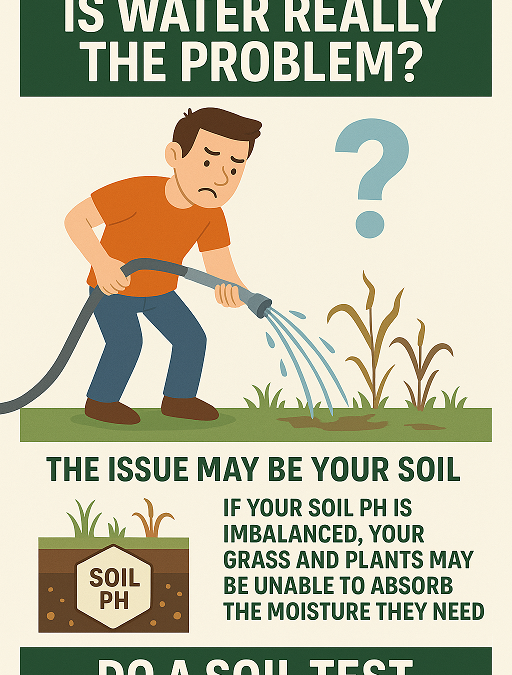
💧 Is Water Really the Problem? Or Is Your Soil Saying “No Thanks”?
We hear it all the time:
“My lawn is dry. I must not be watering enough.”
“My plants are wilting—it must be the heat.”
“Maybe I need to water every day.”
But what if the issue isn’t water at all?
What if you’re putting the right amount of water down, but your soil—or more specifically, your soil pH—is preventing your plants from using it?
🌿 Water May Be Present, But Is It Actually Getting In?
Plants take up water through their roots, where it’s used to:
-
Deliver nutrients throughout the plant
-
Fuel photosynthesis
-
Regulate temperature
-
Maintain structure and cell turgor
But that whole process depends on one thing:
The ability of the roots to access both water and the nutrients dissolved in it.
If your soil’s pH is out of balance—too acidic or too alkaline—nutrient availability becomes severely restricted, even if water is present. In other words:
The plant is thirsty, not because there’s no water—but because it can’t use the water.
⚠️ What Is Soil pH and Why Does It Matter?
Soil pH measures how acidic or alkaline your soil is. It directly affects:
-
Microbial activity
-
Nutrient solubility
-
Root absorption efficiency
Most plants thrive in a slightly acidic to neutral pH range (6.0–7.0). Outside that range:
-
Iron, phosphorus, calcium, and manganese can become locked up
-
Microbes responsible for soil health slow down or die off
-
Water movement is hindered due to poor root function
So even if your irrigation schedule is perfect, your grass or garden may still show signs of:
-
Wilt
-
Yellowing
-
Slow growth
-
Patchiness
All signs that look like water issues… but aren’t.
🧪 The Real Fix Starts With a Soil Test
Before you crank up your sprinklers or spend a fortune on drought-tolerant turf, ask yourself:
“Do I even know what’s happening below the surface?”
A soil test will tell you:
-
Your current pH
-
Nutrient levels
-
Organic matter content
-
Biological activity
-
Cation exchange capacity (CEC)
Once you understand the soil’s condition, you can make corrections that actually work, like:
-
Lime or sulfur applications to adjust pH
-
Biological inoculants to restore microbial activity
-
Organic matter to increase water-holding capacity
💡 More Water Isn’t Always the Answer—Smarter Soil Is
We’ve been taught to look at the surface:
If it’s dry, water it. If it’s green, it’s healthy.
But in reality, the soil is the command center—and if it’s out of balance, everything else suffers.
So before you assume water is the problem, take a deeper look.
Because sometimes your plants aren’t crying out for water.
They’re begging for soil they can live in.