
Last Updated on June 24, 2025 by Brian Beck
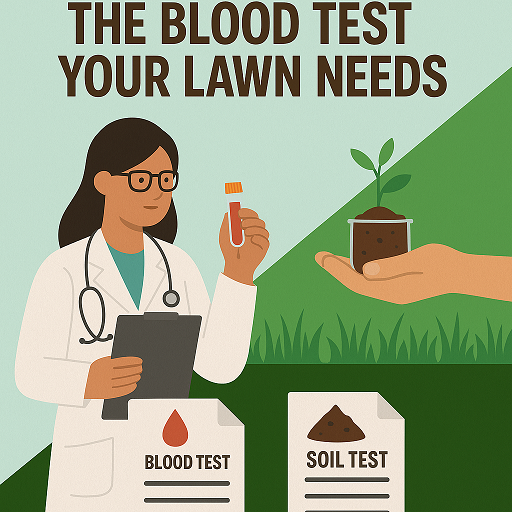
Why Soil Testing Is the Blood Test Your Lawn Desperately Needs
If you walked into your doctor’s office and asked for the same prescription your neighbor is taking—without any exam, symptoms, or tests—they’d probably look at you sideways. That’s because what works for your neighbor’s body might be completely wrong for yours. Your health is unique, and so is your lawn.
That’s exactly why soil testing is the first, most essential step in building a healthy, biologically fertile lawn.
Your Lawn’s Blood Test
Think of a soil test like a blood panel for your lawn. It tells us what’s really going on under the surface—levels of nutrients, pH balance, organic matter, and biological activity. Without that information, any product or treatment is just a guess. It might help. It might hurt. But chances are, it’s just throwing money (and fertilizer) to the wind.
And that brings us to your neighbor’s yard.
Forget the Joneses
It’s easy to look over the fence and wonder what “magic potion” they’re using. But the truth is, your lawn is not your neighbor’s lawn. Soil types vary from lot to lot—even on the same street. One might be compacted clay with no organic matter, while another is sandy and prone to drying out. Add in differences in watering habits, mowing height, sun exposure, pet traffic, and past chemical use… and you’ve got completely different biological environments.
So copying what your neighbor does isn’t just unhelpful—it’s often harmful. It ignores the unique needs of your soil and delays real progress.
Why It Matters in a Biological Program
When you switch from a synthetic fertility program to a biological one, you’re no longer “force-feeding” your lawn. You’re partnering with nature—leveraging microbes, organic matter, and soil health to create self-sustaining fertility. But here’s the catch: biological systems thrive on balance.
If your soil is deficient in calcium, overloaded with phosphorus, or lacking microbial life, the biology can’t work effectively. You wouldn’t start a fitness program without a checkup, and you shouldn’t start a biological fertility program without a soil test.
The Payoff: Precision and Long-Term Health
Once we have your soil test results, we can craft a fertility plan that matches your lawn’s exact needs—nothing more, nothing less. You save money, reduce waste, and avoid the chemical rollercoaster that synthetic programs often cause. Even better? Over time, your lawn becomes more resilient, uses less water, and naturally resists weeds, pests, and disease.
Conclusion
So before you buy another bag of fertilizer or copy what your neighbor is doing, ask yourself: Would you take a prescription without knowing what’s wrong?
Your lawn deserves the same level of care and precision as your body. A simple soil test is the first step to a healthier, more sustainable landscape.
Ready to find out what your lawn really needs? Let’s start with a soil test.