
Last Updated on September 15, 2026 by Brian Beck
For decades, the lawn-maintenance industry has depended on the same basic system:
Load several workers and thousands of pounds of equipment onto a truck, drive from property to property, unload everything, mow the lawn, load everything again, and repeat the process until daylight runs out.
It is a familiar system—but it is becoming increasingly difficult, expensive, and unreliable to operate.
The lawn-care industry is approaching a labor crisis, and the companies that wait until the crisis fully arrives may discover that they waited too long to adapt.
Where Will the Best Workers Go?
America desperately needs skilled tradespeople. Electricians, plumbers, HVAC technicians, welders, mechanics, equipment operators, and construction professionals are already in high demand.
According to the Associated General Contractors of America, workforce shortages remain a major challenge for trade employers. In its 2025 outlook, 75% of surveyed construction companies identified an inadequate supply of skilled workers or inexperienced labor as a serious concern. The U.S. Bureau of Labor Statistics also projects continued demand across numerous skilled occupations.
As trade schools, apprenticeship programs, and employers become more aggressive about recruiting dependable young workers, the best candidates will naturally gravitate toward careers offering stronger wages, specialized training, advancement, and long-term security.
That will make the remaining labor pool available to traditional lawn-maintenance companies increasingly difficult to recruit from.
This does not mean that every future lawn employee will be unmotivated or unprofessional. There will always be good people in the industry. But the pool of dependable candidates is likely to become smaller, while competition for those candidates becomes much greater.
Companies that continue relying almost entirely on entry-level manual labor may face:
- Higher wages without a corresponding increase in productivity
- Greater employee turnover
- Less experienced crews
- Inconsistent workmanship
- Poorer communication
- Increased property damage
- More callbacks and customer complaints
- Difficulty maintaining professional standards
Eventually, the customer pays the price.
The Route-Based System Is the Real Problem
Labor is only one limitation of traditional lawn maintenance. The entire route-based system is surrounded by bottlenecks.
A conventional crew can only produce work while:
- Employees are available
- Trucks are operating
- Equipment is functioning
- Weather conditions cooperate
- Roads remain accessible
- Daylight is available
- Noise restrictions allow the work
- Physical fatigue has not reduced performance
Every property requires transportation, unloading, mowing, trimming, cleanup, reloading, and travel to the next stop.
That is an enormous amount of motion simply to cut grass.
Traffic slows the route. Rain pushes the schedule back. Heat exhausts employees. Equipment breaks. Workers call in sick. Trucks consume fuel. Trailers require maintenance. Daylight eventually disappears.
Even an excellent lawn crew cannot escape these limitations.
The problem is not necessarily the people. The problem is the system we are asking those people to operate.
Automation Defeats the Route
Robotic mowing changes the entire operating model.
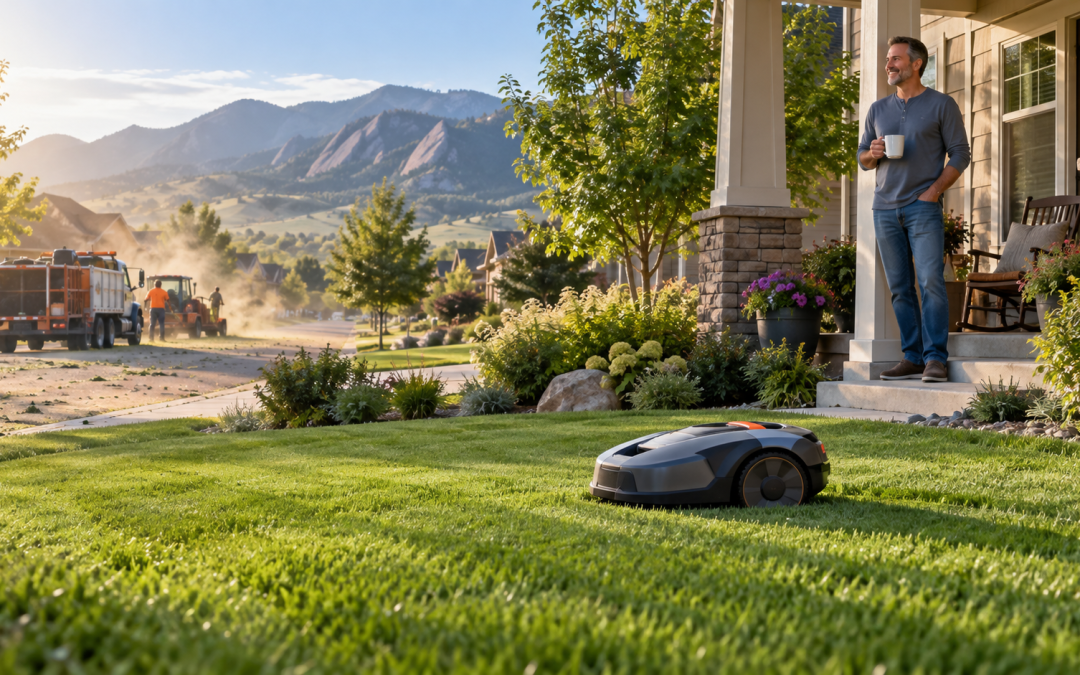
Instead of transporting a large mower to the lawn once every week, the mower remains at the property and maintains the grass frequently. It does not need to fight traffic, load a trailer, wait for daylight, or rush through the lawn because five more properties remain on the schedule.
The work moves from a route-based system to a property-based system.
That distinction is enormous.
A properly selected and professionally installed robotic mower can quietly maintain the lawn throughout the week, producing a consistently groomed appearance without the disruption of a traditional mowing crew.
Research from UF/IFAS Extension reports that robotic mowers can maintain turf quality comparable to conventional mowing while reducing labor, noise, and emissions. Frequent mowing can also benefit turf health when the system is properly managed.
Instead of allowing the grass to grow tall and then removing a large portion of the plant at one time, robotic mowing removes tiny clippings more frequently. Those fine clippings return organic material and nutrients to the lawn while reducing the physical shock associated with aggressive weekly mowing.
The lawn is not repeatedly growing out and being cut back.
It is being continuously maintained.
Automation Does Not Eliminate Good Employees—It Elevates Them
There is an understandable fear that automation will eliminate lawn-maintenance jobs.
We believe it can do something much better.
Automation can eliminate many of the repetitive, physically exhausting, low-value tasks that make lawn maintenance difficult to staff. It allows a company to employ fewer—but better-trained and better-paid—professionals.
Instead of spending the entire day sitting on a mower or pushing equipment across lawns, employees can become skilled automation technicians and turf-care professionals.
Their responsibilities can include:
- Robotic mower installation and programming
- Property mapping and system optimization
- Blade and equipment maintenance
- Turf-health inspections
- Irrigation evaluation
- Troubleshooting and customer support
- Biological soil and plant-health management
That creates a more professional career path.
The employee gains technical skills, greater responsibility, improved working conditions, and the opportunity to earn more. The customer receives more consistent service and better communication. The company becomes less dependent on an increasingly unstable labor supply.
That is how we elevate the lawn-maintenance industry.
Better Technology Still Requires Professional Management
Buying a robotic mower is not the same as creating a successful lawn-automation system.
The mower must be matched to the property’s size, slope, layout, turf type, obstacles, navigation requirements, and access points. Mowing height, frequency, operating schedule, blade condition, irrigation timing, and seasonal turf stress must also be considered.
A poorly selected or improperly managed machine can create frustration.
A professionally designed system can completely transform how the property is maintained.
At Front Range Biological and Lawn Automation, our objective is not simply to sell someone a mower. We want to help homeowners understand how robotic automation can improve the entire lawn-maintenance relationship.
That means maximizing the homeowner’s role as an informed client while we maximize turf health, system reliability, and long-term productivity.
The Time to Investigate Automation Is Now
The labor shortage will not suddenly announce itself one morning.
It will appear gradually through missed mowing days, inconsistent crews, rising prices, poorer communication, declining quality, and companies that can no longer maintain the standards their customers expect.
By the time the consequences become obvious, the most capable lawn-automation companies may already be operating at capacity.
Homeowners who begin evaluating their options now will have time to select the right equipment, address property-access challenges, plan installation, and create a mowing system designed around the actual needs of their lawn.
Automation is not a futuristic lawn-care experiment.
It is the practical solution to a route-based system that is rapidly approaching its limits.
The lawn-maintenance companies of the future will not succeed by finding more people to operate an inefficient system. They will succeed by building a better system—one in which automation performs the repetitive work and skilled professionals manage the technology, the turf, and the customer experience.
The labor crisis is coming.
The opportunity to get ahead of it is already here.
Discover What Lawn Automation Could Do for Your Property
Do not wait until labor shortages, rising prices, or declining service quality force you to look for another solution.
Contact Front Range Biological and Lawn Automation today. We will evaluate your property, explain the available technology, and show you how professionally managed robotic mowing can produce a quieter, more consistent, and healthier lawn-maintenance experience.
Call 719-380-0136 or use the link below to request more information:
Request a Robotic Mowing Consultation
The future of lawn maintenance is not another truck, another trailer, or another struggling crew. It is intelligent automation—and the time to prepare is now.