
Last Updated on November 15, 2026 by Brian Beck
Are weeds really the problem, or are they symptoms of something much bigger?
By Front Range Biological & Lawn Automation
A customer approached me recently with a concern that I have heard countless times throughout my years in the lawn care industry.
He was frustrated by the weeds appearing in his lawn, particularly during a year of unusually challenging weather conditions. The heat had been relentless, the grass was under considerable stress, and weeds seemed to be appearing almost as quickly as they could be eliminated.
His concern was understandable. After all, most homeowners have been conditioned to believe that weeds are enemies that must be destroyed.
But I offered him a very different perspective.
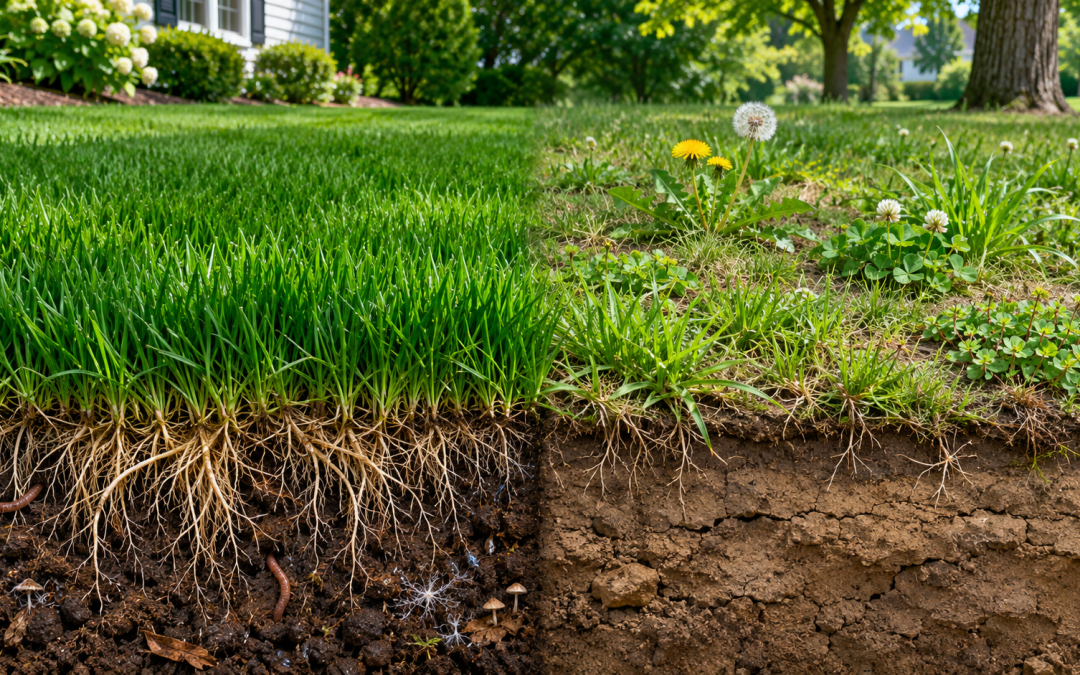
What if the weeds weren’t the underlying problem? What if they were telling us something about the condition of the soil?
That simple question changes the entire conversation.
Weeds Are Not Random
One of the greatest misconceptions about weeds is that they simply appear by chance, invading otherwise healthy lawns without explanation.
While weed seeds can arrive through wind, animals, water, equipment, and numerous other sources, their ability to establish and flourish is heavily influenced by the environment they encounter.
Weeds are opportunistic plants.
They exploit conditions where desirable turfgrass struggles to compete. Those conditions may include:
- Soil compaction and poor structure
- Nutrient deficiencies or imbalances
- Inadequate biological activity
- Improper water management
- Excessive soil temperatures
- Poor root development
- Excessive shade or inadequate sunlight
- Thin, weakened, or stressed turfgrass
Different weeds thrive under different conditions. Some tolerate drought exceptionally well. Others flourish in compacted soils, persistently wet areas, or environments where desirable grasses struggle.
Their presence can provide valuable clues about what is happening beneath our feet.
Weeds don’t necessarily create the problem. Very often, they exploit a problem that already exists.
And there is an important distinction here: weeds do not consciously emerge to repair deficiencies or correct mineral imbalances. However, their characteristics can make them particularly successful in compromised environments. Some also contribute organic matter, protect exposed soil, and recycle nutrients as part of natural ecological processes.
Instead of viewing weeds exclusively as enemies, perhaps we should begin viewing them as messengers.
Weeds Are Not the Result of a Herbicide Deficiency
Consider this analogy.
Imagine someone who experiences frequent headaches.
The conventional response might be to reach for a bottle of Tylenol. The medication may alleviate the pain, sometimes quite effectively.
But what caused the headache in the first place?
Perhaps dehydration. Maybe stress, poor sleep, or any number of underlying physiological conditions.
We would never reasonably conclude that the person developed a headache because they weren’t consuming enough Tylenol.
A headache is not caused by a Tylenol deficiency. And weeds are not caused by a herbicide deficiency.
Yet that is remarkably similar to the way many homeowners have been taught to approach weed management.
We see a weed. We spray it.
Another weed appears. We spray again.
Eventually, we begin measuring the effectiveness of our lawn care program by how frequently we apply herbicides rather than by how successfully we are improving the environment that allowed weeds to flourish.
This is what I call symptom chasing instead of problem solving.
Chemical weed control may remove the immediate symptom, but it does not necessarily correct the conditions that encourage weeds to return.
Why Heat Makes the Problem More Pronounced
Here in Colorado, we experience periods of intense summer heat, low humidity, and significant environmental stress.
For cool-season grasses such as Kentucky bluegrass, these conditions can be especially challenging.
As temperatures rise, grass may slow its growth, reduce its ability to recover, and struggle to maintain adequate hydration.
If the underlying soil lacks good structure, sufficient rooting depth, or effective water infiltration, those weaknesses become increasingly apparent.
Meanwhile, certain warm-season weeds are approaching their preferred growing conditions.
Crabgrass, purslane, and spurge, for example, can take advantage of warmer soils and openings in weakened turf.
The result is often predictable.
As desirable turfgrass loses its competitive advantage, opportunistic plants gain an opportunity to establish themselves.
This doesn’t mean that all weeds prefer heat. Different species germinate and grow under different seasonal conditions.
But it does mean that environmental stress can expose weaknesses in a lawn that were already present long before the weeds became visible.
The hotter and more stressful the conditions become, the more obvious those weaknesses may be.
Every Rainstorm Can Create Another Opportunity
Another common misunderstanding involves what happens after a lawn has been sprayed.
Many homeowners assume that once weeds have been treated, their lawn should remain relatively weed-free for an extended period.
Unfortunately, that isn’t necessarily how weed control works.
Many post-emergent herbicides are designed primarily to control weeds that are already growing. They do not necessarily provide meaningful protection against future germination.
Pre-emergent herbicides are different. They are specifically designed to interfere with the establishment of susceptible germinating weeds and can remain effective for weeks or months, depending on the product and conditions.
But neither approach corrects underlying soil dysfunction.
Weed seeds can remain dormant in soil, sometimes for years, waiting for favorable conditions.
When sufficient moisture, suitable temperatures, oxygen, and other requirements come together, another generation can begin germinating.
Under favorable conditions, some weed species can germinate within days.
A rainstorm or irrigation event can create another opportunity for susceptible seeds to germinate, even after previous weeds have been successfully controlled.
This is one reason repeated spraying can become such a frustrating cycle.
We eliminate what we can see, but the conditions that favor the next generation may remain unchanged.
Your Weeds May Be Giving You Valuable Information
Rather than immediately reaching for a sprayer, consider asking a few questions.
Why are these particular weeds appearing?
Why are they concentrated in one area rather than another?
Why do certain sections of the lawn recover quickly while others deteriorate?
What is happening with the soil’s mineral balance, moisture retention, structure, and biological activity?
These are the questions that begin moving us toward meaningful, long-term solutions.
Different weed species may provide different clues.
For example, knotweed is frequently associated with compacted soils. Clover can sometimes appear in lawns with inadequate nitrogen availability. Certain sedges may indicate persistently wet conditions.
However, these associations are clues, not laboratory diagnoses.
The presence of a particular weed does not automatically prove that a specific nutrient is deficient or that a particular mineral is excessive.
That is why proper testing, observation, and interpretation are so important.
The weeds provide the clues. The soil provides the evidence.
The Biological Approach: Change the Environment, Change the Outcome
At Front Range Biological & Lawn Automation, we approach lawn care differently.
Our objective is not simply to maintain the appearance of green grass through repeated chemical interventions.
We want to develop a functioning soil environment that supports healthy, resilient turfgrass while reducing the conditions that allow unwanted plants to dominate.
That means looking beyond conventional fertilizer schedules and herbicide applications.
We examine soil chemistry, mineral relationships, soil structure, biological function, and water management.
We want to encourage an environment where beneficial microorganisms can function, organic matter can participate in nutrient cycling, and roots can develop more effectively.
We also recognize that healthy turfgrass is one of the most effective natural defenses against weeds.
Dense turf occupies space, intercepts sunlight, and competes for moisture and nutrients.
When grass is healthy and growing under favorable conditions, it becomes substantially more difficult for opportunistic weeds to establish themselves.
This is where biological soil management and proper cultural practices can become powerful tools.
Our goal is to help lawns become increasingly self-sustaining rather than perpetually dependent on corrective chemical applications.
Does that mean we will never encounter another weed?
Of course not.
Weed seeds are part of the environment. Even well-maintained lawns can experience weed pressure, and some weeds require direct management.
But there is an enormous difference between occasionally managing a weed and maintaining an entire lawn through a seemingly endless cycle of chemical intervention.
Reducing Herbicides by Reducing the Need for Them
I want to make an important distinction.
We are not suggesting that every herbicide application is unnecessary or that targeted weed control never has a legitimate place in lawn management.
There are circumstances where intervention is appropriate, particularly when controlling aggressive, invasive, or established perennial weeds.
But our philosophy is straightforward:
The best opportunity to reduce herbicide dependence is to reduce the conditions that make repeated herbicide applications necessary.
If we can improve soil function, develop stronger roots, manage moisture more effectively, and maintain a dense, vigorous lawn, we can often reduce weed pressure substantially.
In some situations, that may allow us to eliminate routine herbicide applications altogether, although individual weeds may still require attention.
That represents an important shift in thinking.
Instead of asking, “What can we spray to kill these weeds?” we begin asking, “What can we change so these weeds no longer have such a competitive advantage?”
One question perpetuates a maintenance cycle.
The other opens the door to a long-term solution.
Stop Fighting the Symptoms. Start Understanding the System.
For decades, the lawn care industry has largely operated around a predictable formula.
Feed the grass. Kill the weeds. Repeat.
And when weeds return, repeat the process again.
But what if there is a better way?
What if we stopped viewing the lawn as an isolated collection of grass plants and started recognizing it as part of a much larger biological system?
Soil is not merely dirt that holds plants upright.
It is a complex environment involving minerals, water, air, organic matter, microorganisms, and biological relationships that influence how plants grow.
When those relationships are functioning well, we give desirable turfgrass a better opportunity to thrive.
When they are compromised, opportunistic plants may take advantage.
After more than two decades in this industry, I have come to recognize that the most meaningful improvements in lawn care often begin when we stop asking how to eliminate the visible problem and start investigating why the problem exists.
Weeds are not proof that your lawn needs more herbicides. They are an invitation to investigate whether your lawn needs a better foundation.
And that foundation begins with the soil.
Ready to Look Beneath the Surface?
At Front Range Biological & Lawn Automation, we’re changing the way homeowners think about lawn care.
Through advanced soil testing, biological soil management, and improved watering practices, we work to identify the conditions contributing to poor turf performance, persistent weeds, and unnecessary chemical dependence.
We believe the future of lawn care isn’t about doing more of the same.
It’s about understanding more, correcting what’s wrong, and allowing a healthier system to do more of the work naturally.
If you’re tired of chasing weeds year after year, perhaps it’s time to stop looking at the weeds and start looking at the soil.
Front Range Biological & Lawn Automation
Better Soil. Stronger Lawns. Fewer Unnecessary Interventions.