
Last Updated on November 17, 2025 by Brian Beck
Most people think fertilizer is just “plant food.”
Spread it on the lawn, water it in, and everything gets greener… right?
Not exactly.
When your soil becomes anaerobic—meaning it runs out of oxygen—synthetic fertilizers don’t just stop working.
They actually break down the wrong way, turn into toxic gases, and can even start harming the lawn, the soil life, your water bill, and sometimes even the air around your home.
Let’s break it down like you’re 14, because this science is real but it doesn’t have to be confusing.
What Does “Anaerobic” Even Mean?
Soil is supposed to breathe.
Healthy soil has:
-
Air pockets
-
Water pathways
-
Microbes that need oxygen
-
Roots that exchange gases
But when soil becomes compacted, waterlogged, over-fertilized, or dead from heavy chemical use, oxygen disappears.
Now the soil is anaerobic — basically a suffocating, swampy environment.
And in this swamp? Fertilizers behave very differently.
What Happens to Synthetic Nitrogen When Oxygen Disappears
Most bagged fertilizers use nitrates (NO₃⁻) or ammonium (NH₄⁺) to force quick greening.
In anaerobic conditions, microbes that don’t need oxygen take over.
These microbes start denitrifying the nitrogen — tearing apart the nitrate to survive.
This releases toxic gases like:
1. Nitric Oxide (NO)
-
A lung irritant
-
Escapes into the atmosphere as air pollution
2. Nitrous Oxide (N₂O)
-
300× more powerful than CO₂ as a greenhouse gas
-
Escapes from your lawn into the air
-
Represents lost nitrogen YOU paid for
3. Ammonia Gas (NH₃)
-
Sharp odor
-
Can burn plant roots
-
Represents MORE lost nitrogen you paid for
So instead of feeding your lawn, your nitrogen is literally gassing off into the air as harmful fumes.
And that “quick green” you paid for?
Gone.
What Happens to Synthetic Phosphorus in Anaerobic Soil
Phosphorus is supposed to help:
-
Root growth
-
Energy production
-
Seed establishment
But in anaerobic soil, phosphorus becomes trapped.
Without oxygen, phosphorus gets chemically locked up, binding to:
-
Iron
-
Aluminum
-
Calcium
-
Heavy metals
The result?
1. Plant roots can’t absorb it
So your soil can test “high” in phosphorus but the grass still looks starved.
2. It builds up to toxic levels
Too much tied-up phosphorus can:
-
Block micronutrients like zinc and iron
-
Contribute to algae blooms if it washes away
-
Cause weak, shallow roots instead of strong ones
Phosphorus doesn’t gas off like nitrogen —
it just becomes useless and harmful.
What Happens to Potassium in Anaerobic Soil
Potassium (K) is the “stress tolerance mineral.”
It helps with:
-
Water movement
-
Disease resistance
-
Heat tolerance
But in anaerobic conditions:
1. Potassium becomes displaced
Ammonium (from synthetic fertilizer) competes with potassium.
Too much ammonium → plants can’t take up potassium.
2. Potassium gets leached out
Without oxygen, soils lose structure.
Nutrients wash deeper than roots can reach.
3. The plant becomes fragile
Low potassium leads to:
-
Drought stress
-
Heat stress
-
Weak blades
-
More disease
-
More thatch
-
More dollar spot, rust, and leaf spot
In other words, your lawn becomes soft and weak, even if the soil test says there’s plenty of K present.
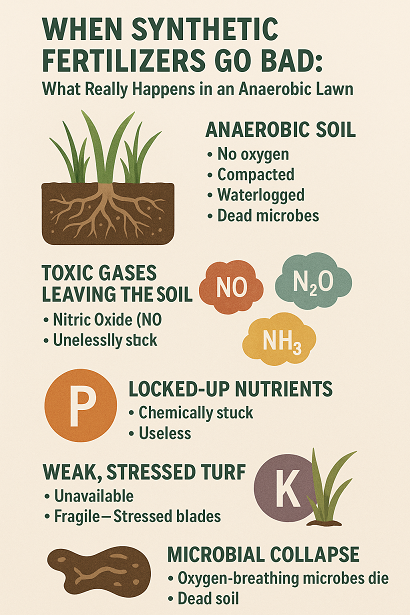
The Bigger Problem: Anaerobic Soil Turns Fertilizer Into Poison
When synthetic fertilizers meet anaerobic soil, you get:
Toxic gases leaving the soil
-
Nitric oxide
-
Nitrous oxide
-
Ammonia
Locked-up nutrients
Phosphorus becomes chemically stuck and useless.
Weak, stressed turf
Potassium becomes unavailable.
Microbial collapse
Anaerobic conditions kill oxygen-breathing microbes.
Dead microbes = dead soil = dependency on more chemicals.
This is why synthetic systems create addiction — they destroy the natural system that would otherwise feed the lawn for free.
Why Biological Systems Don’t Do This
Natural, oxygen-based soil biology:
-
Converts nitrogen slowly & safely
-
Keeps phosphorus dissolved but not toxic
-
Balances potassium uptake
-
Prevents compaction through natural channels
-
Restores oxygen flow
-
Creates humus that holds water like a sponge
-
Runs on carbon, not chemicals
Biological programs don’t gas off, don’t create toxic fumes, and don’t force-feed the plant.
They build a soil engine that runs itself, reducing costs year after year.
The Bottom Line
Synthetic fertilizers only work in healthy, oxygen-rich soil…
and the synthetic model itself is one of the fastest ways to destroy the oxygen in the first place.
Once the soil becomes anaerobic:
-
Nitrogen becomes toxic gases
-
Phosphorus becomes locked up
-
Potassium becomes unavailable
-
Turf becomes fragile
-
You waste money
-
And the lawn declines, slowly or dramatically
A biological system prevents this by keeping oxygen, structure, microbes, and nutrient pathways alive.